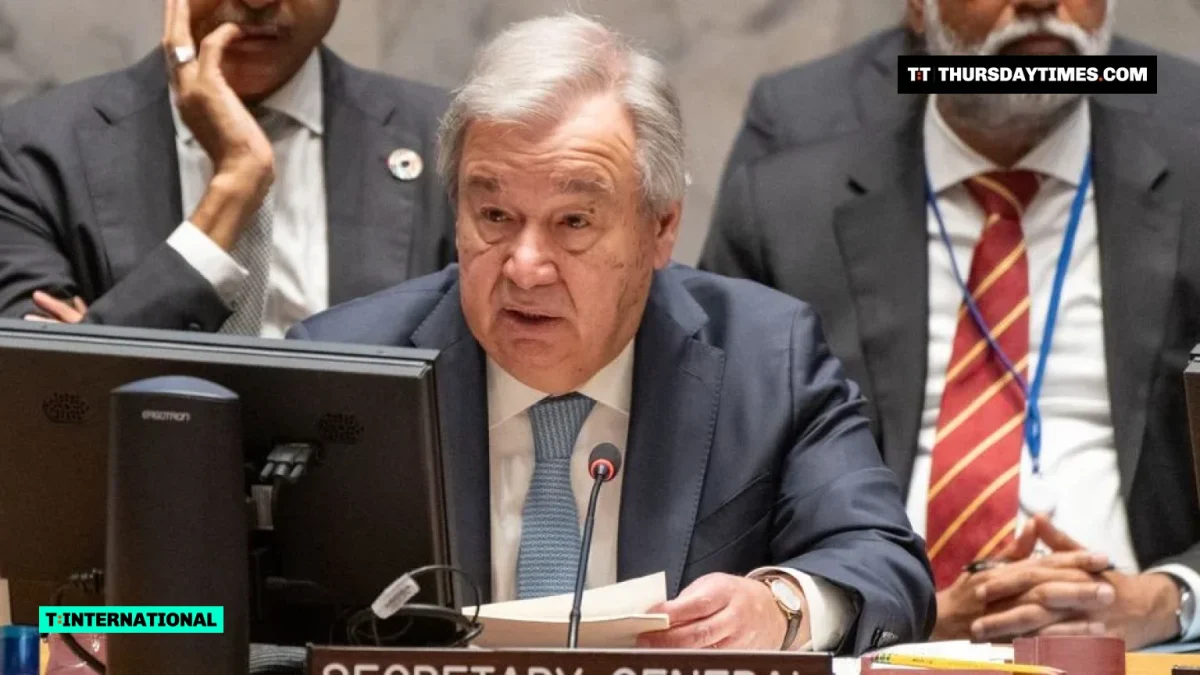
BRIDGETOWN (The Thursday Times) — UN Secretary-General António Guterres on Monday called on member states to begin discussions on a multilateral framework for managing the risks of artificial intelligence, saying protections remain fragmented and governments are “playing catch-up”.
He was speaking to reporters at the close of the Bridgetown Special Summit on AI Safety in Barbados, which the United Nations co-hosted with the Barbadian government. “That is why today we are issuing a call from Bridgetown for Member States to begin discussions on a multilateral AI Risk Management Framework,” he said. “Put simply, we need a common foundation for AI safety.”
The framework he outlined would include shared safety measures, common approaches to testing, clear safeguards and standards, basic transparency requirements, independent evaluation and oversight of advanced AI models, and support so that every country can put them into practice.
Power shifting to companies
Guterres, who leaves office at the end of December, said some of the leading AI developers are themselves sounding the alarm about increasingly powerful systems. He said recent technological outages and cyberattacks had exposed the vulnerabilities of the digital systems the world depends on, and that AI was amplifying the threats, with systems behaving in ways “even their developers did not always anticipate”. The aim, he said, was not to stop innovation or spread fear, but to ensure that the capacity to manage the technology keeps pace with it.
In a conversation with Barbadian Prime Minister Mia Mottley, he said power was moving “from States, from governing institutions to a small number of companies and persons”, a shift for which institutions created after the Second World War, including the UN, were not adequately equipped. He called for deep reform of global governance and said the UN, as the only body where the whole world is represented, has the legitimacy to lead.
Guterres also repeated his support for a ban on autonomous weapons, calling the idea that a machine can choose who to kill “absolutely unacceptable”. He warned that the capacity to weaponise AI is concentrated in two countries and a limited number of companies. Separate UN talks on autonomous weapons ended without a binding treaty mandate.
Mottley said small states often have no say in the rules that affect them. Asked whether a frontier AI lab should have to pay if one of its AI agents hacked a bank in Barbados, and whether her government should have a “kill switch” to cut off access to its models in an emergency, she answered yes to both.