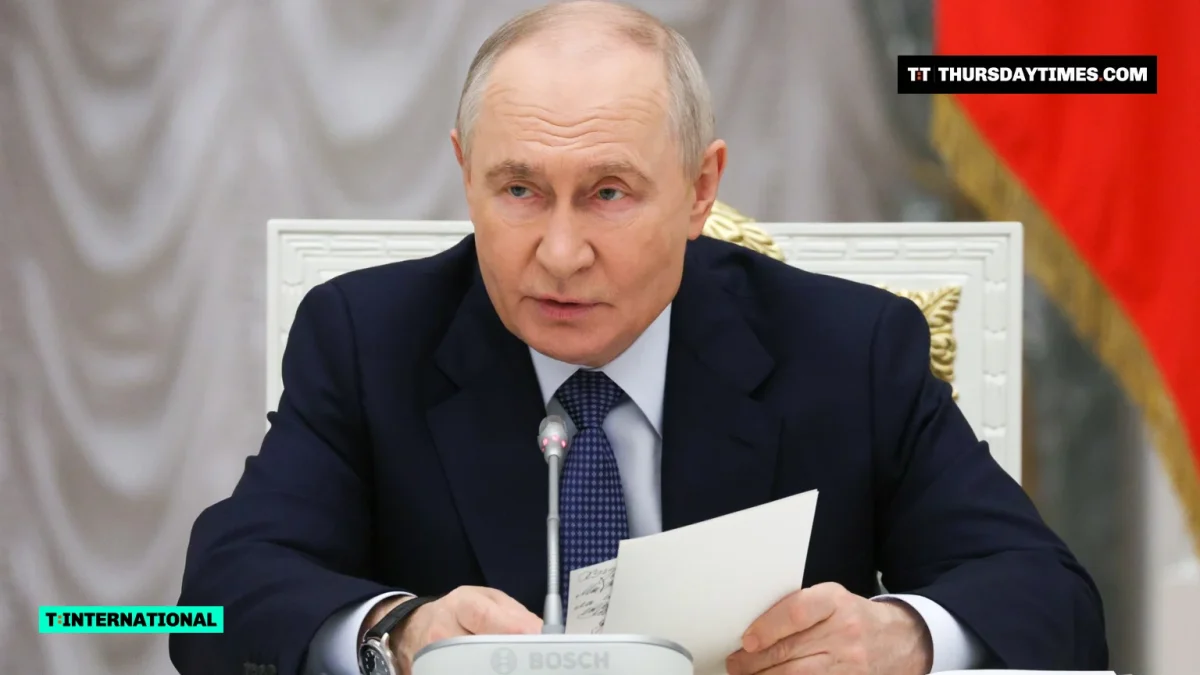
MOSCOW (The Thursday Times) — President Vladimir Putin said on Tuesday that Russian retaliation for Ukrainian strikes on its oil refineries is “inevitable”, accusing Kyiv of carrying on with the attacks despite a direct request from the US president to stop.
He was opening a meeting of the Presidential Commission for Strategic Development of the Fuel and Energy Sector in the Kremlin, according to the transcript published by the Kremlin. “We see that the Kiev regime has not stopped its attacks on our oil refining infrastructure – and this is despite the call and direct request from the President of the United States to refrain from such attacks,” Putin said. “Let me be clear on this: retaliatory measures on our part are inevitable, and everyone should be aware of that.”
He gave no details of what form the response would take. Putin said Russia had said many times that the escalation Ukraine launched in early June, which he said Kyiv had publicly declared would run for 40 days, “cannot inflict critical damage” on the country. He proposed that the commission discuss further steps to strengthen the security of oil refineries and to protect the people who work in them.
On the domestic fuel market, Putin said the government had kept supplies stable after restricting exports of gasoline, jet fuel, and diesel, with some diesel supplies to global markets continuing as agreed with the US president. He said Russia had also introduced an import dampening mechanism and adjusted exchange trading requirements for gasoline and diesel. Gasoline prices in most regions peaked in early October and have since mostly stabilised, he said, though the situation in the petroleum products market “remains difficult”.
Turning to Europe, Putin said continuing attempts to restrict Russian energy exports carry serious consequences “above all for the Europeans themselves”, who would have “less of our oil and gas and more problems”. He said Russia had never imposed restrictions on anyone and that European leaders were “bringing this upon themselves”.
Russia would keep expanding its markets and developing new supply routes, he said, including the Trans-Arctic Transport Corridor with the Northern Sea Route at its core, more rail and road capacity across Siberia and the Far East, and more oil refining and petrochemical capacity in the east of the country. He then gave the floor to Igor Sechin, the chief executive of Rosneft and executive secretary of the commission.