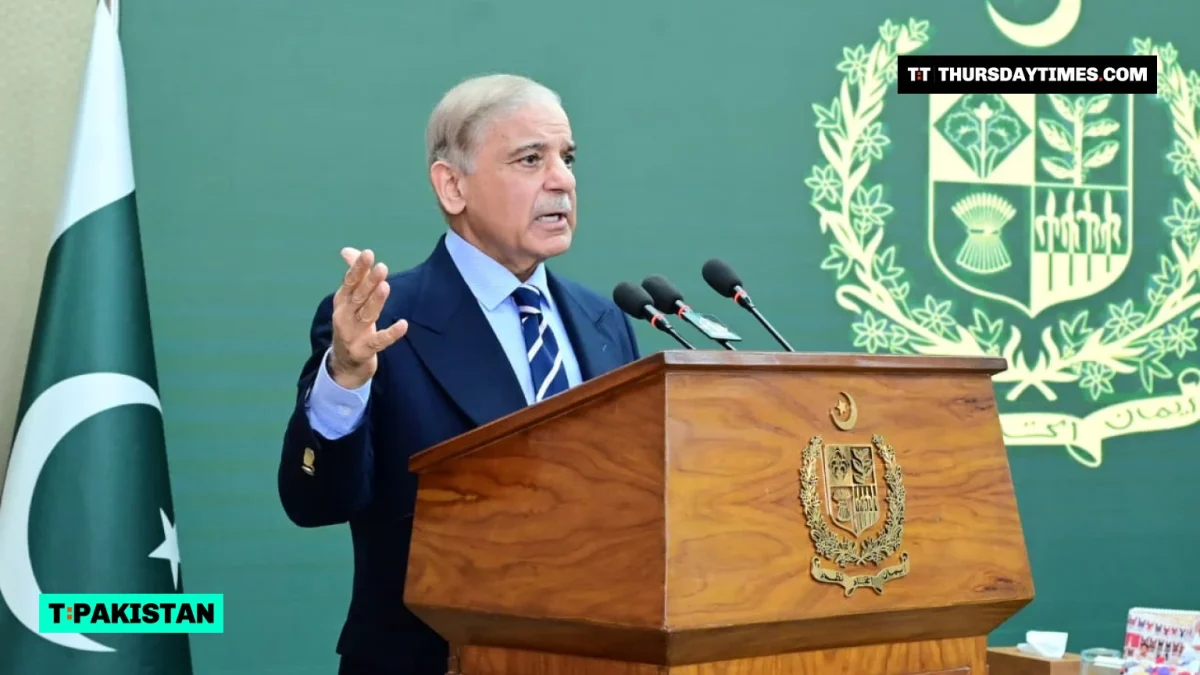
ISLAMABAD (The Thursday Times) — Prime Minister Shehbaz Sharif on Sunday called for political unity and “bitter decisions” to free Pakistan from its external debt, telling participants at the National Security Workshop in Islamabad that the country could clear its loans if the whole nation agreed to do so.
“There are solutions to this, but we will have to take bitter decisions,” he said. “The nation, all political parties, segments of society, if we collectively decide, I guarantee you without any fear of contradiction that we will rid Pakistan of this mountain of loans.”
Subsidies, state firms, and tax evasion
The prime minister said loans had been rising for 80 years and blamed subsidies, which he noted are paid for out of tax revenue, for leaving the nation “impoverished”. He also pointed to the trillions pumped into loss-making state-owned enterprises and to tax evasion, and said the aim was not to point fingers but to understand where the problem lay and fix it.
He defended the closure of the Pakistan Public Works Department, which he said ended Rs100bn in corruption despite the criticism it drew, and of the Utility Stores Corporation, where he said people had queued each year for substandard rice and flour. Support now reaches people through digital wallets, he said, and Rs27bn has gone to families under the Benazir Income Support Programme this year. He also defended the privatisation of Pakistan International Airlines, saying the airline had been losing around Rs300bn a year.
On revenue, Sharif said the Federal Board of Revenue had undertaken “long overdue” reforms to rid itself of corrupt elements, and that indirect taxes such as sales tax were the largest source of evasion. “For the first time in the history of Pakistan, we were able to recover Rs900 billion through enforcement,” he said. He added that the managing director of the International Monetary Fund had told him Pakistan was “a changed country”.
Growth, exports, and farming
Growth had been projected at 3.5%, he said, but “we have to touch minimum 6pc as early as possible”. Foreign exchange reserves were at their highest level in history, he said, but the country had to decide whether it wanted “a life of asking for alms” or one of honour and dignity, which he said required hard work and honesty.
Exports rose 8% in the first quarter of the current financial year, and IT exports reached $4.6bn in the previous one, he said, adding that much more was needed. Speaking “with a heavy heart”, he said the country had not done what it needed to in agriculture, which he claimed could be reformed “within six months” with hard work. He said the government was working with the provinces on wider technical and vocational training, and that a network of Daanish Schools, with merit-based admissions, was being set up in Azad Jammu and Kashmir, with institutions nearing completion in Bhimber and Bagh.
Foreign policy and teamwork
Sharif recalled Pakistan’s part in bringing the United States and Iran to talks in Islamabad after 47 years, crediting Field Marshal Syed Asim Munir and Deputy Prime Minister Ishaq Dar, and said the defence pacts with Saudi Arabia and Türkiye were not directed against any country. Those pacts are the subject of our report on what is settled and what is still open in the Makkah alliance. “I think it is time to convert these achievements into economic gains because time and tide wait for none,” he said.
Social and economic goals could not be reached by a “solo flight”, he said. “It has to be teamwork,” he added, stressing cooperation between the federation and the provinces. Answering questions from participants, he called rapid population growth a “ticking time bomb” for economic development.