Iranian president Pezeshkian to visit Pakistan on Tuesday
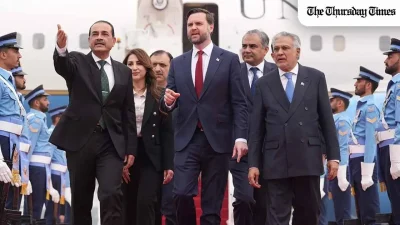
Iranian President Masoud Pezeshkian will visit Pakistan on June 23 for a one-day official trip following Pakistan and Qatar’s mediation in the latest Iran-US talks in Switzerland.
News from The Thursday Times' news desk.
Iranian President Masoud Pezeshkian will visit Pakistan on June 23 for a one-day official trip following Pakistan and Qatar’s mediation in the latest Iran-US talks in Switzerland.

Iranian media say Tehran is closing or keeping the Strait of Hormuz closed over alleged breaches of the Islamabad MoU, while US officials say they have not seen evidence of a physical closure.

Pakistan did what many thought impossible: it helped secure a US-Iran framework that has entered into force and now moves into technical implementation.
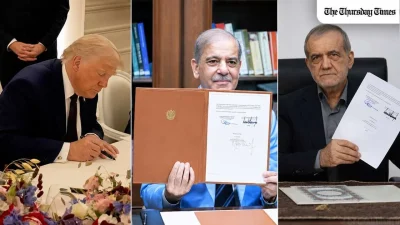
Prime Minister Shehbaz Sharif has signed the Islamabad MoU as mediator after Donald Trump and Masoud Pezeshkian endorsed the US-Iran agreement aimed at ending hostilities and reopening the Strait of Hormuz.

Pakistan’s mediation in the US-Iran peace agreement has won Saudi credit and global recognition, strengthening Islamabad’s diplomatic position as the deal moves toward permanent settlement talks.

Field Marshal Asim Munir’s military diplomacy helped Pakistan steer US-Iran tensions away from wider regional war through restraint, crisis management and quiet coordination, security sources.
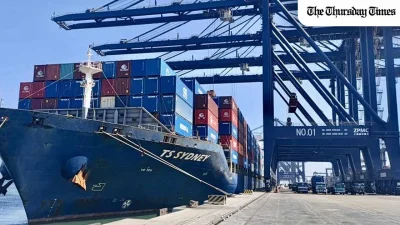
Pakistan’s major ports are seeing a sharp rise in container and transshipment activity as Gulf disruption redirects cargo towards Karachi, Port Qasim and Gwadar.
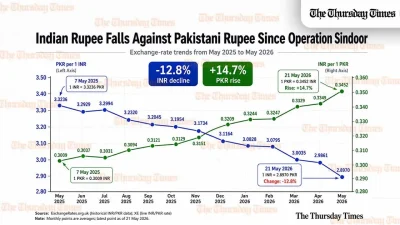
One year after Operation Sindoor, the Indian rupee has lost nearly 12 per cent against Pakistan's currency, hit a record low of 96.47 against the dollar, and become Asia's worst-performing currency. Pakistan's rupee, once called worthless, has stabilised. The Thursday Times explains what the data means.
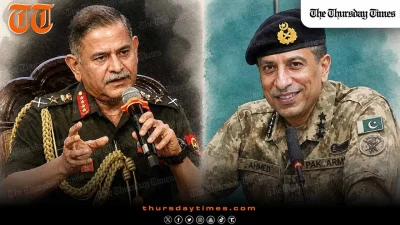
On the first anniversary of Marka-e-Haq, Pakistan's military has dismissed the Indian Army Chief's "geography or history" warning as the rhetoric of a state suffering "a bankruptcy of cognitive capacities", and has reminded Delhi that any attempt to target a nuclear neighbour would be neither geographically confined nor politically survivable.
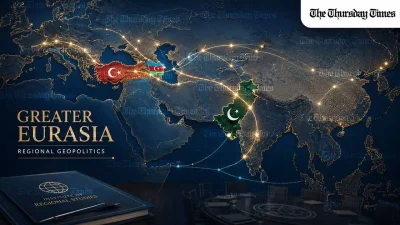
The Institute of Regional Studies hosted a seminar in Islamabad on Greater Eurasia, where speakers from Pakistan, Türkiye and Azerbaijan called for deeper connectivity, stronger trade corridors and closer strategic cooperation in a rapidly changing multipolar order.