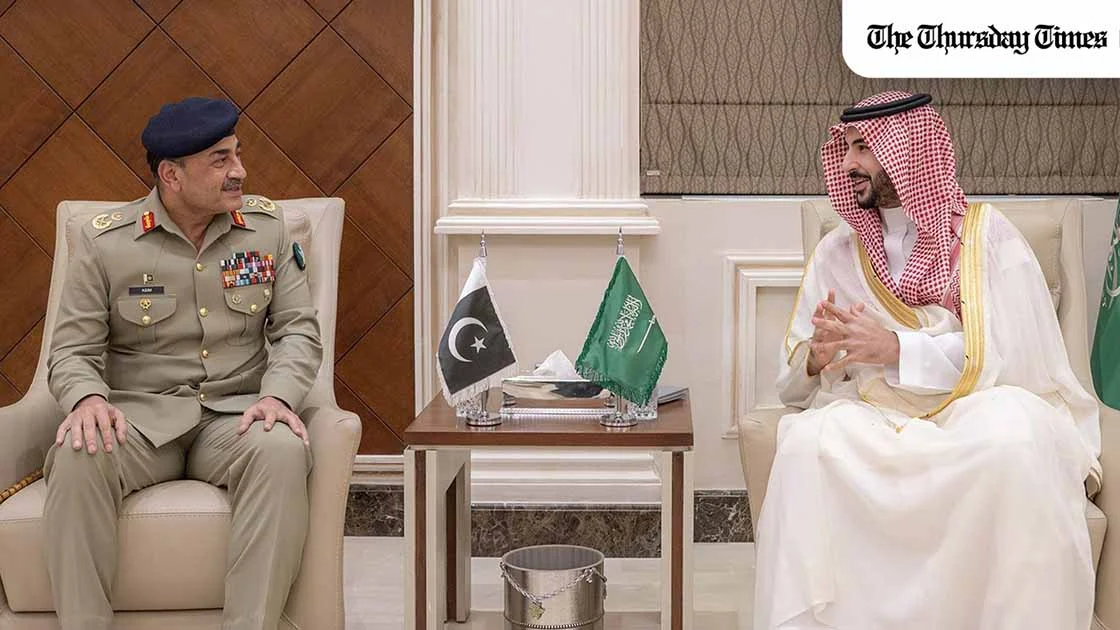
RIYADH (The Thursday Times) — A meeting between Pakistan’s top military leader, Field Marshal Asim Munir, and Saudi Defence Minister Prince Khalid bin Salman has pushed Pakistan–Saudi security coordination back into focus as Gulf capitals weigh the risks of Iranian missile and drone activity targeting the Kingdom.
The tone of the readout was deliberate. Rather than signalling a dramatic escalation, Prince Khalid’s statement positioned the response within an existing bilateral architecture, describing discussions on Iranian attacks and the steps required to halt them “within the framework” of the Joint Strategic Defence Agreement. The language emphasised regional security and stability, paired with an appeal for Iran to “exercise wisdom” and avoid miscalculation.
Met with Pakistan’s Chief of Army Staff and Chief of Defense Forces, Field Marshal Asim Munir. We discussed Iranian attacks on the Kingdom and the measures needed to halt them within the framework of our Joint Strategic Defense Agreement. We stressed that such actions undermine… pic.twitter.com/OuELnf9LU6
— Khalid bin Salman خالد بن سلمان (@kbsalsaud) March 7, 2026
For Pakistan, the messaging fits a familiar posture: deterrence and crisis management designed to prevent spillover into the Gulf, where millions of Pakistanis live and work and where Islamabad has long treated instability as both an economic and security risk. The Riyadh optics also underline a point often missed in day-to-day coverage of Pakistan’s Gulf ties: these relationships extend beyond labour flows and finance into formalised security coordination that can be politically emphasised even when operational details remain undisclosed.
The meeting comes at a moment when multiple confrontation theatres are overlapping across the region, raising the premium on controlled signalling. Gulf capitals are recalculating air-defence readiness and the risk that a single misjudgement could widen the conflict footprint beyond immediate flashpoints. In that environment, public readouts that foreground restraint and stability are not simply diplomatic niceties. They function as part of the deterrence language itself, intended to warn against further strikes while keeping diplomatic off-ramps open.
Prince Khalid’s choice of words, and the decision to foreground the bilateral defence framework, will be read in Islamabad as a calibrated message: alignment with Saudi security concerns coupled with a clear preference for de-escalation rather than a widening regional war.∎