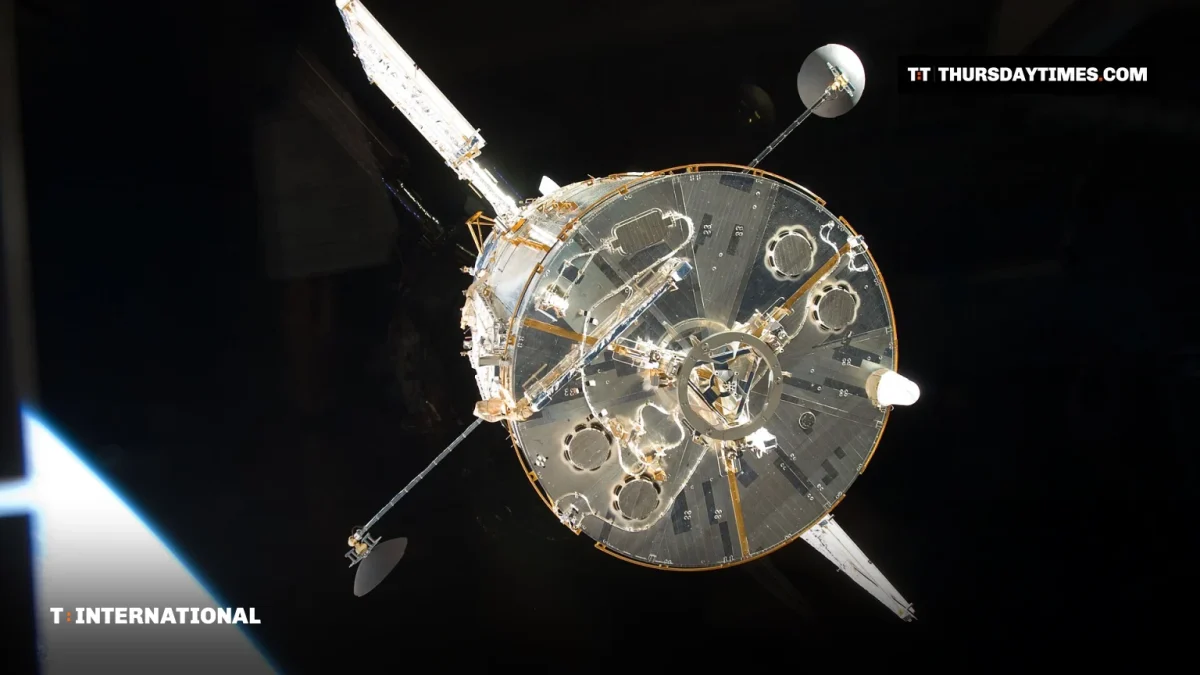
WASHINGTON (The Thursday Times) — NASA has asked private companies for ideas on how to save the Hubble Space Telescope, which is working well after 36 years but is on course to fall back to Earth in 2033 or 2034.
In a request issued on October 29, the agency asked for proposals on servicing Hubble in space, which could mean boosting its orbit, which is slowly decaying because of atmospheric drag, or even improving its abilities. Any such mission would have to take place in 2032, NASA said. The request also leaves room for the alternative, a safe, controlled re-entry at the end of the telescope’s life.
NASA administrator Jared Isaacman, whose 2022 proposal, as a private citizen, for a repair mission using SpaceX hardware was turned down, said the agency should “be looking at every reasonable opportunity to keep it delivering for as long as possible”. He wrote on X: “Hubble deserves it.”
Launched in April 1990 with the European Space Agency, Hubble was serviced five times by space shuttle astronauts, most recently in 2009. It has helped show that the expansion of the universe is accelerating, and its observations have led to at least 23,000 scientific papers. Astronomers still ask for about seven times more observing time than it can give.
NASA is about to lose another telescope this way: its Swift observatory is expected to fall back to Earth around Friday after a rescue mission failed.