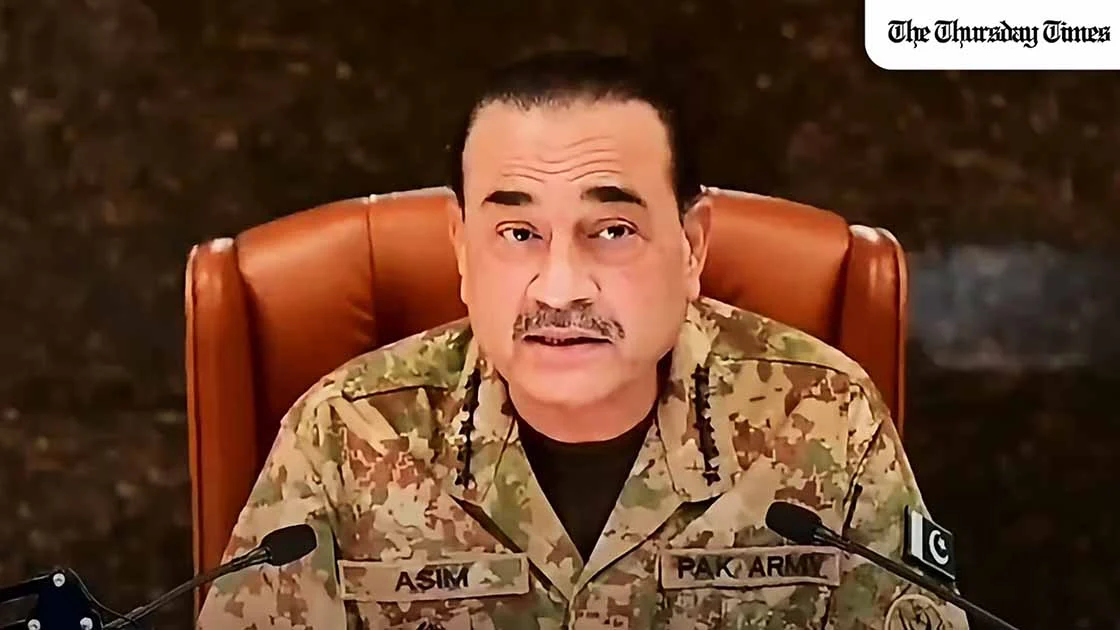
RAWALPINDI (The Thursday Times) — The 277th Corps Commanders’ Conference, presided over by Chief of Defence Forces and Chief of Army Staff Field Marshal Asim Munir at General Headquarters, resolved that any attempt to create a “May 9-like situation” would be met with “decisive force and rule of law, without hesitation and discrimination,” a warning issued just two days ahead of a planned march on Islamabad set to depart Peshawar on October 4.
According to Inter-Services Public Relations, the forum underscored the importance of internal stability and resolved that such action would be taken “on any pretext whatsoever.” The warning references the unrest that swept the country on May 9, 2023, following Imran Khan’s arrest. The upcoming march, originally planned for September 27, was postponed to October 4 amid security and logistical concerns, with October 5 separately marked by organisers as Khan’s birthday.
The commanders separately turned to Pakistan’s regional defence partnerships, welcoming the Makkah Joint Defence Agreement between Pakistan, Saudi Arabia, and Türkiye and its contribution to what ISPR described as “longstanding strategic and collective defence ties.” The forum “strongly resented” Houthi attacks against Saudi Arabia, expressed solidarity with the Kingdom, and affirmed Pakistan’s commitment to the security and sanctity of the Haramain Sharifain. The statement follows a week of escalating exchanges between Houthi forces and Saudi Arabia, including a drone attack on a power station supplying the Prophet’s Mosque in Madinah, and comes days after the military chiefs of Pakistan, Saudi Arabia, and Türkiye met in Riyadh under the same pact.
Pakistan's Corps Commanders' Conference reaffirmed the right to targeted action against terrorism from Afghanistan, saying the Taliban leadership facilitating terrorism on India's behalf bears full responsibility.
The forum also warned any "May 9-like situation" would be met… pic.twitter.com/i6P4ruAgkg— The Thursday Times (@thursday_times) October 2, 2026
On the country’s western border, the commanders reaffirmed Pakistan’s right to take “targeted action against terrorism originating from Afghanistan,” a position consistent with Pakistan’s strikes on militant hideouts in Afghan territory in recent weeks following a drone incursion into Pakistani airspace.
The conference also addressed the broader shape of Pakistan’s counterterrorism approach. The commanders appreciated intelligence-based operations carried out by law enforcement agencies but stressed that military measures needed to be complemented by non-kinetic steps, including grassroots governance, public engagement, dismantling links between terrorism and criminal networks, and strengthening police capacity. The point echoes DG ISPR Lieutenant General Ahmed Sharif Chaudhry’s direct questioning, at a press conference the previous day, of why Khyber Pakhtunkhwa’s provincial government had not taken stronger measures to build up its own police capacity, remarks Defence Minister Khawaja Asif separately described as an almost complete “charge sheet” against the provincial government.
Field Marshal Munir directed commanders to continue strengthening intelligence-based operations and to improve combat capabilities through modern technology, enhanced training, and multi-domain integration.
The forum also reiterated Pakistan’s position on Indian-administered Kashmir, voicing support for resolving the Kashmir dispute “in accordance with relevant UN Security Council resolutions and the aspirations of the Kashmiri people.”∎