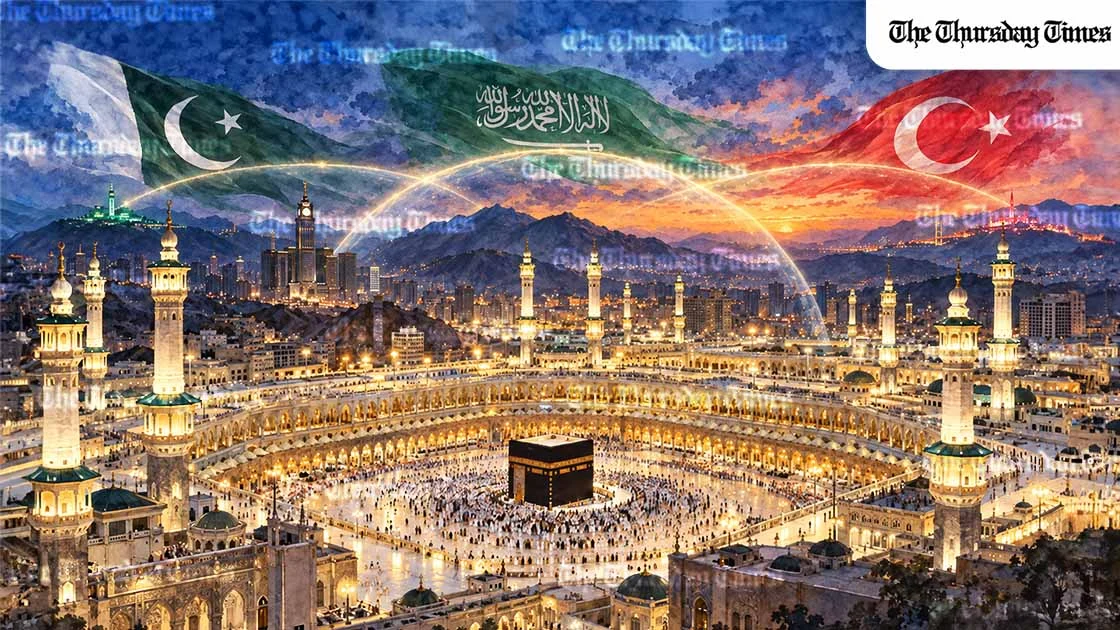
For Muslims across the world, Makkah and Madinah are not simply cities. They are part of a spiritual geography that predates modern borders, military alliances and the strategic vocabulary of states.
That is why the question of their protection should not be reduced to the familiar language of deterrence, deployments and defence hardware.
If the Makkah Defence Pact is to matter, it must become more than an arrangement for responding to danger. Its real value will lie in whether it can help prevent danger from reaching the sacred cities at all.
That requires strength, certainly. But it also requires judgement.
Pakistan has an obvious place in such an architecture. Its relationship with Saudi Arabia rests on decades of defence cooperation, political ties and deep people-to-people links. Yet the connection to the Haramain runs beyond diplomacy. For millions of Pakistanis, Makkah and Madinah occupy an intimate place in religious life. Their protection is therefore seen not merely as a strategic undertaking, but as an amanah, a trust.
That sentiment is powerful. It should also be handled with care.
Sacred obligations do not become stronger simply because they are expressed in increasingly martial terms. The most credible security policy is often the one that prevents a confrontation before anyone is forced to test the strength of an alliance.
A shield is most effective when its presence discourages the strike.
That principle matters because contemporary conflict no longer fits neatly into the categories of war and peace. Drones cross borders at relatively low cost. Cyberattacks can disrupt essential infrastructure without a soldier entering another country. Disinformation can create confusion before governments have established what has happened. Armed groups exploit political vacuums, porous frontiers and regional rivalries.
The battlefield has expanded, and so must the meaning of defence.
Collective security around the Haramain should therefore involve far more than conventional military planning. Intelligence-sharing, counter-drone systems, cyber resilience, protection of critical infrastructure, early-warning mechanisms and crisis communication should all form part of the same architecture.
Pakistan and Türkiye bring useful experience to this equation. Pakistan has spent years confronting insurgency, terrorism and unconventional security threats. Türkiye has developed significant technological and defence capabilities. Saudi Arabia provides the political centre of gravity and, as custodian of Islam’s two holiest sites, bears a responsibility unlike that of any other state.
But capability alone is not strategy.
The region already suffers from too many conflicts in which suspicion hardens into certainty long before the evidence does. The Houthis, TTP, TTA and BLA emerge from different political histories and operate under different circumstances. There may be value in studying common features of asymmetric warfare, proxy competition and the use of non-state actors. But strategic comparison must not become intellectual shorthand.
The Middle East and South Asia have paid a high price for narratives that move faster than facts.
Claims of foreign sponsorship or covert coordination should therefore be investigated rigorously, not merely repeated because they fit an existing geopolitical story. Good intelligence narrows uncertainty. Poor intelligence, or intelligence used carelessly, can widen wars.
This distinction is particularly important when sacred geography is involved.
The Haramain should never become rhetorical accelerants in disputes that can still be contained politically. Their protection should be a reason for greater discipline, not less.
That means constructing an alliance capable of speaking two languages at once.
The first is the language of defence. No hostile actor should doubt that threats to Saudi territory, civilian populations or the holy cities would meet a serious and coordinated response.
The second is the language of de-escalation. Political communication, mediation, intelligence channels and diplomacy must remain available precisely when tensions are at their highest.
A mature security order needs both.
The temptation in public debate will always be to ask how many troops might be sent, which systems might be deployed, or what capabilities individual states could bring to a confrontation. But such questions can obscure the more important point.
Operational secrecy is normal in serious defence relationships. Political intent matters more.
Pakistan does not need to publish an inventory of what it would contribute in order to make its commitment credible. What matters is whether Riyadh and Islamabad possess the trust, mechanisms and readiness required to act together when necessary.
Resolve is not measured in press releases.
Nor is restraint the opposite of resolve.
In fact, states that are genuinely confident in their capabilities are often better placed to exercise restraint. They do not need to turn every provocation into a spectacle of retaliation. They understand that deterrence is successful when adversaries calculate that escalation will fail, while diplomacy still gives them a way to step away from it.
That is the balance the Makkah Defence Pact should seek.
It should be formidable enough that its commitments cannot be dismissed, but sophisticated enough that military force remains the last instrument rather than the first instinct.
The Haramain themselves offer a useful metaphor. For centuries they have stood at the centre of a Muslim world divided by geography, language, politics and competing interests. Their significance has endured precisely because it is greater than those divisions.
Any security architecture built around them should aspire to the same principle.
It should not merely gather weapons around sacred ground. It should build a protective distance between sacred ground and the region’s conflicts.
Pakistan can make an important contribution to that task, not only through military capability but through intelligence, diplomacy, technological cooperation and political restraint.
The ultimate success of such an alliance should not be measured by the force it one day deploys.
It should be measured by how rarely that force becomes necessary.
The strongest defence of the Haramain would be one that keeps the turbulence of the region far from their gates.
That is more than deterrence.
It is stewardship of a trust larger than any single state.