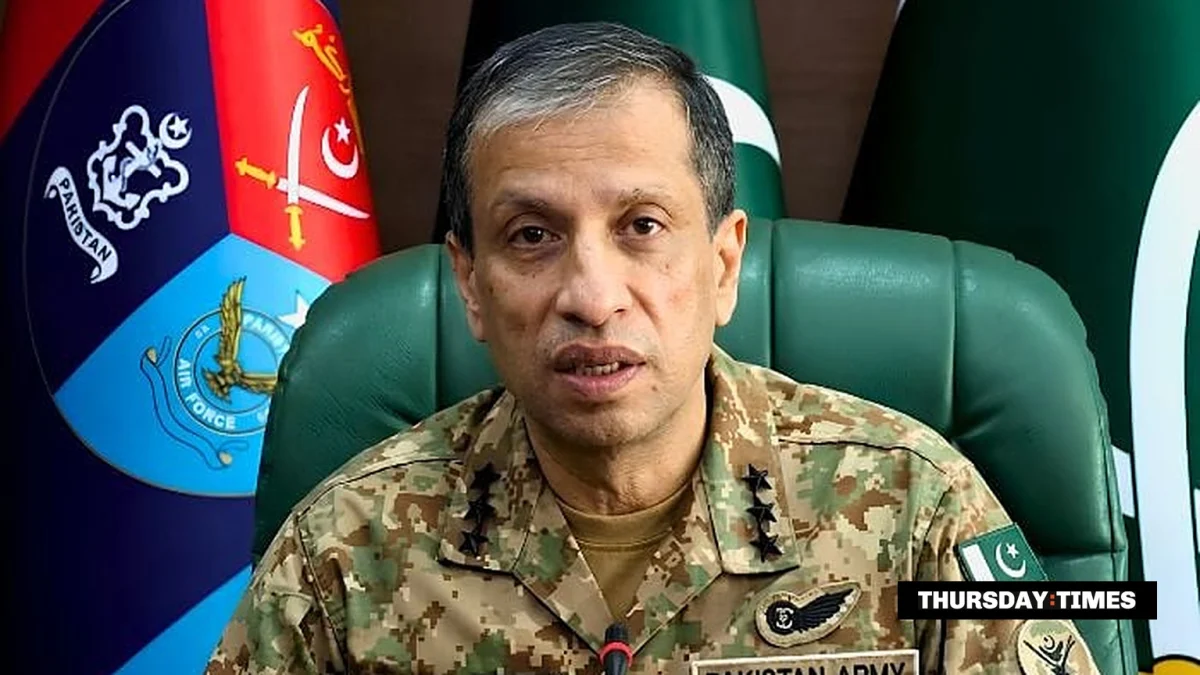
RAWALPINDI (The Thursday Times) — Pakistan’s military spokesman has given the fullest public account yet of how the Makkah Joint Defence Alliance is structured, telling Independent Arabia that the three-member pact has moved “phenomenally” fast from signature to practical deployment, and that its door remains open to other states that share its principles.
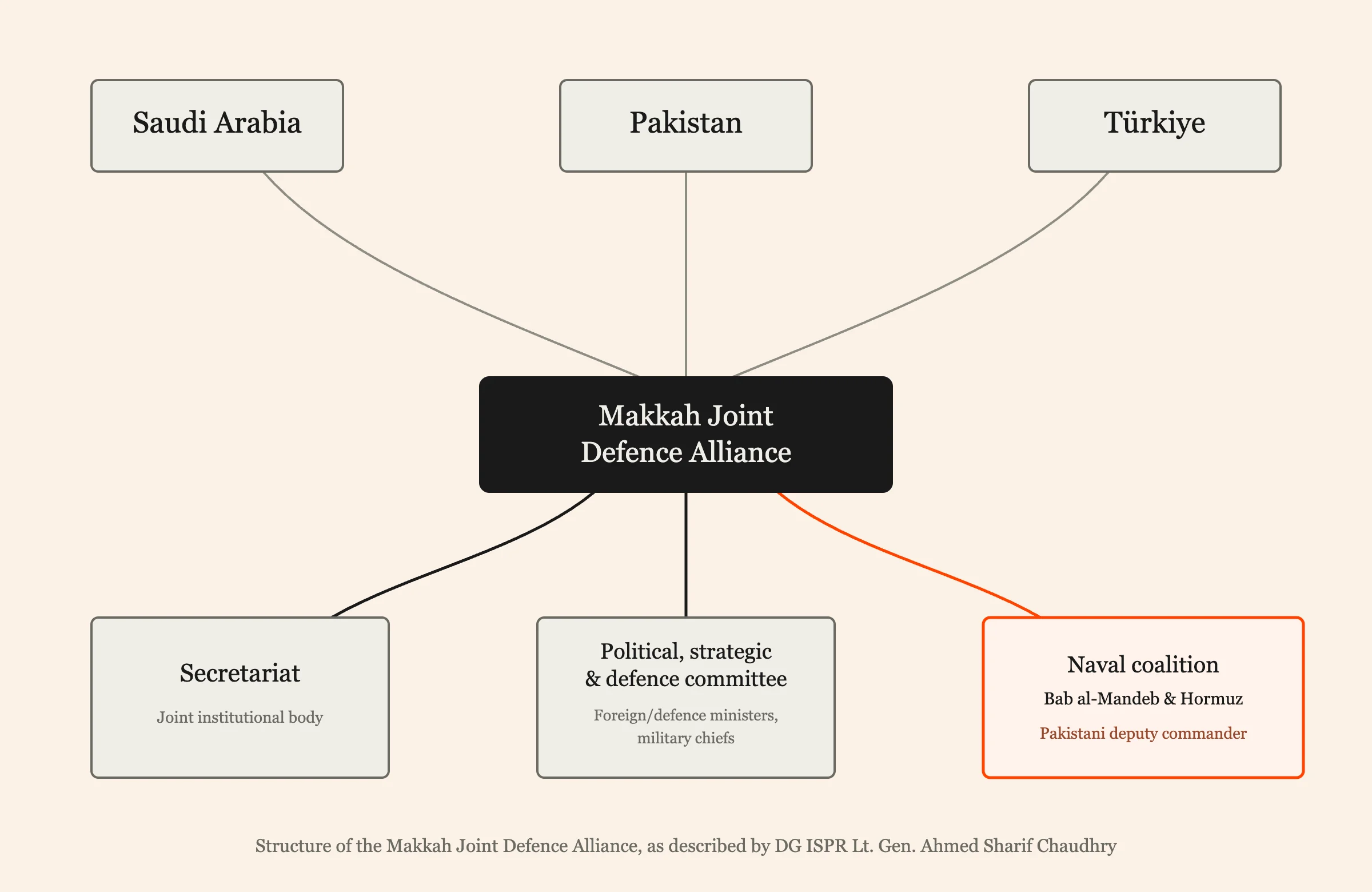
In an interview that aired on Sunday, the Director General of the Inter-Services Public Relations (DG ISPR), Lieutenant General Ahmed Sharif Chaudhry, said Saudi Arabia, Pakistan and Türkiye have already stood up a secretariat and a political, strategic and defence committee drawing on each country’s foreign ministers, defence ministers and military chiefs. “The alliance’s evolution has been phenomenal,” he said, pointing to the pace at which the institutional machinery had been assembled since the pact was signed in August.
“The alliance’s evolution has been phenomenal,” — Lt. Gen. Ahmed Sharif Chaudhry, DG ISPR
Chaudhry grounded the alliance’s legal footing in Article 51 of the UN Charter’s provision for collective self-defence, repeating that the pact carries no offensive intent and does not replace any member’s existing bilateral defence agreements or security partnerships. Asked about reports that Egypt and Syria had expressed interest in joining, he declined to confirm specifics, saying any such decision would rest with the leaderships of the three founding members. “The door is open,” he said, “to countries that share our principles.”
Beyond its land and political architecture, the DG ISPR described a maritime dimension to the alliance that has drawn less public attention: a Saudi-led multinational naval coalition covering the Bab al-Mandeb Strait and the Strait of Hormuz, two of the world’s most strategically sensitive waterways. A Pakistani naval officer serves as the coalition’s deputy commander, he said, giving Islamabad a direct hand in policing the sea lanes most exposed to any escalation stemming from the Houthi conflict or wider regional tension.
Chaudhry said the alliance’s first real test had arrived sooner than its architects might have hoped, with Houthi attacks on Saudi Arabia triggering the collective-response clause that treats an attack on one member, direct or indirect, as an attack on all three. He was careful, however, to describe the mechanism as a deterrent rather than an instrument of escalation: “If negotiations fail and conflict erupts, the alliance’s collective deterrence would apply,” he said, stressing this was “already happening” in the form of coordinated support to Riyadh rather than open warfare.
“If negotiations fail and conflict erupts, the alliance’s collective deterrence would apply.”
He used the interview to press a broader argument about fractures in the Muslim world, suggesting that the alliance’s real value lay as much in demonstrating that Muslim-majority states could act collectively as in any specific military capability it adds. Horizontal escalation, drawing more actors into the Houthi conflict, or vertical escalation, intensifying the fighting that already exists, would serve no one’s interests, he said, repeating his appeal for unity: “We need to stop attacking each other.”
Pakistan has separately confirmed the presence of its own troops in Saudi Arabia, which officials describe as a continuation of a military relationship that predates the Makkah alliance by decades, now operating under its new collective-defence framework.