ISLAMABAD (The Thursday Times) — Since July, when Interior Minister Mohsin Naqvi said the governance system had collapsed and called for more provinces or administrative units, Pakistan’s argument over smaller provinces has narrowed to a single question: who decides? Supporters of a public vote say the answer is the people. The Pakistan Peoples Party says the answer is already written in the Constitution. On 21 November both claims have some force, and neither has been tested, because there is no bill, no cabinet decision, and no formal request to the Election Commission.
Where the argument stands
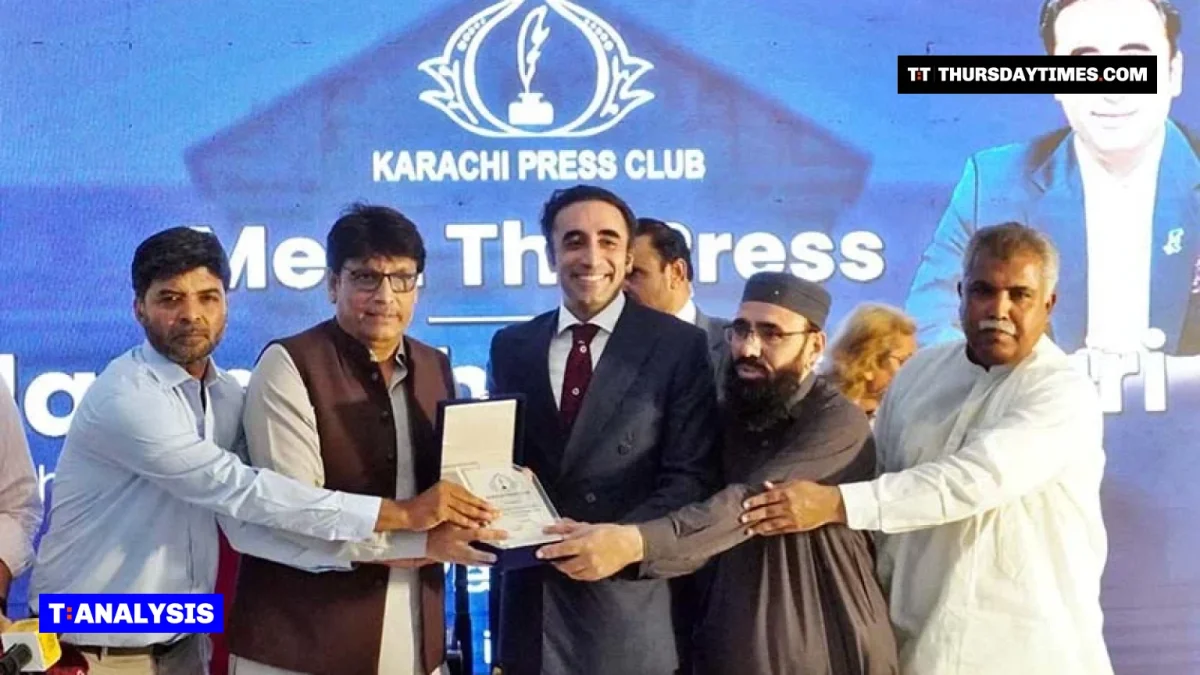
The sequence matters. On 31 July Naqvi made his call at an economic summit in Islamabad, after Health Minister Mustafa Kamal, who leads the MQM-PThe Muttahida Qaumi Movement-Pakistan, the urban Sindh party in the federal coalition that campaigns for more administrative units in the province., had floated the division of Sindh. On 4 September the Sindh Assembly passed a resolution rejecting any attempt to divide the province, and Chief Minister Syed Murad Ali Shah said there would be no compromise on its geographical unity. On 14 November President Asif Ali Zardari met Prime Minister Shehbaz Sharif after Naqvi proposed a referendum. Three days later, at the Karachi Press Club, PPP chairman Bilawal Bhutto Zardari rejected the idea and warned that dividing Sindh by force would bring bloodshed to Karachi and Hyderabad. The president and the prime minister met again on 19 November and pledged to settle their differences through dialogue.
On 20 November the opposition PTI and Information Minister Attaullah Tarar both said a referendum could settle the matter, while Railways Minister Hanif Abbasi said no decision had been taken and that any move would need approval from both houses of parliament, as The Thursday Times reported. A day later the Election Commission said it had received no request or instructions, and the federal cabinet has not formally discussed the idea. Party sources say the PML-N plans to consult the PPP and the MQM-P, and that a national political conference and a parliamentary committee are possible if consensus emerges. Bilawal has hinted that a 28th Amendment is being considered, but nothing has been tabled. The Thursday Times’s editorial of 20 November faulted the language of bloodshed, yet agreed with the PPP on one point: a referendum run by the executive is not the constitutional route. For the wider map debate, see what it would take to give Pakistan 12 provinces.
The case for asking the people
Supporters of a public vote begin with sovereignty. No provincial assembly, they argue, can claim to speak for its voters on how they want to be governed unless the voters have been asked, and the government cannot treat governance as a favour it grants. Each province should vote for itself, they say, so that no province imposes its will on another. If the PPP is confident of public opinion in Sindh, the argument runs, it has nothing to fear from a transparent poll and should welcome the result. They add that smaller units would bring government closer to people, make the bureaucracy more accountable, and open more political space for those who believe in service and delivery.
There is a record to point to. Aamir Dogar, the PTI’s chief whip in the National Assembly, said Imran Khan has consistently favoured smaller provinces and that a South Punjab province was in the party’s 2018 manifesto. Kamal, speaking on 20 November, argued that the MQM-P turned to the demand because local governments in Sindh lack real powers, and said his party would have backed the 26th or 27th Amendment had it given local governments constitutional authority. He also pointed to Article 239 as the mechanism the Constitution already provides.
“The will and opinion of the people should prevail.”
Supporters also cite Sindh’s own history of subdivision, from three divisions and 11 districts in 1973 to seven divisions and 30 districts today, and ask why Sindh cannot have provinces within its existing boundaries. That comparison needs care. Sindh now has 30 districts, and its divisions number six or seven depending on whether Bhambore, a recent addition, is counted. The 1973 starting point is harder to document, and the count of 11 districts could not be confirmed. The argument also cuts both ways. Divisions and districts are administrative tiers that a provincial government can create on its own authority, as the PPP, which has governed Sindh for 18 years, has done. A province is a different kind of unit, with its own legislature, its own share of national revenue, and its own seats in the Senate. The first does not settle the second.
The counter-case from Sindh
The PPP’s case rests on three arguments. The first is process. Bilawal has said the Constitution already sets a procedure, and that a referendum amounts to looking for another route. “It is not about a referendum, it is about intent,” he said, according to reports of his remarks. The party says it does not oppose new provinces where people want them, and has said it would not stand in the way of a South Punjab province if the Punjab Assembly passed a resolution. The second is fear of division. Sindh regained provincial status only in 1970, after the One UnitThe 1955 scheme that merged the western provinces, Sindh included, into one West Pakistan. Sindh regained provincial status in 1970. years, and Karachi and Hyderabad carry memories of ethnic violence. The party warns that forcing the issue risks reviving them. The third is that boundaries are not the problem. Bilawal has argued that political and institutional failures, not the map, are the root of the governance crisis.
“It is not about a referendum, it is about intent.”
The counter-case has weaknesses, and critics have named them. Ministers have pointed out that the PPP has governed Sindh for 18 years and was fully involved in the 26th and 27th Amendments it now criticises. Critics say that warning of bloodshed hardens positions and gives opponents an easy reply. And it is less clear what the PPP would offer urban Sindh in place of a new province, though the MQM-P’s core complaint, that local governments lack the powers to deliver basic services, is one a reform of local government could address without redrawing a map.
What the Constitution requires
The route is narrower than either camp usually admits. Under Article 239The part of the Constitution that sets out how it can be amended. Clause 4 bars any change to a province’s limits unless that province’s own assembly approves it by two-thirds., a bill that changes the limits of a province cannot go to the president for assent until that province’s own assembly has passed it by two-thirds of its total membershipEvery seat in the house, not just the members present on the day, so an absent member counts against the bill.. The bill itself must first clear two-thirds of the total membership of each house of parliament. A referendum is a separate matter. Article 48 lets the prime minister refer a question of national importance to a joint sittingA combined meeting of the National Assembly and the Senate. and, if that approves, put it to the public as a question answerable by yes or no. Nothing in that article makes the result a substitute for the amendment. As one senior lawyer put it, a referendum cannot override the requirements of Article 239.
The arithmetic that decides it
Reports in 2025 and 2026 put the governing coalition above the National Assembly threshold, at roughly 233 to 237 seats, and above the Senate threshold, so the federal houses are not the main obstacle. The obstacle is in Karachi. The PPP is reported to hold about 116 of the 168 seats in the Sindh Assembly. It would need only 57 to block a bill, so Sindh’s consent, not the centre’s, decides whether any new province carved from Sindh can be created. Supporters of a vote know this, which is why they stress that Sindhis, not MPAs, should speak. A province-wide poll, though, raises its own question. If all of Sindh votes on dividing Sindh, the result will depend on how the whole province votes, not just its cities, and nobody has said how a question like that would be framed.
That does not make a vote useless. A clear result could shift the political cost of a decision, either giving the PPP a reason to move or giving the federal side a reason to stop. Kamal has said the prime minister has the authority to hold a referendum, and the PML-N’s own consultations may produce a question and a mechanism. The Election Commission’s two-month preparation window means nothing can happen quickly, and the MQM-P has postponed its 29 November rally for new provinces, with Kamal saying it would withdraw if there were any risk of clashes. For now, the first real test is not a ballot box. It is whether the PPP, the MQM-P, and the PML-N can agree on a question they are prepared to take to parliament.
A vote can tell Pakistan what people want. Only an amendment can give it to them.
Both sides can claim the people. Only one route leads to a new province, and it runs through the Sindh Assembly.