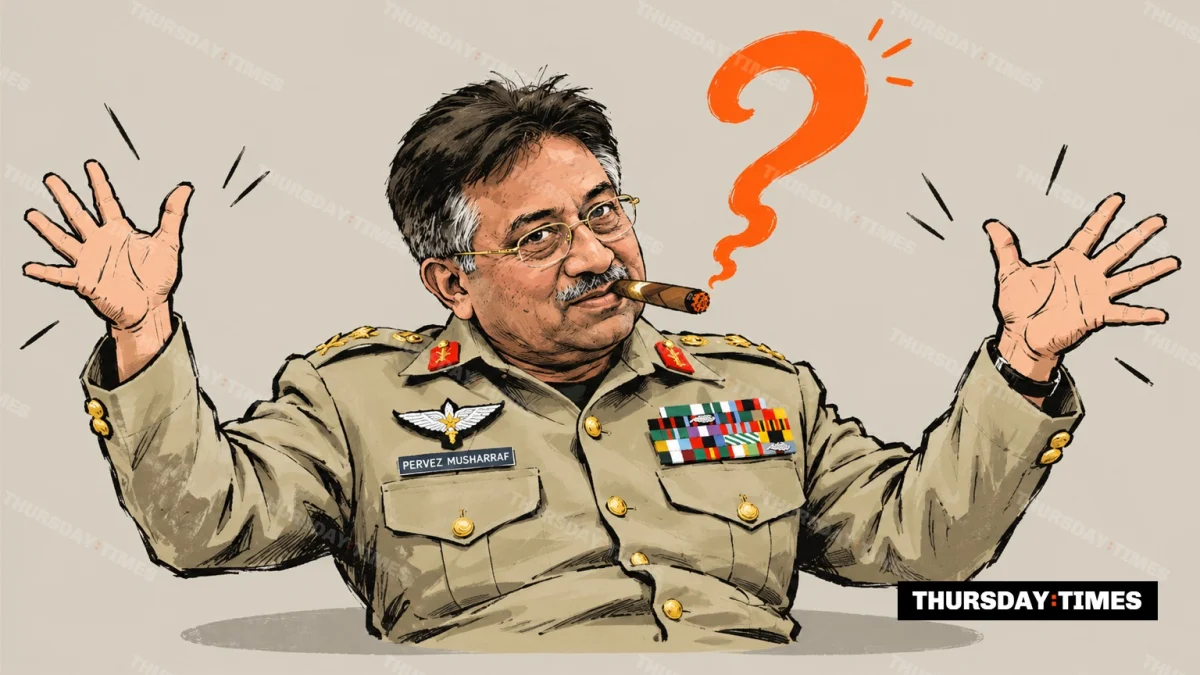
We heard a lot of bad things about Pervez Musharraf growing up.
I gained consciousness in the post-2008 era of Pakistani politics, when Asif Ali Zardari had become the nation’s president for the first time. We had heard, dimly, that Benazir was dead, and the name “Yusuf Raza Gilani” was ingrained in our minds from watching too much television.
The programmes on that television talked about this Musharraf figure as the man to blame for whatever calamity had befallen Pakistan lately. It is a strange thing to look back on, because the calamities were only getting started. The years that followed — the People’s Party’s years — were the years the bombs actually peaked. The worst bloodletting in the country’s recent memory happened on the watch of the people blaming him for it.
As a PML-N-supporting family, we reached adolescence on a steady diet of the injustices Musharraf had done to Nawaz Sharif. He caused Kargil. He caused martial law to be nafazed upon the Republic. He put an elected prime minister in a cell, then on a plane to Jeddah. The story had one villain, and we knew his name.
But was he really all that bad?
For the record, here is where I stand. I want a secular Pakistani state. I am a liberal, and a feminist to a certain degree. I think we should make peace with our neighbours on both sides of the border. I think the maulvis who have held a veto over Pakistani life since Zia should have it taken off them, permanently, and I have no patience left for the politicians who keep renewing it. I think, in other words, most of the things a Pakistani of my generation and my politics is supposed to think.
The trouble is that the man I was raised to despise spent the better part of a decade trying to do most of them.
Start with women. In 2006, over the walkouts and the howling of the religious parties, Musharraf signed the Women’s Protection Act, which took rape out of the Hudood Ordinances and put it back in the Penal Code — where a victim no longer needed four male witnesses to be believed, and no longer faced a charge of adultery if she couldn’t produce them. Two Benazir governments and two Nawaz governments had looked at those ordinances and left them exactly where Zia put them. Four years earlier, he had reserved one in six seats in the National Assembly for women. The democrats had the moral high ground for a decade and did nothing with it; the dictator did it with a signature.
The democrats had the moral high ground for a decade and did nothing with it; the dictator did it with a signature.
Women’s reserved seats in the National Assembly, before and after 2002
Musharraf’s Legal Framework Order tripled the number overnight.
Women’s reserved seats, national versus local government
The 2000 Devolution Plan went further at the local level than the 2002 reforms did in parliament.
Then the neighbours. He went to Agra in 2001, was sent home with nothing, and kept trying anyway. He agreed a ceasefire on the Line of Control in 2003 that held for the best part of five years. He sat down with Vajpayee in Islamabad in 2004 and opened the composite dialogue, went to Delhi in 2005 to watch the cricket, and through the back channel got closer to a settlement on Kashmir than any Pakistani leader before or since. He sat with Karzai at a peace jirga in Kabul in 2007. His government had Radio Pakistan beaming across the borders in Persian, Dari and Hindi, and he stood in front of the cameras and told the people of India, directly, that Pakistan did not want war.
The whole train of thought started with a clip on Twitter the other day: Musharraf and George Bush walking up to a set of microphones, and Musharraf saying that Pakistani forces had entered the tribal areas for the first time in well over a century — that the British, in all their years on the frontier, had never managed it. What struck me wasn’t the claim. It was that he wasn’t performing. There were no votes in Waziristan. There was just a man who found the problem genuinely interesting and wanted a state that behaved like one — a state that could go anywhere it liked inside its own borders.
The country he ran was, for a few years, visibly changing shape. Growth ran north of six per cent for most of the middle of the decade. The mobile phone went from a rich man’s accessory to something a rickshaw driver kept in his breast pocket. The private television channels came into existence because he licensed them, and it tells you something about the man that the channels he created were the ones that eventually brought him down. A modern economy was being bolted onto a traditional one — unevenly, on a lot of consumer credit, with a fair amount of showing off — but it was being built, and you could watch it being built.
Mobile phone subscribers in Pakistan, 2000 to 2007
From a rich man’s accessory to a rickshaw driver’s breast pocket, in under a decade.
The Red Mosque I only heard about years after the fact, and I heard about it the way my family did: a massacre of students in the heart of the capital. Now I read what happened in the months before the siege. Clerics and their students had spent the first half of 2007 abducting police officers, kidnapping women they had decided were prostitutes, making bonfires of DVDs in the street, and announcing that a sharia court would sit in a mosque a few kilometres from the parliament. A state that lets that go on is not a state. Musharraf sent in the army. It was ugly, and many of the dead were very young. I would have sent it in too.
A state that lets that go on is not a state.
None of this makes him a democrat, and I am not going to pretend otherwise. He sacked a Chief Justice, and when that didn’t take, he sacked the rest of the judiciary along with him. He took the channels off air the moment they turned on him. Nawab Bugti died in a cave. People disappeared. The Imran Khan who would spend the next fifteen years selling himself as the only Pakistani who ever stood up to the establishment was, in November 2007, sitting in a cell under terrorism charges for trying to lead a student protest in Lahore — put there by the general, not the civilians. Kargil was his, and Kargil was a disaster. A leader can be all of that and still be the best this country has had in fifty years, because the bar, God help us, is where it is.
A leader can be all of that and still be the best this country has had in fifty years, because the bar, God help us, is where it is.
His decade, at a glance
I think Musharraf wanted to do most of the things I can only dream of a Pakistani leader wanting to do. I think I am slowly beginning to understand where he was coming from as I get older. I think he is one of the greatest leaders Pakistan has ever had.
I remember when word came, in the summer of 2022, that the amyloidosis he had been fighting for years was going to win, and his family did not expect him to recover. It was supposed to be a moment of joy for the nation: the zaalim was finally going to his maker to atone for his sins. A special court had already ruled, back in 2019, that if he died before he could be hanged, his corpse should be dragged to D-Chowk and strung up for three days. People on my timeline shared that paragraph approvingly. Atone for his sins.
What sins?∎