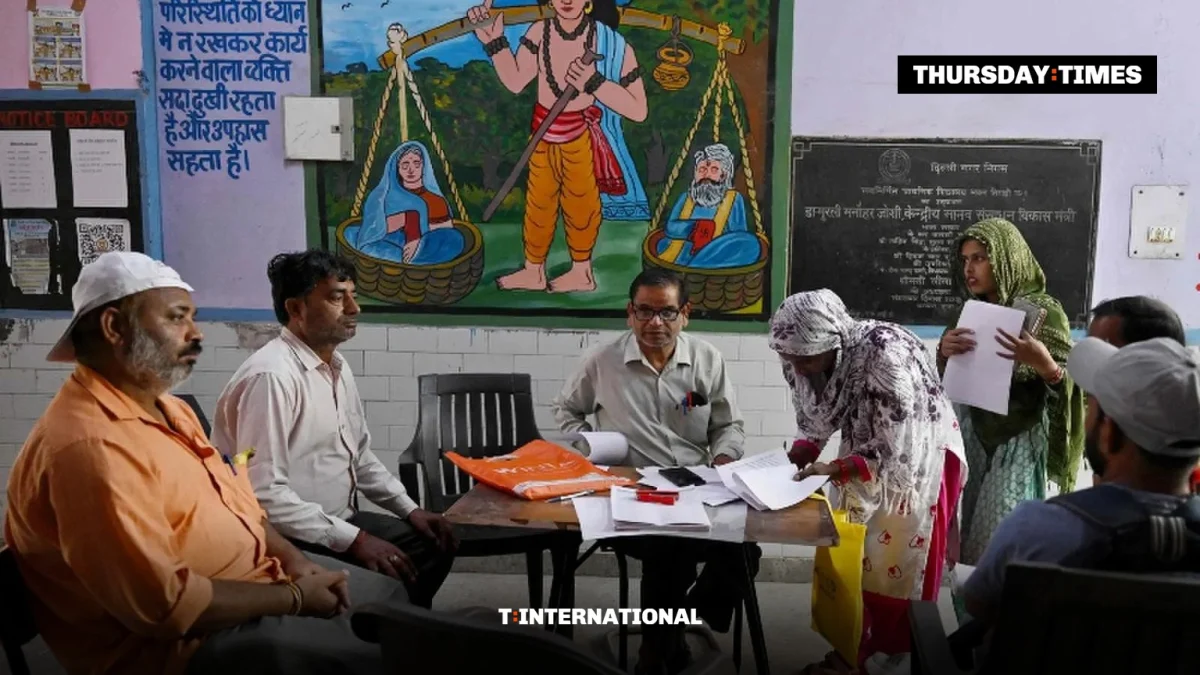
NEW DELHI (The Thursday Times) — Millions of Indians are scrambling to prove they still have the right to vote as the Election Commission of India carries out the biggest overhaul of voter rolls in the country’s history, with critics warning that the poor, women and Muslims are bearing the brunt, AFP reported on Wednesday.
Under the Special Intensive Revision (SIR), voters must link themselves, directly or through a parent or grandparent, to the electoral rolls of 2002-03, the last comparable review. More than 133 million names have been cut from the rolls so far, including 28 million listed as dead, according to figures cited by Indian media and by opposition parties in court filings.
In Delhi alone, the draft roll published on August 31 dropped about 4.7 million of the capital’s 14.5 million voters. The commission said most had shifted or could not be found, while about 282,000 had died and 141,000 were registered in more than one place.
The commission, a constitutional body, denies wrongdoing and says the revision complies with the law. Prime Minister Narendra Modi’s Bharatiya Janata Party (BJP) strongly backs it, and has long alleged that undocumented migrants from Bangladesh, particularly Muslims, have fraudulently found their way onto the rolls. Protesters in New Delhi have demanded the resignation of the chief election commissioner, accusing the commission of reshaping the electorate in the BJP’s favour, and the opposition INDIA bloc has taken the commission to the Supreme Court.
The burden of proof
Critics say the exercise shifts the burden of proof from the state to the voter. Laddli Khatun, 39, who lives in a Delhi slum, was too young to vote in 2002-03 and must now show that a parent or grandparent was on those rolls. Her parents died when she was a baby.
Former election commissioner Ashok Lavasa told AFP that the commission had previously verified voters door to door, and that making people re-establish their eligibility after due process had never been the intention. “It was never that you asked people wholesale to establish their eligibility all over again,” he said.
Surajmukhi, who lost her Delhi home in an eviction drive, was removed from the draft rolls and marked “untraceable”. She was never enrolled in 2002 and her parents are dead, though officials registered her as a voter afterwards. Mukesh Khanna, a booth-level officer in a Delhi suburb home to many working-class migrants, said tracing people to the 2002 lists was hard for those who were not educated or comfortable with technology.
Who gets flagged
Automated systems have flagged millions of voters for further checks over “logical discrepancies”, such as mismatched names or inconsistent family details. An analysis by The Hindu newspaper found that Muslims, who are 13.6 per cent of Delhi’s electors, made up 20.3 per cent of the 1.93 million voters flagged in the capital. The Kolkata-based Sabar Institute found an even wider gap in West Bengal.
Shahida, 42, a street cleaner, received a notice because the software judged the age gap between her and her mother suspicious; she pointed out that child marriage was common among the poor at the time. Aslam, 24, a national rugby player and actor who uses one name, was flagged because six other people were linked to his late father. A Muslim with six siblings, he told AFP: “It is clearly targeted against voters who don’t vote for the BJP.”
Transparency activist Anjali Bhardwaj said women, minorities, the marginalised and the poorest were hit hardest, because they struggle most to produce the documents demanded of them.
Fear of what comes next
India’s Supreme Court has said that being left off the rolls does not establish that a person is a foreign national. But Indian media have reported cases in West Bengal of excluded voters being accused of being Bangladeshi migrants, detained and in some cases pushed across the border. Khatun fears she could face the same fate.∎