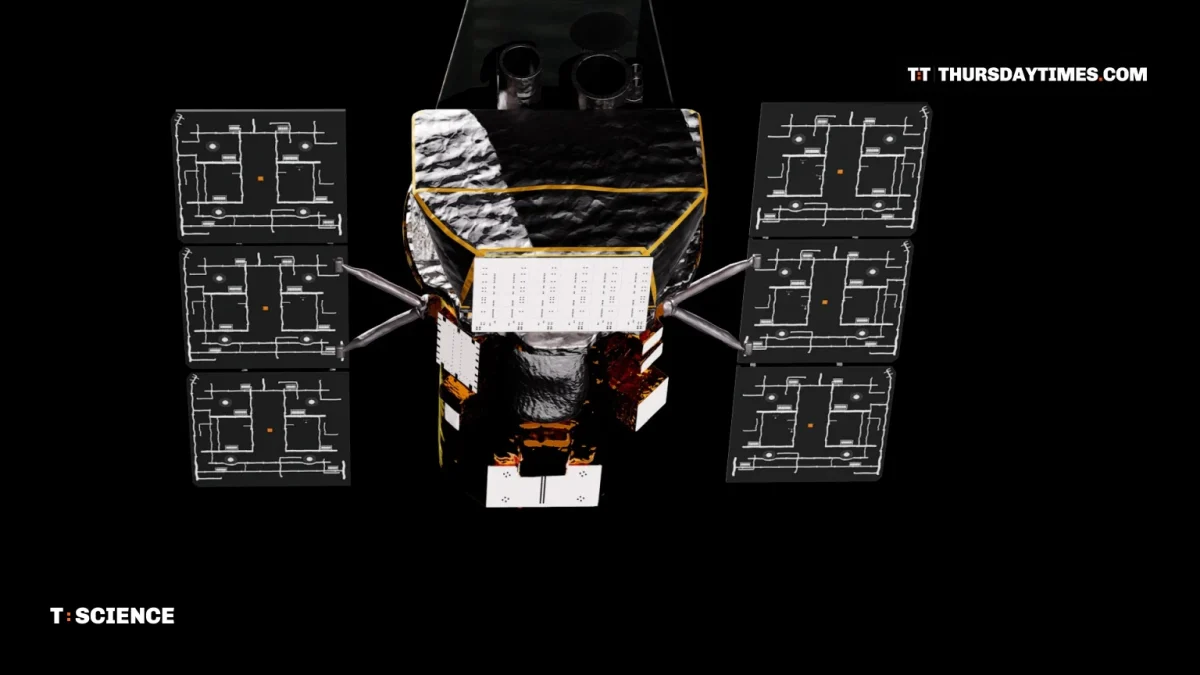
WASHINGTON (The Thursday Times) — NASA’s Neil Gehrels Swift Observatory, which spent more than two decades tracking the most powerful explosions in the universe, is expected to fall back to Earth around Friday after a commercial mission to rescue it failed.
NASA announced on October 23 that Swift’s science mission had ended, because the spacecraft had sunk below 275 kilometres, where atmospheric drag stopped its telescopes from holding steady on their targets. The 1,500-kilogram observatory has no engine of its own to climb back up, and the re-entry will be uncontrolled. It is not yet known exactly when or where it will come down, and reports put the projected date at about November 6.
A robotic spacecraft built by Arizona-based Katalyst Space was meant to dock with Swift and lift it to a higher orbit, but NASA and the company said in August that the plan had been dropped because of an attitude control problem on the rescue craft.
Most of Swift is expected to burn up in the atmosphere, although experts say dense parts of its telescopes may survive. They do not expect it to pose a significant danger to people on the ground.
Launched in November 2004, Swift was built to catch gamma-ray bursts, swinging quickly towards each new explosion to study it before it faded. It observed more than 2,000 of them, and NASA says it leaves behind a legacy of major discoveries in high-energy astrophysics.