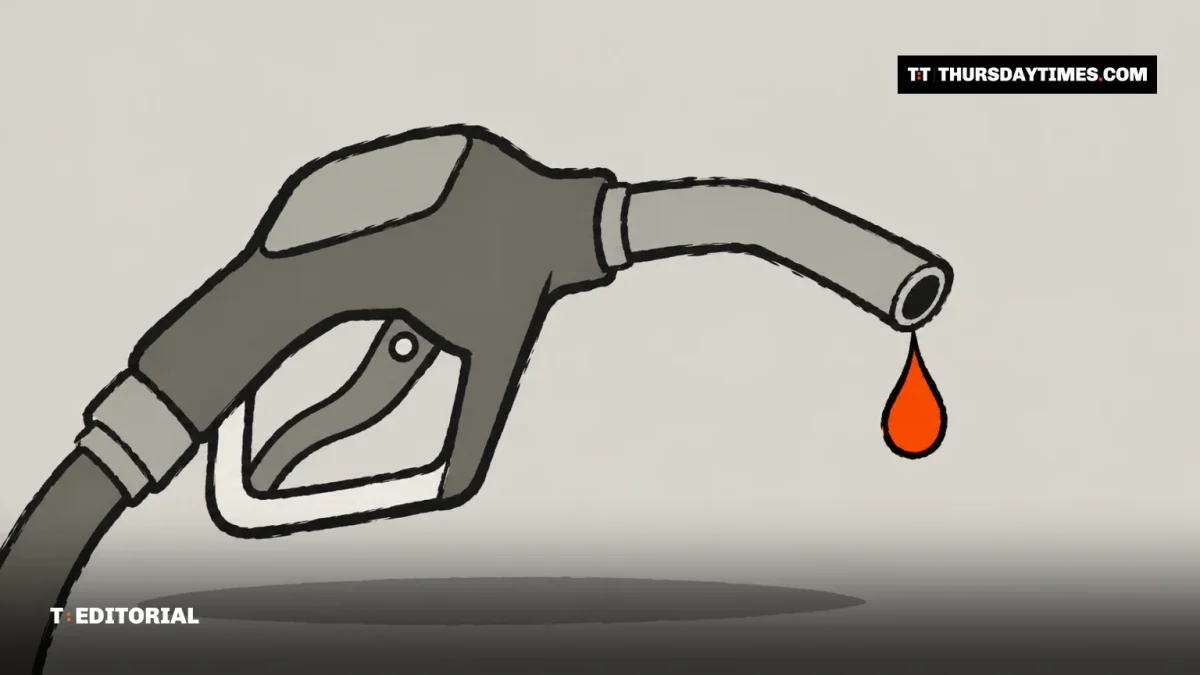
Oil fell by almost $9 a barrel on Monday, the pump price in Pakistan came down the next morning, and for a day the country could breathe. It should use the breath to fix what the war exposed, because a good day in the oil market is not an energy policy.
The relief is real, and it is welcome. Brent crude settled at $104.77 on Monday, down more than 7 per cent, after US Vice President JD Vance spoke of “some progress” with Iran and Qatari mediators returned to Tehran. Pakistan’s regulator cut petrol by Rs3.40 a litre to Rs374.51 and diesel by Rs7.76 to Rs395.20 from Tuesday. Inflation, at 9.6 per cent in October, is off its September level of 10.3 per cent.
None of that should be mistaken for the end of anything. A barrel at $104 is still an expensive barrel. A litre of petrol at Rs374 still eats a working family’s week. And markets that fall on hope can rise on disappointment by the following Monday, as anyone who remembers the memorandum of understanding signed in June, and dead by August, will know.
“The price came down because of a sentence in Washington. It can go back up because of another one.”
That is the first lesson of this year, and it is a humbling one. The biggest single influence on Pakistani household budgets in 2026 has been a narrow strip of water that no Pakistani official controls, and a conversation between other governments about whether ships may pass through it.
What eight months have cost
Look at what the war has already done. Between March and July this year, Pakistan spent somewhere between $7.7 billion and $7.9 billion on petroleum imports, roughly a fifth more than the $6.6 billion it spent in the same months of 2025. Officials have long worked with a rule of thumb that every $10 on the price of a barrel adds between $1.5 billion and $2 billion to the current account deficit. For a country that has only recently steadied its reserves, those are not rounding errors.
Petroleum imports, March to July
Five months of the war. The 2026 figure is the middle of the reported range of $7.7bn to $7.9bn.
Then there is the bill that never appears at the pump. The petroleum minister said on Monday that a very large crude carrier, once available for a few hundred thousand dollars, can now rarely be had for even a million. Insurance has risen many times over. The premium on refined product, $5 a barrel before the crisis, was capped at $20. Each of those costs ends up in a fuel price, an electricity tariff, a freight charge and, eventually, a bag of flour.
Gas is the quieter half of the story. Some Pakistani buyers have been told there will be no Qatari liquefied natural gas until the end of December, under a force majeureA contract clause that excuses a supplier from delivering because of events beyond its control, such as a war. notice that keeps being extended, just as winter demand arrives. QatarEnergy has made a final offer to reprice Pakistan’s long-term contracts at 11.96 per cent of Brent, for fewer cargoes. Whatever the merits of that offer, a country should not have to weigh it with its back to the wall.
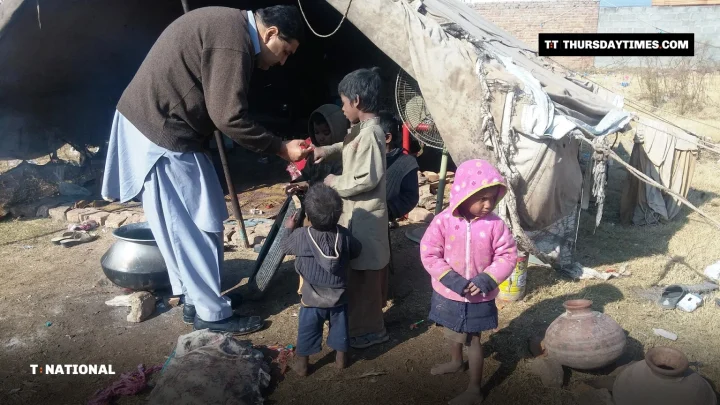
The prices have reached people who are already stretched. Inflation averaged 10.05 per cent in the first four months of this financial year, against 4.79 per cent in the same months last year. Analysts expect it to average above 9 per cent for the year if oil stays between $100 and $110, which is where it still sits today.
Headline inflation, year on year
Source: Pakistan Bureau of Statistics.
Credit where it is due
The government deserves fair credit for how it has handled the emergency. Ministers say November’s supplies are fully covered and no shortage is coming, and so far that has held. More than 15 million people have benefited from the prime minister’s fuel relief package, with Rs27 billion paid out to motorcyclists, rickshaw owners and drivers of small cars. That is targeted help, the kind this newspaper would like to see more of. Stopping a Rs15 rise in petrol last week spared millions of people a further blow.
Pakistan has also done something far harder than managing a price. It has been a central go-between in this war, with Field Marshal Asim Munir travelling to Tehran several times, and with Islamabad and Doha together helping to broker the June memorandum. Few countries can talk to Washington, Tehran and the Gulf in the same week. Pakistan can, and if the talks succeed the region will owe it a debt.
But diplomacy cannot be the energy plan, however skilled the diplomats. A mediator does not get a discount at the Strait of Hormuz.
“A mediator does not get a discount at the Strait of Hormuz.”
What to do with the breathing space
If there is a deal, the temptation will be to declare victory and move on. That is exactly what happened after the last oil shock, and the one before it. This time the state should treat the reprieve as a deadline, and spend it on four things.
The first is storage. Pakistan has no LNG storage at all, which leaves its supply entirely at the mercy of import schedules and world prices. A US-backed consortium is now seeking to build a terminal with storage at Port Qasim, and a pipeline upcountry, in a project worth up to $4.4 billion. It should be judged hard on its terms, because the last frontrunner for such a project, a venture of the Lucky Group and QatarEnergy, walked away citing unresolved policy and fiscal issues. That complaint should worry Islamabad more than any tanker rate. Nobody builds a tank in a country whose rules may change before it is full. The same logic applies to oil: a serious strategic reserve, built when prices fall and drawn down when they spike, is the cheapest insurance on offer.
The second is a rule for prices. Last week’s relief came with a load of about Rs15 billion a month placed on the refineries, with the minister arguing they had earned more in three months than in years. He may well be right about their profits. But a refinery upgrade is a decade-long bet, and investors watch closely when a burden is moved by news conference. If the state wants to hold a price, it should say how, for how long, and who pays, in a formula published in advance. Discipline has its own value. Relief that arrives by surprise can be taken away by surprise.
The third is the petroleum levyA fixed charge the government adds to each litre of fuel. It goes to the federal budget.. It raised Rs1.342 trillion in the ten months to April, and the target for this financial year, agreed with the International Monetary Fund, is Rs1.73 trillion. It is easy to see why finance ministers love it: it is simple, it cannot be evaded, and it pays the bills. It is also a tax on the man on the motorcycle, charged at the same rate as the man in the Land Cruiser. As long as the budget leans on fuel, every oil shock lands twice. The way out is the unglamorous one of taxing those who currently pay little or nothing, so that a future government has room to cut the levy when the world turns against us.
The numbers to remember
The fourth is the door Pakistanis have already opened for themselves. Without much help from any ministry, households and businesses have bought solar panels on a scale that surprised everyone, including the power companies, importing about 17 gigawatts of them in 2024 alone. Every rooftop is a small retreat from the Strait of Hormuz. The state’s instinct has too often been to treat this as a threat to the grid’s finances, and those finances do need attention. The better instinct would be to treat it as the largest energy-security programme the country has ever had, and to extend the same thinking to transport, where the motorcycles that receive fuel relief today could be running on electricity tomorrow. A subsidy for petrol ends the day the money runs out. An electric motorcycle goes on saving imports for a decade.
The test is what happens if it works
It is entirely possible that the talks fail. Hours after Monday’s fall in oil, US officials said American forces had struck Iran’s Qeshm Island, in the latest of several quiet, limited strikes, and that Gulf states had been told to prepare for a short, intense operation after the midterms. Israel’s prime minister is said to be pushing for more strikes, the Iranian foreign minister says everything depends on Washington’s “political rationality”, and tankers were reported on fire in the strait as recently as this week. If oil goes back to $120, nobody will need persuading that Pakistan has an energy problem.
The real test is the opposite case. Suppose the strait reopens in two days, as Iran says it could. Suppose oil drops to $80, the rupee firms, inflation falls and the fuel relief package quietly ends. That is the moment at which every ministry will find something more urgent to do, and storage, reserves, pricing rules and the levy will slide back into next year’s file. Eight months of war will have taught us nothing.
Pakistan has earned a place in the room where this war may end. It deserves the same seriousness at home. Monday’s fall in oil was a gift from events far away. What the country does with it is the only part of this story that is entirely in its own hands.