From now on, every tin of formula milk sold in Pakistan must tell the parent holding it, in Urdu and in English, that mother’s milk is best for babies. The Drug Regulatory Authority of Pakistan has the right instinct, and its order deserves support. But a slogan on a tin will change far less than it should unless the state finally enforces the law it already has.
The order, which follows directions from the Senate Standing Committee on Health, covers locally made and imported formula alike, including the so-called growing-up milks sold for children aged one to three. Manufacturers must also explain the benefits of breastfeeding on the information panel of every pack. It changes what is printed on the tin. It does not restrict what is sold, where it is sold or how it is pushed, and no deadline for compliance has been made public.
That gap matters, because the tin is the last place the decision is made, not the first. By the time a parent is reading the side of a formula pack in a pharmacy aisle, the choice has usually been shaped somewhere else: in a labour ward where the newborn was not put to the breast in the first hour, in a clinic where a free sample found its way into a tired mother’s bag, in an office with no room to express milk and no leave long enough to make breastfeeding possible. A warning on the label reaches the parent at the till. Almost everything that matters has happened before.
“A warning on the label reaches the parent at the till. Almost everything that matters has happened before.”
What the numbers say
Pakistan has made progress, slowly. The 2018 National Nutrition Survey found that 48.4 per cent of babies under six months were fed only breast milk, up from 37.7 per cent in 2011, according to UNICEF. The share of newborns put to the breast within an hour of birth rose from 40 per cent to 45.8 per cent over the same period. These are real gains, and the health workers, doctors and mothers behind them deserve credit.
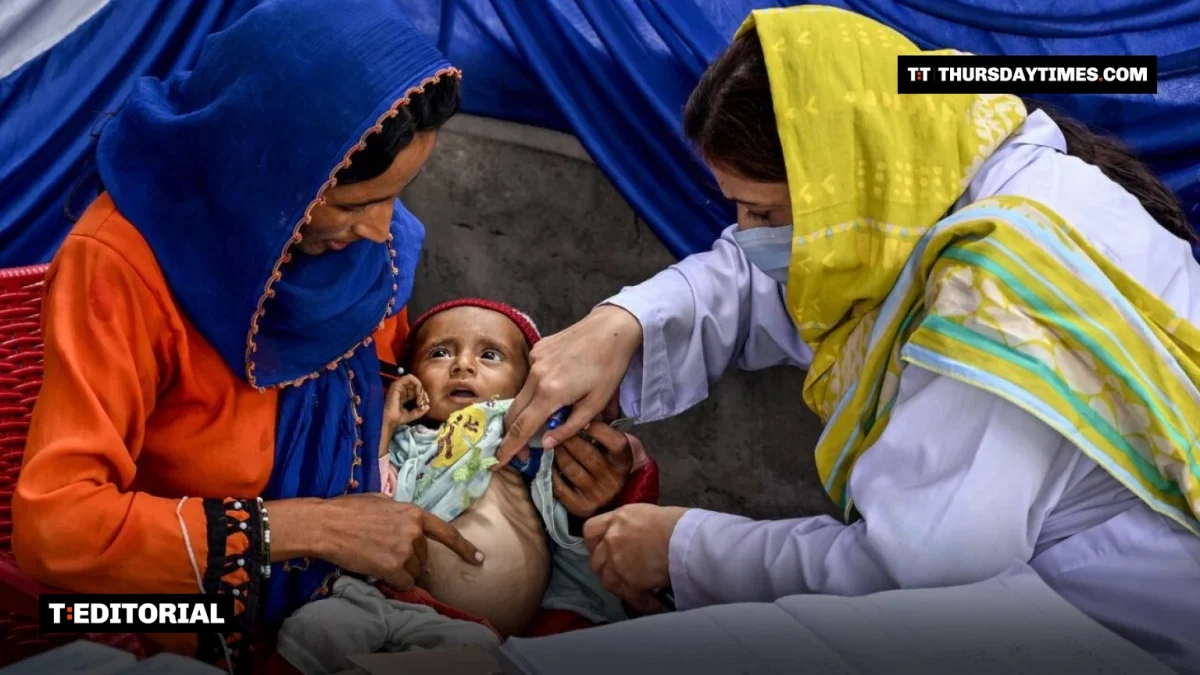
They also mean that more than half of Pakistan’s infants are not getting what paediatricians say they need in their first six months, and that most newborns miss the first hour, when the first thick milk, colostrumThe first milk a mother produces after birth. It is rich in antibodies and is sometimes called a baby’s first vaccine., does its most important work.
Breastfeeding in Pakistan, 2011 and 2018
Source: National Nutrition Survey 2018, as reported by UNICEF. Bars are drawn to a scale of 100 per cent.
The national figure also hides wide gaps. UNICEF reported exclusive breastfeeding above 50 per cent in Sindh, Khyber Pakhtunkhwa and Gilgit-Baltistan, but only 42 to 44 per cent in Punjab, Balochistan and Azad Jammu and Kashmir. Breastfeeding within the first hour ranged from 61.1 per cent in Khyber Pakhtunkhwa to just 20.1 per cent in Gilgit-Baltistan. Gaps that wide suggest the problem is not culture or poverty alone. It is practice: what happens in the labour ward in the first minutes of a child’s life, and whether anyone is there to help a new mother get started.
The consequences are not abstract. Roughly 38 per cent of Pakistani children under five are stuntedToo short for their age, a sign of long-term undernutrition that can affect growth and learning for life., according to official figures. Breastfeeding alone will not fix that, but it is the cheapest protection a child will ever receive, and the first one. UNICEF estimates that better breastfeeding worldwide could prevent 823,000 deaths of children under five every year.
The cost of getting the start wrong
Sources: official Pakistan figures for children under five; UNICEF.
Dr Khalid Shafi, secretary-general of the Pakistan Pediatric Association, has put the medical advice simply: a newborn should get mother’s milk within the first hour of birth, and nothing but mother’s milk for the first six months. Nobody seriously disputes that. The argument is about why so many families cannot follow it, and whose interests are served when they do not.
The law Pakistan already has
None of this is new to the state. Pakistan voted for the World Health Organization’s International CodeThe International Code of Marketing of Breast-milk Substitutes, adopted by the World Health Assembly in 1981. It bars the promotion of formula to the public and to health workers. on the marketing of breast-milk substitutes in 1981. In 2002 it went further than many countries and wrote the Code into national law, through the Protection of Breast-feeding and Child Nutrition Ordinance, followed by rules in 2009. Punjab passed its own version in 2012.
On paper, then, Pakistan already bans the promotion of formula as a substitute for breast milk. It bars companies from giving gifts and free samples to health workers. It requires health facilities to support breastfeeding. It backs these rules with fines and prison terms. Few developing countries can point to a stronger statute.
On paper. For years the ordinance produced barely a complaint, let alone a conviction, while promotion carried on through the very channels it was meant to close: sponsored seminars, branded material in clinics, and advice from health workers who should never have been on a company’s mailing list. Parents are told that a particular tin will make a baby taller, cleverer or calmer, and too often the advice comes from someone in a white coat. A law that nobody enforces is not a protection. It is a press release.
“A law that nobody enforces is not a protection. It is a press release.”
The regulator’s order is a useful reminder that the state has the power to act on formula companies when it chooses to. The question is whether it will use the far larger powers it already has.
Where the order falls short
“A clear warning will change what parents buy.”
At the margins, perhaps. Health warnings work best when they are backed by restrictions on the marketing they are competing with. A tin can carry a sentence about breast milk on one panel and a smiling, chubby baby, a list of added nutrients and a promise of brain development on the other three. Unless the claims and the imagery are policed as firmly as the warning is required, the warning will be the smallest thing on the pack.
“Growing-up milks are a different product.”
The regulator is right not to accept that. World Health Organization guidance issued in 2016 says milks marketed for children up to three years old should be treated as breast-milk substitutes, because they are so often advertised in ways that pull mothers away from breastfeeding. The 2002 ordinance was written before that guidance. It should be updated to say so in plain words, so that no company can argue that a toddler milk sits outside the law.
“Labels are enough; the rest is the family’s choice.”
It is the family’s choice, and that is exactly why the information reaching families must be honest. A choice shaped by a sales representative’s gift to a clinic, or forced by a job that offers no time to feed a baby, is not much of a choice. Protecting it means regulating the marketing and changing the conditions mothers live and work in, not just the packaging.
What would actually work
The government does not need a new law to make a difference. It needs to use the one it has, and to fix the places where the decision really gets made.
None of this is expensive by the standards of what poor nutrition costs. A stunted child carries the cost of a bad start through school, into work and into the next generation. The cheapest point at which to intervene is the first hour of life, and the second cheapest is the first six months. Everything after that costs more.
Target the marketing, never the mothers
There is one more thing this debate must get right. Some mothers cannot breastfeed, for medical reasons or because their circumstances make it impossible. Some babies need formula, and for them it is a safe and necessary food. Nothing in the regulator’s order, or in this newspaper’s argument, should make a single parent feel ashamed of feeding a child. The target is the marketing, not the mothers. If your baby is on formula, speak to a doctor before you change anything.
“The target is the marketing, not the mothers.”
A label is a start. It costs the government nothing and it tells the truth, which is more than much of the advertising around it has done. But a country that already passed one of the developing world’s strongest laws on formula marketing, and then let it gather dust for more than two decades, should not mistake a sentence on a tin for a policy. Enforce the law. Fix the labour wards. Give working mothers time and space. Then the warning on the tin will be backed by a country that means it.