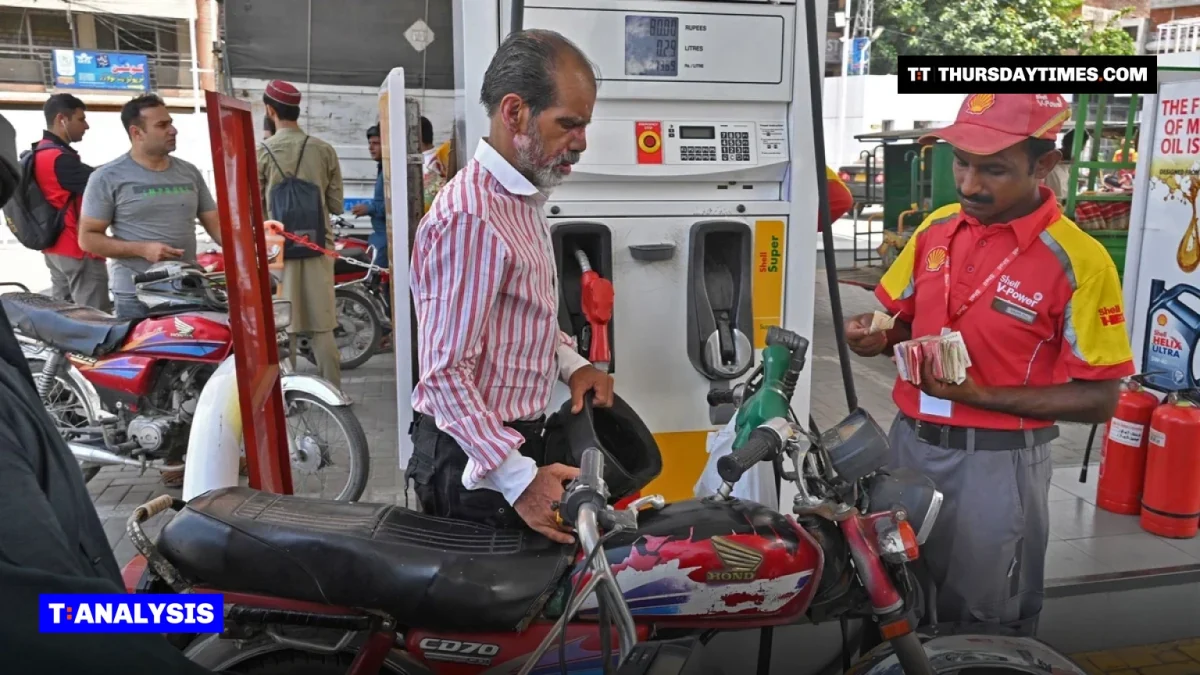
ISLAMABAD (The Thursday Times) — Petrol fell to Rs338 a litre on Wednesday, the second cut in less than a week, and diesel to Rs371. The more telling number sits inside the price. Rs80 of every litre of petrol and diesel sold in Pakistan is petroleum levy, a charge that goes straight to the federal government. Jamaat-e-Islami wants it abolished and has called a rally at Minar-e-Pakistan in Lahore on November 29 to press the demand. The government says it cannot simply switch the levy off, because the budget and the IMF programme are built around it. Both sides now speak of a phased reduction. What that could look like depends on three things: what the levy pays for, what cutting it would cost, and how much of the pump price Pakistan controls at all.
What the levy is
The petroleum levy is a fixed charge per litre, set by the federal government and collected on fuel before it reaches the pump. It is now Rs80 a litre on both petrol and high-speed diesel. On top of it sits a Climate Support LevyA separate charge of Rs5 a litre on fuel, also called the carbon levy, introduced in the 2025-26 budget. of Rs5 a litre, and customs duty on imported fuel. Planning Minister Ahsan Iqbal has put the total of these charges at close to Rs106 a litre.
Unlike most taxes, the levy is not shared with the provinces. It sits outside the divisible poolThe pot of federal taxes that is split between the centre and the provinces under the National Finance Commission award. The petroleum levy is outside it., so every rupee stays with the federal government. That makes it one of the most valuable lines in the federal budget, and one of the most dependable, because it is collected on every litre sold whatever the world price of oil.
What sits inside a litre of petrol
The petroleum levy alone is about 24 per cent of the petrol price. Sources: Oil and Gas Regulatory Authority price notification, Planning Ministry.
What it pays for
The government expects the levy to raise Rs1.676 trillion in the 2026-27 fiscal year. That is Rs109 billion more than it actually collected last year, when receipts of Rs1.567 trillion beat the original budget estimate of Rs1.468 trillion by about Rs99 billion. In July and August, the first two months of this year, the levy brought in Rs220 billion, about 13.1 per cent of the annual target, according to official figures.
The other two fuel charges are smaller. The Climate Support Levy raised Rs27.5 billion in the same two months, already 55 per cent of its Rs50 billion annual target, and a levy that funds the adoption of new energy vehicles raised Rs7.2 billion. Together the three fuel levies brought in Rs254.7 billion against a full-year target of Rs1.748 trillion.
The levy in four numbers
Sources: Finance Ministry fiscal data; Petroleum Minister’s statement to the National Assembly.
Over a longer stretch the levy has become a pillar of federal revenue. Petroleum Minister Ali Pervaiz Malik told the National Assembly that it had raised Rs4.4 trillion since 2022-23, which was Rs227 billion more than the government’s own targets over those four years. He also told the House that the levy was part of the targets agreed with the International Monetary Fund under the $7 billion Extended Fund FacilityThe IMF loan programme Pakistan is in. Money is released in stages after reviews of whether the government has met agreed targets on revenue, spending, and reforms..
That is the heart of the government’s case. The programme sets targets for revenue and for the budget balance, and each review checks them. Money the levy does not raise has to come from somewhere else: other taxes, lower spending, or more borrowing. Pakistan’s tax take is still low for an economy of its size, which is why the levy has carried so much of the load. Jamaat-e-Islami’s deputy chief, Liaquat Baloch, puts the same point the other way round. The levy, he argues, shifts the burden of the Federal Board of Revenue’s shortfalls onto everyone who buys fuel.
“Money the levy does not raise has to come from somewhere else.”
What a cut would cost
The arithmetic is simple. At Rs80 a litre, each Rs10 cut gives up an eighth of the levy’s take. Against this year’s target, that is roughly Rs210 billion a year, if fuel sales held steady. Abolishing the levy outright would remove the whole Rs1.676 trillion, roughly five times what the fuel relief scheme would cost over a full year.
The two sides also disagree about the scale of what is collected and what is given back. Jamaat-e-Islami chief Hafiz Naeemur Rehman says the government takes about Rs150 billion a month through the levy and returns only Rs26 billion to Rs30 billion in relief. The official figures for July and August work out at about Rs110 billion a month. The relief figure is close to the government’s own: the petroleum minister said in September that the fuel relief scheme would cost Rs25 billion to Rs30 billion a month.
The government’s position has moved, but not far. Ahsan Iqbal ruled out an immediate cut under political pressure and said proposals for a gradual decrease would be considered for the next budget. “Pakistan’s current macroeconomic situation, which we have managed with great difficulty, cannot afford a repetition of the mistakes of the past,” he said. A committee of Deputy Prime Minister Ishaq Dar, Iqbal, and Rana Sanaullah has met the party’s representatives about ten times. After the latest round, Baloch said the two sides had agreed the broad outline of a draft, and that the government would share a framework for reducing the levy gradually after consulting the IMF.
What sets the pump price
The levy is the part of the fuel price the government controls. Most of the rest is set abroad. Pakistan imports most of its oil, so the pump price follows the world price of crude and refined fuel, the rupee’s exchange rate, freight and insurance, and the margins of refiners, oil marketing companies, and dealers. Officials say the pricing formula uses a rolling weekly average of import costs, so a fall in world prices takes about a week to reach the pump.
This year has shown how much that matters. Petrol cost Rs266.17 a litre at the end of February, before the war with Iran sent crude soaring. It peaked at Rs458.41 in early April. Diesel, which runs the trucks, buses, and tractors that move most of the country’s goods, cost Rs280.86 before the war and was still above Rs400 at the end of October.
Pump prices this year, rupees per litre
Bars are scaled to the April petrol peak. Source: official price notifications.
The latest cuts track the world market. Brent crude, the international benchmark, fell to about $90 a barrel this week, its lowest since late August, as Washington played down the need for further military action against Iran. The rupee has helped too, holding steady at around 276 to the dollar. Gulf supply is recovering. Saudi Arabia pumped 10.56 million barrels a day in October, its highest since the war began, and the wider OPEC+ group raised output by about two million barrels a day.
But the single largest risk is still in the Gulf. Iran says the Strait of Hormuz will stay shut until the United States meets its conditions, and this week a tanker caught fire after hitting a mine there. If that disruption worsens, world prices could climb again within days, and the pump price with them.
The levy also does quieter work inside the formula. Since October 31 the government has frozen several cost components it allows local refineries for petrol at their March 7 levels, and takes the difference, Rs49.02 a litre, as petroleum levy. The four main refineries have written to the petroleum minister asking for the change to be withdrawn, arguing that it ignores higher crude, freight, and insurance costs and threatens their upgrade plans. The dispute shows how the levy works as the system’s shock absorber. The only question is which way it absorbs.
“The levy is the part of the fuel price the government controls. Most of the rest is set abroad.”
The options in between
Between abolishing the levy and leaving it untouched there is a range of choices. Each has a cost, and each has been raised in some form by one side or the other.
A phased cut on a timetable
The government has floated a gradual reduction from the next budget. A published schedule, so many rupees a litre each quarter, would give consumers certainty and give the Finance Ministry time to agree replacement revenue with the IMF. Its weakness is timing: it offers little before next summer, and Jamaat-e-Islami wants relief now.
A levy that moves against the oil price
The levy could be cut when world prices spike and restored as they fall, inside a set band. Pump prices would swing less and revenue would even out over a year. The risk is a long spell of high prices, when the levy would stay low and the budget would fall short.
Wider targeted relief
The Prime Minister’s Fuel Relief Scheme gives motorcycles, rickshaws, and cars of up to 800cc a Rs100-a-litre discount on a capped amount of petrol. By November 4 more than 15.5 million people had registered and Rs28.6 billion had been paid out. Jamaat-e-Islami wants it extended to cars of up to 1,300cc, farmers’ tractors, and public transport. That would aim money at those who need it most, at a higher cost and with more room for abuse.
Charging more at the top
The party has proposed higher levies and import duties on vehicles above 1,800cc. The government has already gone some way down this road: in March it raised the levy on high-octane fuel, used mainly in larger cars, to Rs300 a litre. Shifting more of the burden onto big engines would protect revenue while easing it for most drivers, though it raises less than a broad levy.
Clear pass-through rules
Much of the anger is about trust: the sense that prices rise at once and fall slowly. A plain weekly breakdown of each price, from import cost and exchange rate to margins and levy, together with a firm rule on how quickly falls in world prices reach the pump, would cost little and answer much of the suspicion.
What to watch
The next step is political. Baloch said another round of talks was expected this week, with a final decision to come at a meeting between Prime Minister Shehbaz Sharif and Hafiz Naeemur Rehman. Jamaat-e-Islami will hold a gathering in Quetta on November 22 before the Lahore rally on November 29, and has warned that it could revive the march on Islamabad it postponed in September if the talks fail.
The second is the IMF. Any change to the levy will have to fit the programme, and the government has said it will consult the Fund before it shares a framework. A plan that pairs a gradual cut with new revenue elsewhere stands a far better chance than a sudden one.
The third is the oil market. Falling world prices have done more for the pump price than any decision in Islamabad: petrol is now about Rs120 a litre cheaper than at its April peak. A lasting settlement in the Gulf would give the government room to ease the levy without losing face or revenue. Renewed fighting would make every rupee of it harder to give up.
The levy is neither the villain its critics describe nor the fixed point the budget treats it as. It is a choice about who pays for the state, and how. Both sides now accept that it should come down over time. The argument that remains is about how fast, who benefits first, and what replaces the money.