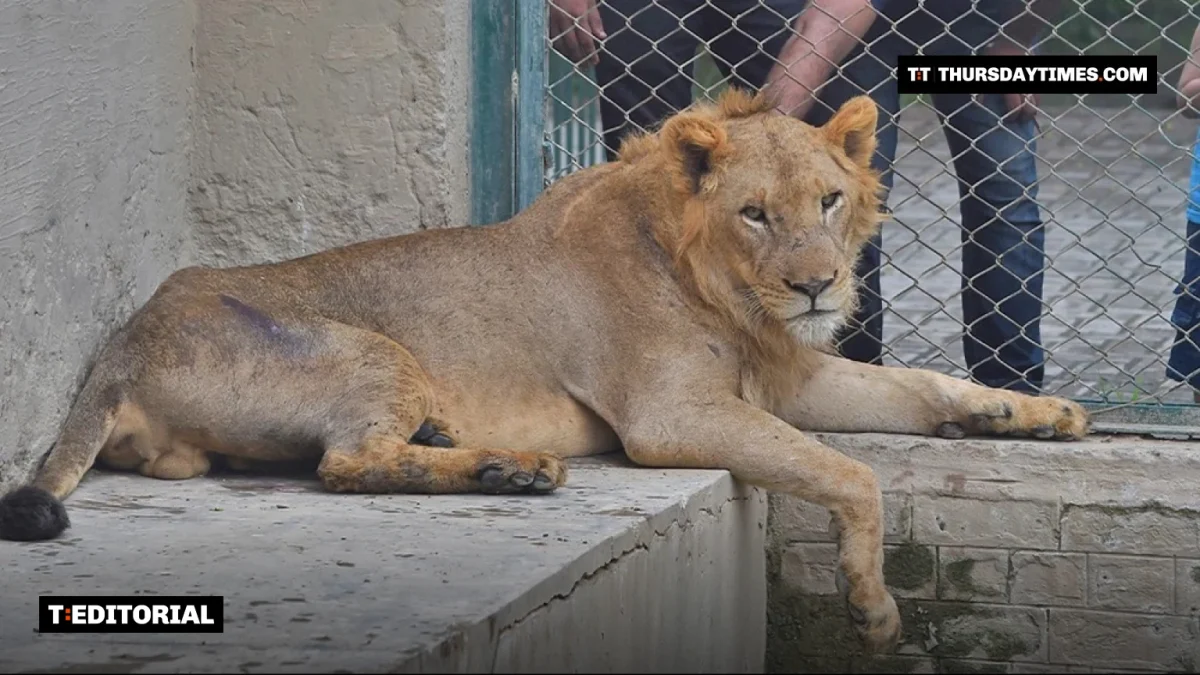
A 19-year-old farm worker died this week because someone wanted a video. Police say a lioness kept at a private farmhouse on the outskirts of Lahore got out of control while a TikToker was there to film it, and that the young man’s wounds were first passed off as a dog bite. The owner and the TikToker have been arrested, and the animal is now with the Punjab Wildlife Department. Punjab has rules for keeping lions. It wrote tougher ones after the last attack, and the one before that. What it has not yet done is make anyone believe those rules will be enforced before the next person is hurt.
The facts, as Lahore police have given them, are stark. The attack happened on Wednesday at a farmhouse in Kahna. The worker was badly injured and died during treatment at a private hospital. Police said there had been an attempt to hide what happened, and that they were now examining the permit for keeping the animal, the safety arrangements at the farm, and possible negligence. The deputy inspector general of operations, Faisal Kamran, put the lesson in one line that the provincial government should adopt as policy.
“A passion for TikTok cannot be worth more than a human life.”
He is right. But a police chief’s anger after a death is not the same thing as a system that prevents one. Punjab has heard this kind of promise before.
A pattern, not an accident
In January 2025, a man was injured by a pet lion in Lahore while filming a video. In July 2025, a lion kept without a licence in a house in Lahore leapt over a boundary wall and attacked a woman and two children, aged five and seven, in the street. The province launched a crackdown that week. Wildlife officials confiscated 18 big cats, raided 38 lion and tiger breeding farms, and arrested eight people. The department’s director general said there were 584 lions and tigers in homes and breeding farms across Punjab.
Six months later, in January this year, an eight-year-old boy lost his arm to a lion at a breeding farm in Lahore’s Sabzazar area. Police said that farm was licensed by the Wildlife Department. They also said the people who brought him to hospital first told doctors his hand had been caught in a machine. Just two days before that, a young girl had been hurt in another lion attack, and police captured around 16 lions in the operations that followed. In September, lions were still being made to perform tricks at circus shows at fairs in Sialkot district and other towns.
And now Kahna. Twice in ten months, by the police’s own account, the people responsible tried to disguise a lion attack as something else: a machine, a dog. That detail matters more than any other. It tells us that owners understand exactly how much trouble they are in, and that they expect to be able to talk their way out of it.
Punjab’s big cats, by the official count
Figures given by the Punjab Wildlife and Parks Department in July 2025.
The rules are already on paper
The striking thing is how much of the answer Punjab has already written down. Under the province’s rules, a lion or tiger can be kept only with a licence, in a cage of a required size, and under set operating procedures. Owners must pay a one-time registration fee of Rs50,000 for each animal. A farm may keep no more than 10 big cats, from no more than two species. The animals must be kept outside city limits, and the worst offenders face up to seven years in prison. Amendments in 2025 tightened the conditions for keeping lions, tigers, pumas, and jaguars, and the law also bars keeping wild animals anywhere their safety, or the public’s, may be at risk.
Punjab has also built more of an enforcement machine than it had. The province says its Wildlife RangersPunjab’s uniformed wildlife enforcement force, which carries out raids, seizures, and rescues under the province’s wildlife law. The province says it now has 552 rangers. now number 552, and that it has opened new rescue centres and a modern wildlife hospital at the Safari Zoo in Lahore. Officials say further amendments to make the conditions stricter still have gone to the provincial cabinet.
So this is not a story about a missing law. It is a story about the distance between a rule and a farmhouse gate. A licence that is never checked is not regulation. It is a receipt.
Where enforcement breaks
The weak points are now well mapped. The first is the licence itself. The Sabzazar farm where a child lost his arm was licensed. That means inspection, not registration, is what has to change. A licence should describe exactly how many animals are held, in what enclosures, with what barriers between the animals and the people who feed and clean them, and an inspector should turn up, unannounced, to see whether that is still true.
The second is what happens after a seizure. In the crackdown that followed July 2025, several cases went to court, and in some of them animals were returned to their owners on the strength of court orders and an affidavitA written statement sworn to be true. In these cases, owners promised in writing to keep the animals at registered farms and out of urban areas. promising they would be kept at registered farms and out of towns. A promise on paper is a weak fence for an animal of that size and strength. Where a seizure is lawful, the animal should go to a properly run public facility, and the cost of its care should fall on the person who broke the rules.
The third is display. The demand for these animals is no longer only about breeding or private status. It is about content. Lions have been brought to weddings and filmed for social media, and the Kahna attack happened during a shoot. Punjab’s law already requires permission to display wild animals to the public. Filming a lion for an audience of millions is public display in every way that matters, and the province should say so plainly.
A licence that is never checked is not regulation. It is a receipt.
What Punjab should do now
The fifth point deserves more than a line. The person who dies in these stories is rarely the owner. In Kahna it was a young farm worker. At Sabzazar it was a child who wandered too close while playing. The people who feed, clean, and lead these animals are often poorly paid and poorly trained, and they have little power to refuse an order to get close for a video. A law that punishes owners after the fact but does nothing to protect the people they employ has its priorities the wrong way round.
The easy objections
Breeding farms are legal businesses
A crackdown only drives animals underground
This is a matter of personal freedom
The test is the next inspection
Punjab’s government has shown that it can move fast when an attack makes the news. It raided farms within days in July 2025, and it seized dozens of animals in January. The province has more rangers, better rescue facilities, and a stricter law than it had two years ago. The provincial government said last month that cruelty to animals would not be tolerated. That is a fair standard, and it should apply equally to the danger these animals pose to people.
What has been missing is the dull, unglamorous work that happens between headlines: the unannounced inspection, the seized animal that stays seized, the cover-up that is prosecuted, and the video that is never posted. A young man in Kahna paid for that gap with his life. The best way to honour him is to make sure the rules Punjab has already written are enforced every week, not just in the week after someone dies.