ISLAMABAD (The Thursday Times) — Nishat Group, one of Pakistan’s largest business groups, is willing to explore investing in a new port the federal government plans to build, the Ministry of Maritime Affairs said on Friday.
The group’s chairman, Mian Muhammad Mansha, told the Federal Minister for Maritime Affairs, Muhammad Junaid Anwar Chaudhry, at a meeting that the group was interested in the project, with a focus on logistics for export-oriented industries. No investment amount, financing structure, or agreement was announced.
The minister said greater private-sector participation was needed to bring in capital and modern technology and to expand the country’s port infrastructure. Another port, he said, would open new avenues for economic growth, create jobs, and strengthen Pakistan’s position as a regional trade and logistics hub.
He said the government was committed to a business-friendly environment and would facilitate domestic and foreign investors interested in the maritime sector.
Where the port could go
The government has not yet decided where the port would be built. In November 2025 the maritime ministry set up a committee, chaired by the minister, to identify sites for new deep-sea ports along the coast from Sir Creek to Jiwani. Its members include the Karachi Port Trust, the Port Qasim Authority, the Gwadar Port Authority, the Special Investment Facilitation Council, and the Sindh and Balochistan governments.
The committee is assessing three candidate locations on water depth, available land, environmental impact, road and rail links, and security. The ministry has not published the sites, a cost, or a timeline, but its long-term plan envisages three to four new ports.
Room at the existing ports
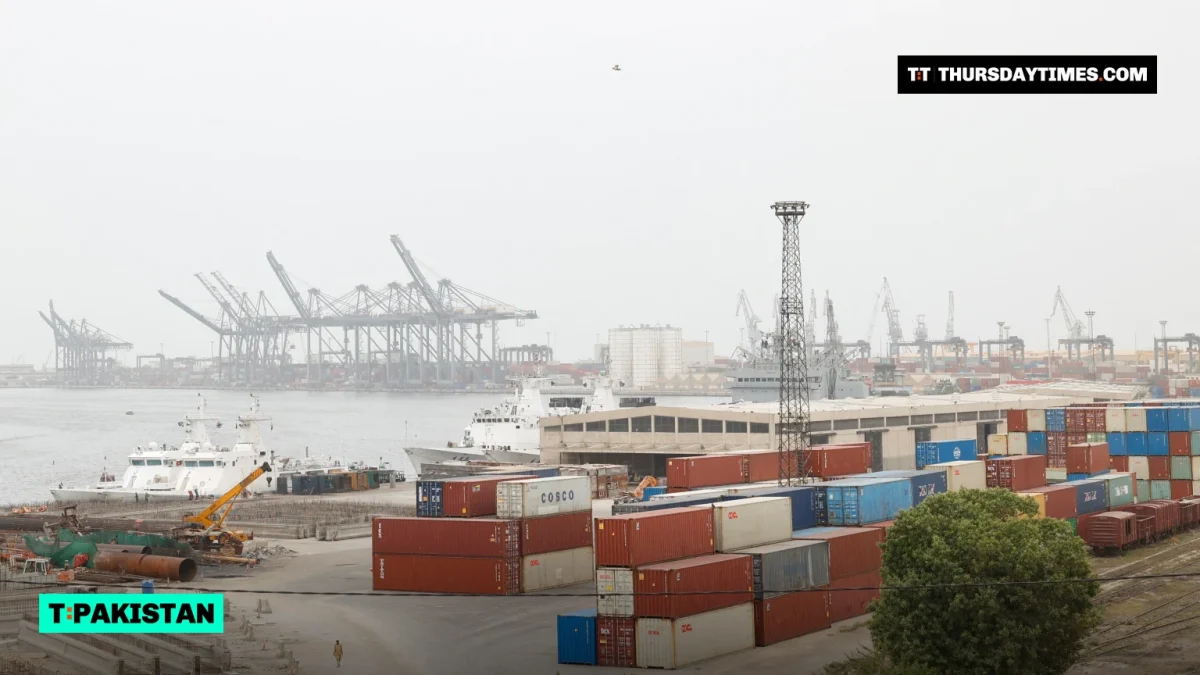
The case for a new port rests on future demand rather than present congestion. The ministry’s own figures put Port Qasim at about 65% of capacity, Karachi Port at about 52%, and Gwadar at 5% to 10%. It expects the three to fill up between 2035 and 2045, driven partly by transit trade with Afghanistan and Central Asia.
A World Bank forecast puts cargo through Karachi’s ports at about 211 million tonnes a year by 2039-40, more than double the roughly 93 million tonnes handled in 2019-20. Because a deep-sea port takes years to plan, finance, and connect by road and rail, sites for capacity needed in the late 2030s have to be chosen now.
Sindh is separately preparing a public-private partnership model to develop Keti Bandar into a deep-sea port. It is not clear whether Keti Bandar is among the federal committee’s candidate sites. Kuwait has separately agreed to use Pakistani storage and ports to re-export fuel.
Nishat’s interest fits its business. Its flagship, Nishat Mills, is among the country’s largest textile exporters, and the group’s holdings include MCB Bank, DG Khan Cement, Nishat Power, and Adamjee Insurance. In August it led a consortium bidding for the Faisalabad Electric Supply Company in the government’s sale of power distributors.
An expression of interest is not a commitment. A port would still need a concession, land, dredging, and financing with a payback measured in decades.