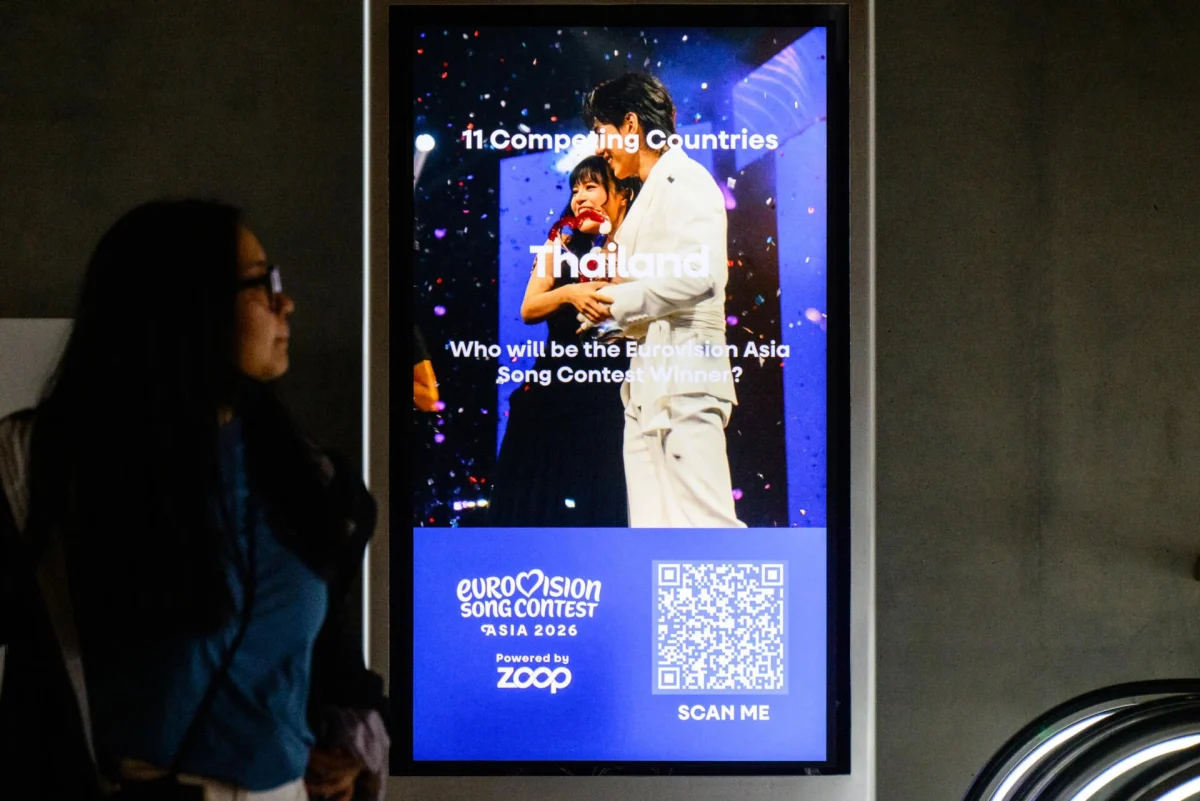
BANGKOK (The Thursday Times) — Eurovision, the song contest that has run in Europe for 70 years, holds its first Asian final in Bangkok on Saturday night, with singers from 11 countries competing for a crystal microphone trophy.
The Eurovision Song Contest Asia starts at 8.30pm local time (6.30pm in Pakistan) at the One Bangkok Forum and is expected to run for about two and a half hours. Presenters Cindy Bishop and Woody Milintachinda will host the show.
Host Thailand is joined by Malaysia, the Philippines, Vietnam, Cambodia, Laos, South Korea, Mongolia, Bangladesh, Nepal, and Bhutan. India, China, Japan, and Indonesia are not taking part, though talks are under way to bring them into a second edition next year. Pakistan is not competing.
Who is singing
Vietnam’s Tóc Tiên opens the show with “EM TIÊN”, and Malaysia’s Aina Abdul closes it with “Bluest Sky”. Thailand’s pop duo MANG x DAOU perform eighth with “Aroma”, followed by South Korea’s JUNHEE with the K-pop track “DEEP DIVE”.
South Asia has three entries. Bangladesh sends Beatmosphere with “Tumi Ele”, Nepal’s Pratik Himal Rai sings “Ananta Maya”, and Bhutan’s Nyendra, 24, performs “Lhayi Semo (The Angel)”. Nyendra had never left his country before the contest. “Nobody knows me,” he said, adding that he hoped to show audiences Bhutan’s culture, including through a handmade traditional outfit.
Mongolia’s Beck Munkhbayar, a trained economist who advises his country’s deputy prime minister on banking, said it was “very important for me to be here, to pay tribute to our ancestors on this big stage.” The Philippines is represented by 19-year-old Carmelle, whose song “Sobra-Sobra” is about women’s empowerment.
How the winner is chosen
As in Europe, national juries and the public each decide half of the result. The juries voted on Friday’s dress rehearsal, awarding the familiar 1 to 8, 10, and 12 points. The public vote is held only online, with no phone lines. Viewers in the 11 countries cannot vote for their own entry, and votes from the rest of the world are pooled into a single set of points.
Unlike the European contest, which is run by public broadcasters, the Asian edition is organised with private television networks, several of which picked singers who are already stars at home.
A bumpy road to Bangkok
An Asian Eurovision has been discussed for about two decades without getting off the ground. This year’s preparations have not been smooth. A budget cut of about $1 million three weeks before the final meant many technicians experienced in staging the contest were not brought to Thailand, and several staff members resigned. Fans have criticised the sound and lighting in rehearsal clips.
The European edition drew 131 million viewers this year, and organisers hope the Asian spin-off can build a following in a region where many viewers had never heard of the contest. The result is expected at around 11pm in Bangkok, 9pm in Pakistan.