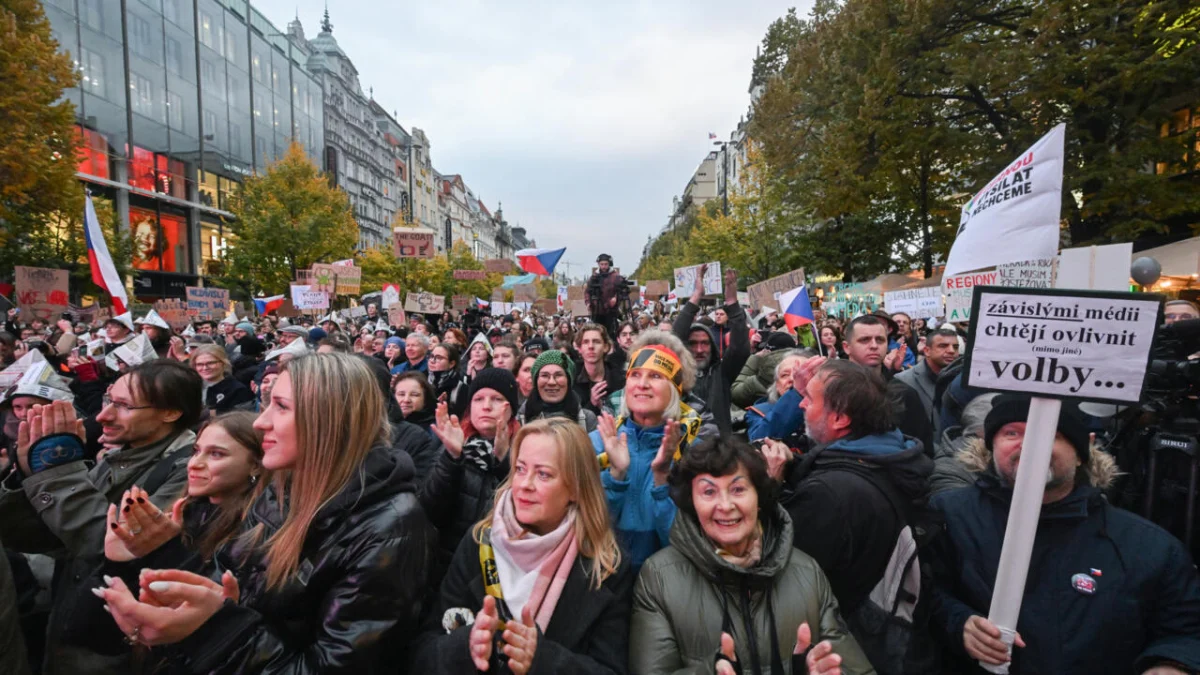
PRAGUE (The Thursday Times) — Hundreds of thousands of people are expected in Prague on Sunday for a rally against the Czech government’s plan to scrap the licence fees that fund the country’s public television and radio, in what organisers say could be the largest protest since the fall of communism.
The rally on the Letná Plain is being organised by the civil society group Million Moments for Democracy. It comes after weeks of demonstrations and a strike by public broadcasters, and two days before the anniversary of the start of the 1989 Velvet Revolution.
The same group brought an estimated 300,000 people onto the streets against Andrej Babiš during his first term as prime minister in 2019, and more than 200,000 earlier this year.
A vote at 4.36am
Babiš’s coalition of his ANO party, the far-right SPD, and the Motorists pushed the first of three readings of the bill through parliament in an overnight session, with the vote held at 4.36am on October 24. Crowds picketed the building through the night.
Under the bill, Czech Television and Czech Radio would no longer be funded by mandatory licence fees and would instead receive money directly from the state budget. Their funding would be cut by about 15% in the first year.
The coalition says the licence fee is an unfair tax and that other European Union countries have made similar changes. Opposition parties, civil society groups, and media watchdogs say the plan would give ministers more leverage over newsrooms whose reporting has long irritated the governing parties. Both broadcasters have warned that the smaller budget would mean cuts to programmes and staff.
Staff at the two broadcasters went on strike on November 3, and demonstrations were held in 21 towns and cities that day. Students, trade unions, churches, and cultural institutions have joined protests since then.
Government shows no sign of backing down
Babiš has said his government will not be deterred by the protests. He has accused the opposition and some journalists of stirring up the public with unfounded claims that the broadcasters’ independence is at risk, and has floated alternatives, including voluntary payments.
He has also said a new proposal, which would move public media funding outside the state budget and guarantee editorial independence, will be drawn up for open debate. Critics say no details have been given and that other members of the government appear determined to press ahead.
“Words are worth nothing,” Million Moments for Democracy said. “While people stand up for independent media, the government continues to act as if it owns the country.”
Czech public broadcasters hold a special place in the country’s politics. In the “Czech TV crisis” of 2000 and 2001, staff occupied the studios of Czech Television and mass protests forced the government of the day to drop an attempt to take control of the station.