KARACHI (The Thursday Times) — The Sindh government has ordered a rapid survey of drought-hit Tharparkar and Umerkot, a week after Chief Minister Murad Ali Shah declared Tharparkar a calamity-hit district, with officials estimating that 85 to 90 per cent of its crops have been destroyed or left unproductive.
The joint assessment, to be run under the Provincial Disaster Management Authority, will cover food, drinking water, healthcare, education, malnutrition, maternal and child health, and the problems facing livestock owners. It was ordered on Thursday at a meeting chaired by Giyan Chand Essrani, the chief minister’s adviser on rehabilitation, which gave the agencies three days to report back.
Essrani said relief must reach beyond the main towns and district headquarters to remote areas, including Diplo, Dahli, Chachro, and Nagarparkar. He said children, women, pregnant women, people suffering from malnutrition, and poor families should come first.
The meeting discussed food supplies, cash assistance, food vouchers, and using the Benazir Income Support Programme to reach affected households. It also agreed to provide healthcare through mobile hospitals, rural health centres, and basic health units, and to review the reverse osmosis plants that supply much of the district’s drinking water.
Representatives of the United Nations, the World Food Programme, the Food and Agriculture Organization, Unicef, the Pakistan Red Crescent Society, and the Pakistan Humanitarian Forum attended. All agencies were asked to share details of their work so that a digital map of needs, water supply, and relief activity can be drawn up before a follow-up meeting agrees a joint relief plan for the two districts.
September rains failed
Shah declared Tharparkar calamity-hit at a meeting on November 7, where he was told that all seven of the district’s talukas faced drought-like conditions. The talukas received between 181 and 273 millimetres of monsoon rain this year, but only 1 to 36 millimetres fell in September, and crops and natural grass dried up before they could mature, officials said.
The chief minister ordered the immediate repair of broken reverse osmosis plants, the restoration of all existing water sources, and emergency fodder for livestock. He asked the chief secretary to study the feasibility of a water pipeline from Naukot to Mithi, the district’s main town, and said the provincial government would not leave the people of Tharparkar alone.
Officials have since also declared 25 desert villages in Tharparkar and Umerkot calamity-hit for 2026-27, while nine canal-irrigated villages in Kaloi taluka were left off the list.
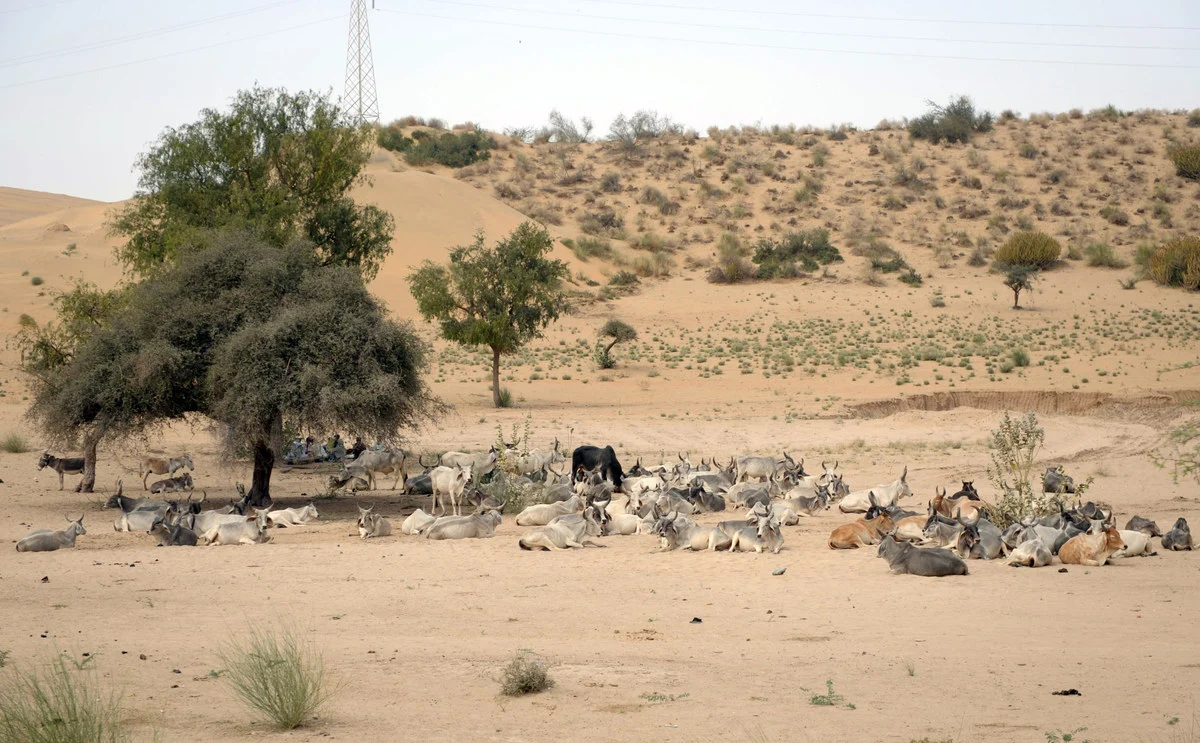
Most families in Thar depend on rain-fed farming and livestock. With grazing land drying up and fodder running short, herders from Mithi taluka and other areas have been moving their animals towards the irrigated barrage lands of Sindh in search of water and feed.
The drought comes as Pakistan presses richer countries for climate finance at COP31, where Sherry Rehman has urged the summit to deliver money, not empty pledges, for countries hit by floods, heat, and failing rains.