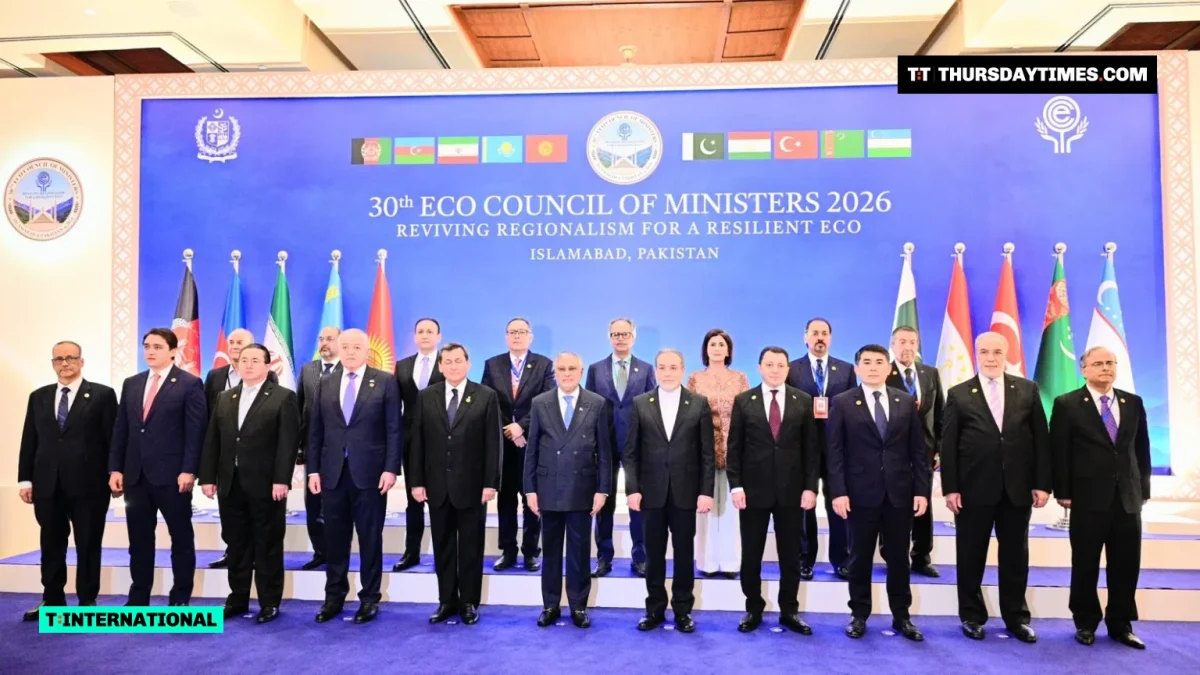
ISLAMABAD (The Thursday Times) — Iran’s foreign minister, Abbas Araghchi, told the 30th meeting of the Economic Cooperation Organisation’s Council of Ministers in Islamabad on Monday that Tehran had stayed committed to diplomacy but that the United States had “chosen a completely different path”. He also called for a regionally led security dialogue and set out Iran’s priorities on trade, transport, and energy. The remarks are taken from a transcript of his speech released by Iran’s Foreign Ministry.
On the United States
Araghchi said Iran had kept its commitment to diplomatic engagement over the past two years. “Unfortunately, the United States chose a completely different path,” he said, accusing Washington of aggression, threats, targeted assassinations, economic pressure, and a blockade that he said violated international law and the UN Charter. Sanctions, he added, had strengthened Iranians’ determination to defend their rights and resist what he called excessive and unlawful demands.
A call for regional security talks
The Iranian minister said Tehran wanted friendly and constructive relations with its neighbours and had no inherent dispute with countries in the region. “The territory, airspace and facilities of countries in the region must not become a platform for attacks against one another,” he said. He argued that Iran’s operations had targeted only the military facilities and bases of those attacking it, and should not be read as actions against neighbouring governments or their peoples.
He called for an inclusive, regionally led dialogue on security arrangements that would uphold non-aggression and prevent third countries from using regional territory to attack another state. He also thanked Pakistan and the ECO Secretariat for organising the meeting and hosting the Iranian delegation.
Trade, transport, and energy
On economic cooperation, Araghchi said trade, transport, and energy should form the “three strategic pillars” of the ECO’s work. He welcomed the creation of a technical negotiating committee to revise the ECO Trade Agreement and urged participating countries to pursue the talks and encourage other members to join. “A modern, inclusive and practical trade agreement could expand regional commerce and strengthen economic resilience,” he said.
He also called for a reliable regional energy mechanism to safeguard supplies amid geopolitical disruption, citing what he described as the impact of US and Israeli attacks on regional energy security. On Gaza, he condemned what he called Israeli genocide and urged international action to ensure unhindered deliveries of food, medicine, temporary shelter, and supplies for rebuilding essential infrastructure.
Pakistan’s position
Foreign Minister Ishaq Dar, who chairs the session, said earlier that Pakistan favours resolving disputes through dialogue and diplomacy under international law and the UN Charter. He said Prime Minister Shehbaz Sharif, the Chief of Defence Forces, Field Marshal Asim Munir, and the Foreign Office had been engaging with friendly countries and partners in support of diplomatic efforts, and that Pakistan would continue them in support of dialogue, de-escalation, and lasting regional stability. His five priorities for Pakistan’s 2026-27 chairmanship are set out in our earlier report.
The Islamabad meeting is meant to prepare the ground for the 18th ECO summit, scheduled for Tehran on December 3 and 4. The final Islamabad Communiqué had not been released at the time of writing.