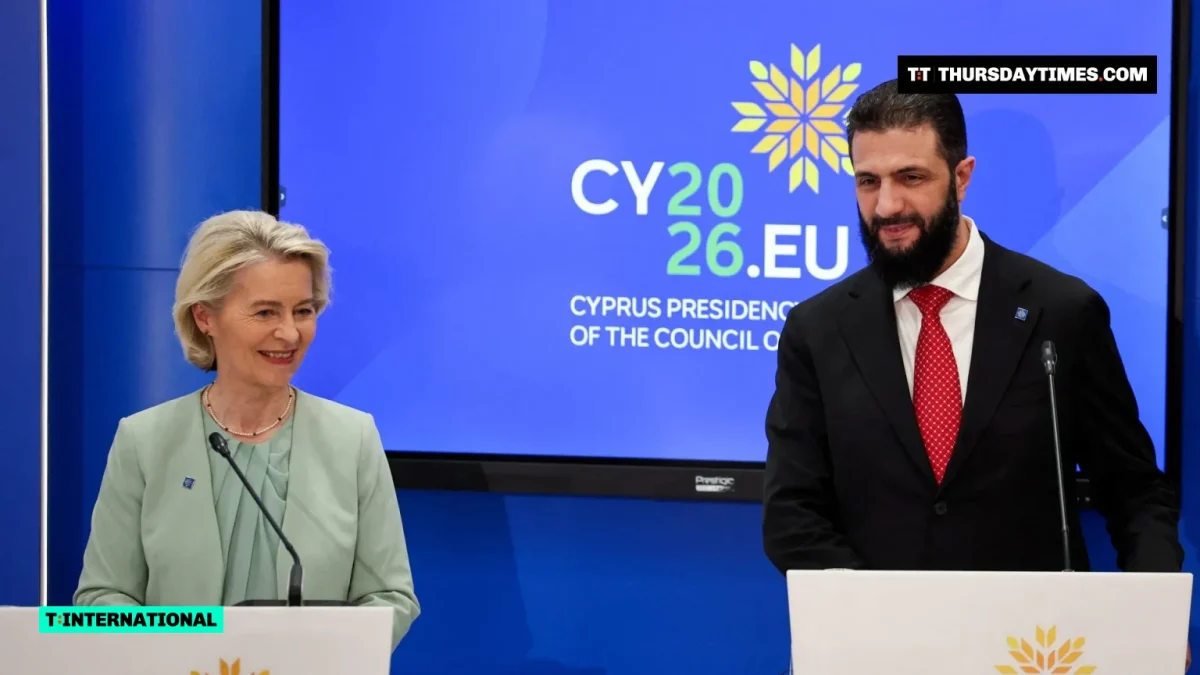
BRUSSELS (The Thursday Times) — European Union foreign ministers agreed on Monday, 16 November, to revive a nearly 20-year-old cooperation agreement with Syria, as the bloc presses to strengthen ties with the war-scarred country.
“Syria needs investment and a successful transition,” EU foreign policy chief Kaja Kallas said. “The aim is to give Europe and Syria a framework for trade, political dialogue and closer cooperation as soon as possible.”
Kallas said the ministers, meeting in Brussels, had “supported moving ahead” with the deal and with launching talks on an updated one. Diplomats will now work through the technical and legal details to finalise it.
An agreement never signed
The EU-Syria association agreement was first made in 2008, under then-President Bashar al-Assad, but was never fully signed by either side because of concerns over the Assad government’s human rights record. An updated deal would create a framework for free trade, political dialogue, and broader cooperation between Brussels and Damascus.
A discussion paper prepared by the EU’s diplomatic service ahead of the meeting described one of Brussels’ most ambitious efforts yet to normalise ties with Syria, less than two years after Assad’s fall. Earlier on Monday, Kallas said the bloc had proposed raising the relationship to a new level; see our earlier report.
Conditions attached
Kallas said the EU would set out new conditions for Syria to secure an updated deal. “We should have clear conditionality regarding human rights,” she said. She added that the bloc should also require non-recognition of occupied Ukrainian and Georgian territories, which Syria recognised under Assad.
“Everybody said that we need to engage with Syria because if we don’t engage, then this vacuum will be filled by other players,” she said.
The move is the latest step in the EU’s efforts to build ties with Damascus and its new leader, President Ahmed al-Sharaa. The bloc lifted its sanctions on Syria’s economy in 2025 to help its recovery after almost 14 years of civil war, and at the start of 2026 announced a two-year funding package worth 620 million euros ($680m).