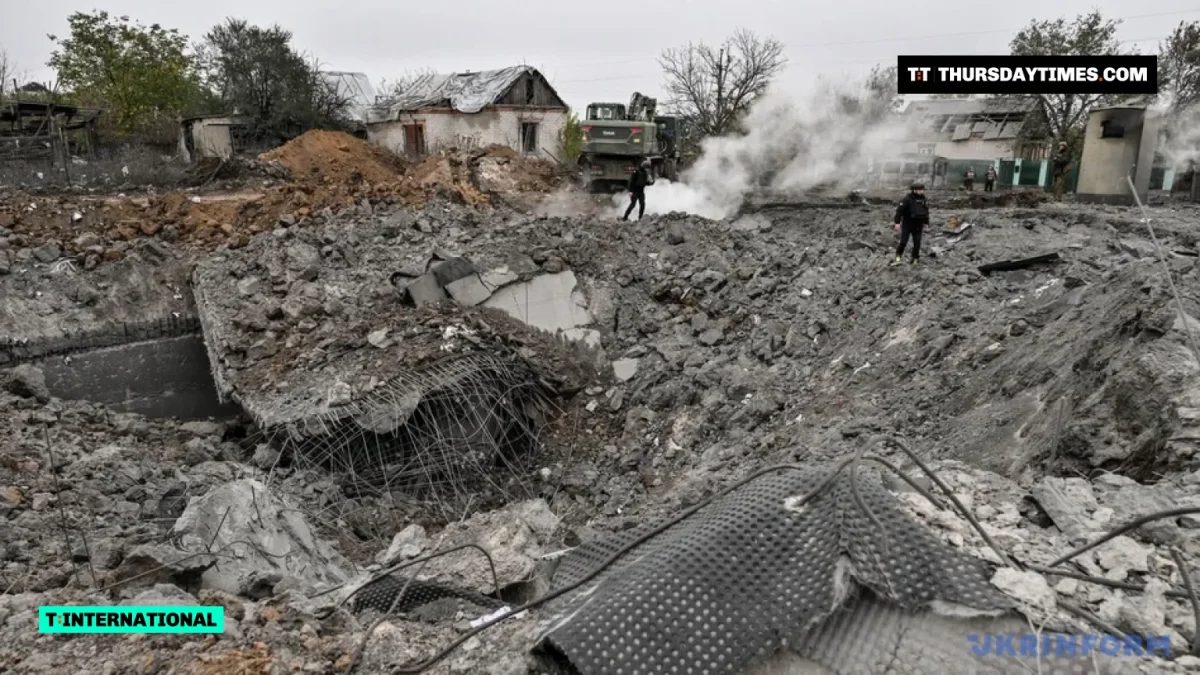
KYIV (The Thursday Times) — Search and rescue work has ended at Komyshuvakha, Ukraine’s interior minister said on Monday, 16 November, putting the death toll from the 2 November Russian strike on the village at 72 and saying Russian forces kept hitting the rescue site for two weeks.
Ivan Vyhivskyi wrote on Facebook that the attack was one of the deadliest incidents of Russia’s full-scale war. The dead included emergency responders, police officers, staff of a gymnasium and an administrative services centre, municipal workers, and medical personnel. Among them was a teacher who regularly used the shelter to give online lessons to children evacuated from the community. The toll had stood at 26 when we first reported the attack.
Rescuers and police worked for two weeks under the threat of further attacks, a few kilometres from the front line, the minister said. Russian forces struck the settlement 11 times in that period, and nine of those attacks hit the search site directly, injuring three police officers and four rescuers and damaging equipment. Four people remain missing, and four who were pulled out in the first hours are still in hospital. Funerals have been held almost daily.
What happened on 2 November
Ukrainian officials say Russia hit a humanitarian aid centre in the village, in the Zaporizhzhia region, twice in quick succession. The first strike, at 09:45 local time, hit buildings above ground and killed one woman, they say. About an hour later a second strike hit the underground shelter where residents had gone for safety, with what Ukraine says were 3,000kg aerial bombs. People had gathered after a local Telegram group said aid would be handed out between 10:00 and 12:00.
Police bodycam footage released in edited segments shows people trying to free a casualty from the rubble while warnings of a second strike grow louder on police radios, until everyone is told to run to the shelter. Later in the same recording there is a large blast, then the screen goes dark. Weapons experts who examined images of the crater and of fragments from the site said they were consistent with a FAB-3000, a Russian bomb that can destroy underground structures. One fragment, they said, is part of a guidance kit compatible with that weapon.
Rescue site targeted
An officer of Ukraine’s security service investigating the case, who was identified only as Oleksiy, said the rescue vehicles were clearly marked and accused Russia of deliberately destroying humanitarian equipment. The State Emergency Service said teams had to keep pausing the search and withdrawing to a safe place because of the threat of repeat shelling.
A general Russian defence ministry statement on 2 November said it had hit energy and transport infrastructure used by Ukraine’s military across the country. It did not name the village. Komyshuvakha has no military or industrial facilities, but it lies close to a key route used by Ukrainian troops for movements, supplies, and evacuations. It had also been struck on 28 October.
International law experts say knowingly attacking rescue workers is a war crime. Ben Saul, a professor of international law at the University of Sydney, said the strike looked like either a deliberate attack on civilians or an indiscriminate one, and that both are war crimes. Samuel Moyn of Yale University said directly targeting rescuers or their equipment is a gross violation of humanitarian law.
The disclosure comes as Russia keeps up its attacks on Ukrainian cities. Missiles hit two bridges over the Dnipro in Kyiv late on Monday, while US envoy Jared Kushner said progress had been made in talks on ending the war.