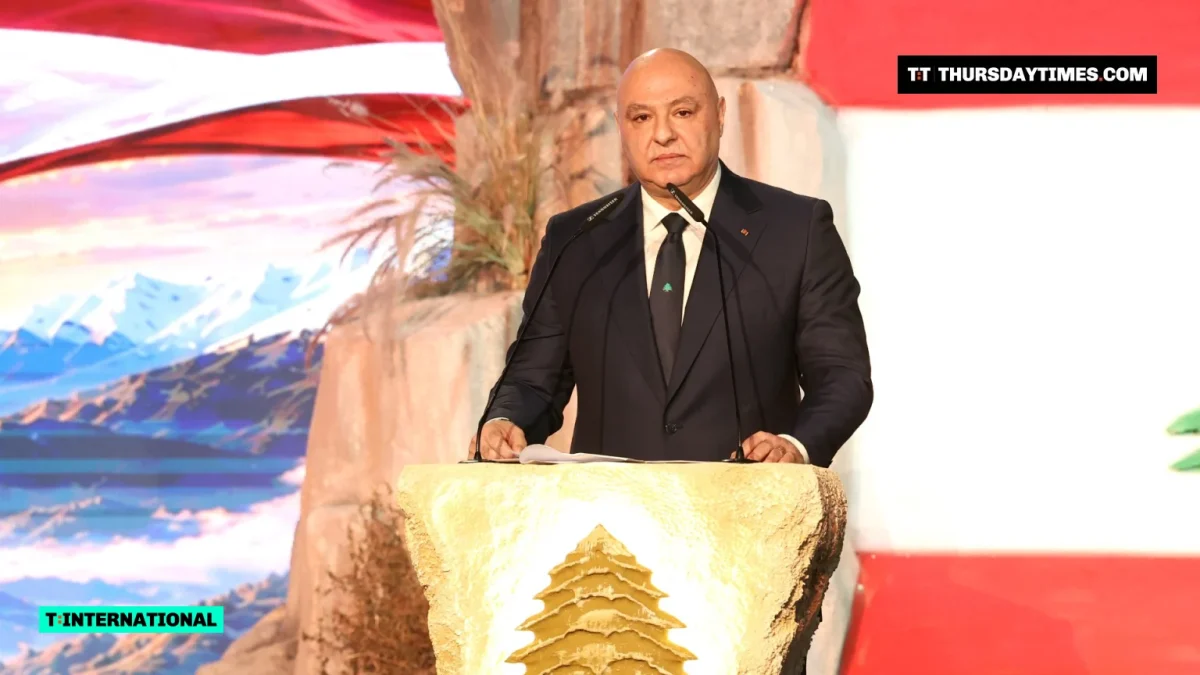
BEIRUT (The Thursday Times) — Lebanese President Joseph Aoun used his Independence Day address on Saturday to demand that Israel withdraw from all Lebanese territory and to tell Iran to stop interfering in Lebanon’s affairs, calling the two issues “inseparably linked” obstacles to full sovereignty.
Speaking at a flag-raising ceremony at the Nahr el-Kalb tunnel on the eve of Lebanon’s 83rd independence anniversary, Aoun said the country could not celebrate as if its sovereignty were complete while parts of its land remained occupied, many displaced families had not returned home, and the decision on war and peace was not yet in the hands of the state alone.
He named the two obstacles as the Israeli occupation of parts of Lebanese territory and outside interference, which he said came from some influential parties in the Iranian regime through weapons and decisions outside the authority of the Lebanese state. He said both had to be solved together: no occupation, and no weapons outside the state that take orders from, or serve, any foreign power.
A message to Israel and to Tehran
Aoun told Israel that occupation does not create security and that destruction does not create peace. He called on it to withdraw, to stop its attacks, and to return Lebanese captives. Dozens of Lebanese are believed to be held in Israeli detention.
Addressing those responsible for Iranian involvement in Lebanon, he said Lebanon respects the Iranian people and their civilisation and wants relations of friendship and mutual respect with Iran, as with other states. But friendship, he said, does not give one country the right to interfere in another’s decisions: what Iran would not accept for its own country, it should not ask Lebanon to accept.
He also said the era of arms outside the state was over, and that Lebanon would not swap one form of guardianship for another. He defended diplomacy as the president’s chosen path, saying negotiation was not surrender and that peace was not the opposite of dignity.
Turning to the public, he urged Lebanese not to fear, despair or tire, and pointed to the Lebanese army as the force that belongs to all Lebanese, whatever their sect or region.
Stalled framework deal
Lebanon and Israel signed a US-mediated framework agreement in June that covers the disarmament of Hezbollah, a phased Israeli withdrawal from southern Lebanon and the deployment of the Lebanese army in the area. Implementation has stalled: Hezbollah has refused to give up its weapons, and Israel has continued to strike Lebanon.
On Saturday, Israeli strikes hit the districts of Nabatieh, Bint Jbeil and Marjayoun in the south, according to reports from the area, and Lebanese state media said a second missile was fired at the town of Kfar Tebnit after the first failed to detonate.
Earlier coverage: US envoy Waltz presses Hezbollah to disarm as UNIFIL exit nears.