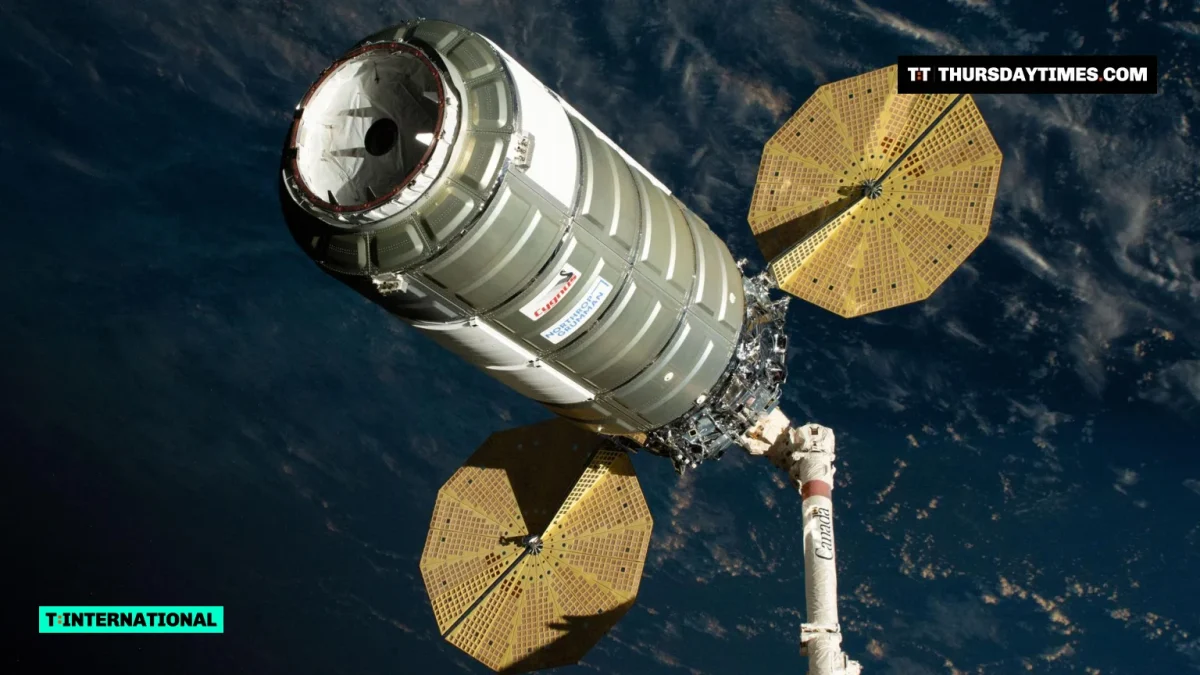
CAPE CANAVERAL, Florida (The Thursday Times) — NASA, Northrop Grumman, and SpaceX are targeting no earlier than 10:47 a.m. US Eastern time (15:47 GMT) on Sunday, 29 November, to launch the Cygnus XL cargo spacecraft to the International Space Station, the agency said. The mission, known as Northrop Grumman CRS-25, will carry about 11,000 pounds (roughly 5,000 kilograms) of science and supplies.
The Cygnus XL will lift off on a SpaceX Falcon 9 rocket from Space Launch Complex 40 at Cape Canaveral Space Force Station. NASA astronauts Jessica Watkins and Luke Delaney, who are living aboard the station, will use the Canadarm2 robotic arm to capture it at about 2:35 a.m. Eastern time (07:35 GMT) on Tuesday, 1 December. Ground controllers will then install it on the Earth-facing port of the Unity module. It is due to stay until May 2027, when it will leave with several thousand pounds of disposal items and burn up on re-entry.
Northrop Grumman has named the spacecraft the S.S. James “Jim” A. Lovell, after the former NASA astronaut who flew Gemini VII, Gemini XII, Apollo 8, and Apollo 13. It is the third flight of the larger Cygnus XL version.
NASA said the cargo includes new experiments. Cardinal Muscle 2.0 will test drugs already approved for other conditions on human muscle cell cultures, to see whether they could prevent or reduce muscle loss. DNA Nano B will use microgravity to make tiny DNA-inspired particles designed to carry medicine into dense tissue such as cartilage and solid tumours.
Encapsulate-1 will grow miniature replicas of patients’ tumours to study how cancer cells move and spread, with the aim of a diagnostic tool that could predict progression months or even years ahead. The Active Radiation Environment Sensor, or ARES, will test a small device for monitoring radiation inside crew areas, in support of future Artemis and lunar missions. Ohalo III is a new plant-growth facility meant to help with food crop production on long-duration missions.
NASA’s live launch coverage begins at 10:25 a.m. Eastern time on Sunday, and arrival coverage starts at 1:10 a.m. on Tuesday. The launch time is a no-earlier-than target.