If the date the Planning Minister has reportedly given holds, a Pakistani will lift off from Jiuquan on 25 November and become the first foreign visitor to China’s Tiangong space station. Ahsan Iqbal has reportedly said so, and China has not confirmed it: the China Manned Space Agency says only that Shenzhou-24 will launch “at an appropriate time”. Whatever the day, the country has earned its pride. The harder question is what Pakistan builds so that this flight is the first of many, not a single bright afternoon.
A moment worth celebrating
Pakistan has waited a long time for this. The China Manned Space Agency said on Tuesday that the Shenzhou-24 spacecraft and its Long March-2F rocket had been moved to the launch area, and that facilities and equipment were in good condition. Earlier crewed missions have flown roughly a week after that step, which points to 24 or 25 November, though that is an estimate and not an announcement.
The agency has said the Pakistani will fly as a payload specialistA crew member who flies mainly to run experiments or carry out a specific mission task, rather than to command or pilot the spacecraft. and come home on Shenzhou-23 after a short stay. That makes the astronaut the first foreigner to visit Tiangong and the first non-Chinese member of a Chinese crewed mission. Two Pakistani pilots, Muhammad Zeeshan Ali and Khurram Daud, have trained in Beijing since April. One has been assigned to the flight and the other will be the backup, and China has not said which is which.
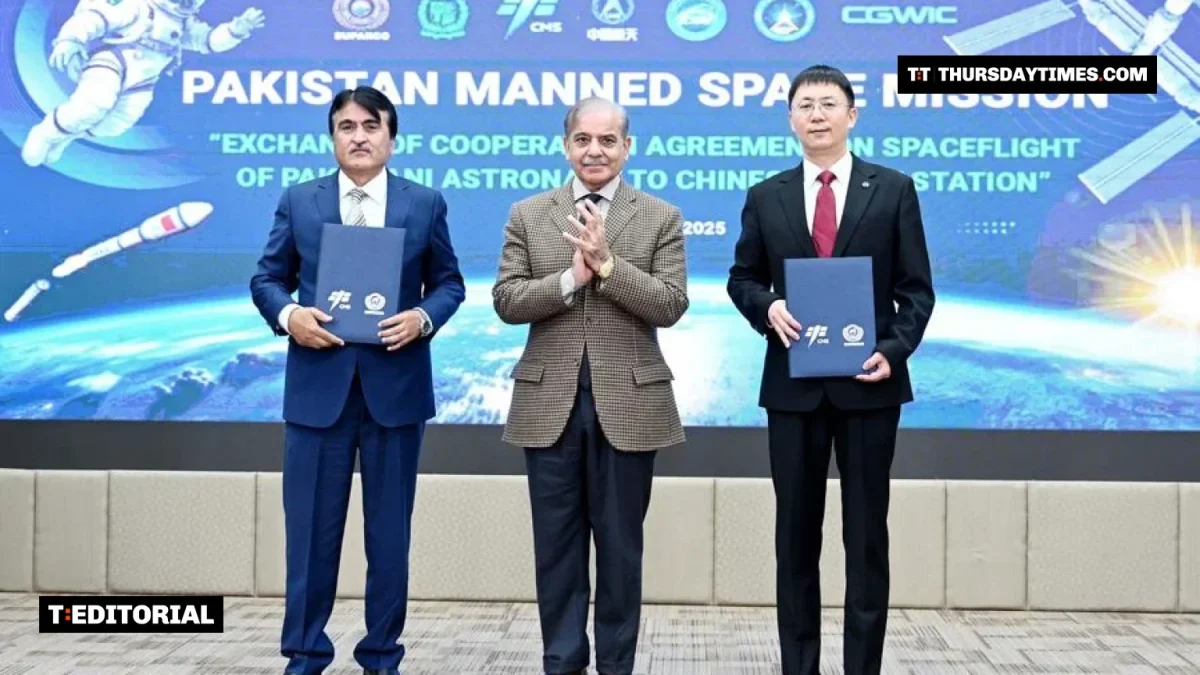
The selection itself is a credit to the people involved. It began after Pakistan and China exchanged a cooperation agreement in Islamabad on 28 February 2025, and it ran in three rounds, with a first phase in Pakistan and the second and final phases in China. Both men passed their assessments. The astronaut will also carry out scientific experiments designed in Pakistan, which matters more than it may sound, because it means the country has a say in what the flight is for.
Pride is the right response to a launch. A budget line is the right response to the morning after.
How Pakistan got here
This did not start in 2025. SUPARCO, the national space agency, dates back to 1961, and Pakistan’s first satellite went up from China in 1990. In 2024 Pakistan’s first lunar payload, the iCube-Q CubeSatA small, standardised satellite built from cube-shaped modules, often weighing only a few kilograms. Its low cost makes it a common first project for universities., rode to the Moon aboard China’s Chang’e-6 mission. It was built by the Institute of Space Technology, Shanghai Jiao Tong University, and SUPARCO together, and carried two cameras to image the Moon.
In July 2025 SUPARCO launched its second remote-sensing satellite, PRSS-II, from China’s Xichang Satellite Launch Centre. The commission described it as part of a wider national vision of using space tools on pressing development problems. Next, Pakistan is due to send its first lunar rover on China’s Chang’e-8 mission in 2028.
Each step was bigger than the last, and each was done with a partner who gave Pakistan a seat on its own missions. That record is the best argument for what comes next: the country has shown it can deliver, which is a good reason to ask it to plan.
Fund the programme, not just the flight
The clearest public picture of where the money goes is the federal development budget. For 2025-26 the government allocated Rs5,418.523 million to SUPARCO across six ongoing and new projects, according to the federal development budget. Rs4,418.523 million went to four ongoing projects, and Rs1,000 million was reserved for two new ones. The astronaut’s mission appears as the “Pakistan Manned Space Mission” at Rs600 million, and the lunar rover as the “Pakistan Lunar Exploration Rover” at Rs400 million.
SUPARCO in the 2025-26 development budget
Bars are scaled to the largest allocation. The six projects total Rs5,418.523 million. Source: Associated Press of Pakistan, report on the 2025-26 PSDP, 10 June 2025. The Thursday Times could not find a confirmed 2026-27 breakdown.
Read the chart for what it says about priorities. The astronaut’s flight is about 11 per cent of the SUPARCO line, and the lunar rover is about seven. The largest items are the Pakistan Space Centre, the observatories, and the satellite programme, which are the long-lived assets. That is a sensible balance, and it points to the first request of this editorial: keep it that way. A flight is an event, while a Space Centre, a satellite line, and a trained workforce are what a programme is made of.
The PSDPThe Public Sector Development Programme, the federal government’s annual list of development projects and their funding. Projects are funded year by year, so multi-year work depends on each new budget. funds projects one year at a time, and space engineering does not work in one-year units. A satellite takes years to design, build, test, and launch, and the people who build it need to know their jobs will be there for the next one. So the government should publish a multi-year roadmap that names the next satellites, the Space Centre milestones, the lunar rover timeline, and the next astronaut flight, and then fund it with a commitment that survives a change of minister. SUPARCO already has the projects, and what it needs is the certainty.
A flight is an event. A Space Centre, a satellite line, and a trained workforce are a programme.
Satellites that answer to the farmer and the district officer
The best argument for space spending in a country with Pakistan’s needs is not prestige. It is that a satellite can look at the whole country on a regular schedule. SUPARCO and officials have described PRSS-II as a tool for disaster response, crop health, water management, urban planning, glacier monitoring, and forest protection. Those are the problems Pakistan lives with.
Take floods. After a river breaks its banks, officials need to know within hours which villages are under water and which roads are cut. Take crops. A district agriculture officer who can see which fields are stressed, and when, can warn farmers before the yield is lost. Take air quality: satellites can map fire spots on farmland during the burning season and help enforcement teams reach the right fields.
The satellite is the easy part, and the harder part is the chain after it. Imagery has to reach provincial irrigation departments, disaster authorities, and agriculture offices in a form they can use, on a schedule they can rely on. That means ground stations, analysts, data-sharing agreements between federal and provincial bodies, and clear standards. Each province should have a small team that can turn a picture into a decision. If the astronaut inspires a generation, these are the first jobs that generation can fill.
The same logic argues for more than one satellite. One earth-observation satelliteA satellite that photographs or measures the land, water, and air below it, so that governments can track floods, crops, forests, and cities from orbit. passes over the same place only now and then. A programme that adds satellites steadily, as the PRSS-O2 project does, gives the country a record that gets better every year, and a record is worth more than a snapshot.
From the classroom to the control room
Every astronaut and every satellite begins in a school lab. The iCube-Q partnership shows what a university can do when it is given a real mission: a CubeSat from a university-led partnership went to the Moon.
The aim should be to make that the rule instead of the exception. The Institute of Space Technology and other universities could be funded to offer undergraduate and postgraduate degrees in space science, orbital mechanics, remote sensing, and spacecraft design, with research chairs and placements at SUPARCO. A national student CubeSat programme, with a launch slot offered through the partnership with China, would give every engineering faculty a goal worth working towards.
Pakistan does not need a million astronauts. It needs ten thousand engineers who can read a satellite image.
Room for private builders
Space is no longer only a state business. Around the world, small companies now build satellites, analyse imagery, and sell data to farmers, insurers, and city governments. Pakistan has software and engineering talent that could do the same, and the Pakistan Manned Space Mission and the satellite programmes give it a reason to start.
The state can help in three plain ways. First, it can be a customer: SUPARCO and the federal and provincial departments can buy analysis and components from local firms, and not only from abroad. Second, it can make the rules clear: a simple route to licensing, a predictable approach to launch and spectrum permissions, and sensible limits on what is controlled. Third, it can share data: where imagery is not sensitive, making it available to researchers and start-ups gives them something to build on. None of this weakens the state’s space agency. A healthy private sector would multiply what SUPARCO can do with a budget that stays modest.
A partnership to build on
The cooperation with China deserves to be described plainly and warmly. China launched Pakistan’s first satellite, carried its first lunar payload, hosted the second remote-sensing launch, trained its astronauts in Beijing, and is about to fly one to a station that, until now, only Chinese crews have used. The agency has described the flight as the first joint mission of Chinese and foreign astronauts. That is a high level of trust, and it reflects a friendship that has stood through many seasons.
The way to honour it is to make the most of it. Pakistan should aim for the skills to stay in the country when the rocket leaves: Pakistani engineers sitting inside design reviews, Pakistani staff at mission control for the lunar rover, joint research labs in Pakistani universities, and training places for the next intake. The Tiangong flight is a chance to agree on a long-term plan with the Chinese space agencies that names those exchanges and sets dates for them. Both countries gain when Pakistan becomes a stronger partner.
What a lasting programme looks like
The list is short. A multi-year, published roadmap for SUPARCO with funding that does not depend on the year. More earth-observation satellites, and a data pipeline that gets their images to farmers, flood managers, and district officers. Degrees, labs, and a student CubeSat programme in the universities. A clear route for private firms to supply and to build. And a partnership with China that is judged by the skills it leaves behind.
None of it is out of reach. The country has the projects, the people, and a friend willing to launch them, and for 2025-26 it set aside Rs5.4 billion to begin. What it needs is the will to keep going when the cameras have moved on.
When the Long March rocket clears the tower, Pakistan will have every reason to cheer. The best way to thank the astronaut, the engineers, and the trainers who got a Pakistani to the launch pad is to make sure the next one is easier to find.