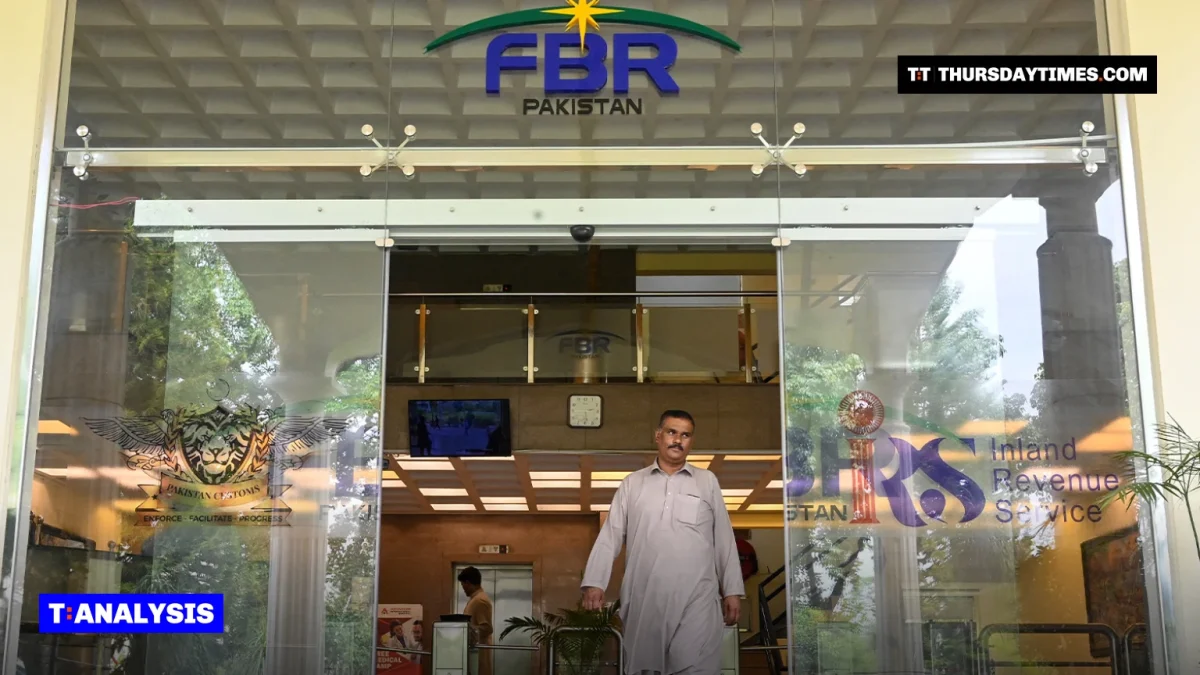
ISLAMABAD (The Thursday Times) — Two sets of numbers landed in Islamabad this week, and they belong together. The Federal Board of Revenue collected Rs4.089 trillion in the first four months of the fiscal year, about Rs95 billion short of its target. The same week, the economic affairs ministry reported that Pakistan paid $14.44 billion to service its foreign public debt last year, and borrowed $16.16 billion more. On their own, neither figure is a crisis. Read together, they show the bind at the centre of the budget: the state is not collecting enough to cover what it owes, so it borrows to pay what it borrowed, and the interest on that borrowing eats into what it collects.
A target that gets steeper every month
The FBR’s shortfall is not large in percentage terms. Collections for July to October were up about 6.6% on the same months last year, and the gap to target is a little over 2%. The problem is the shape of the year. The full-year target is Rs15.264 trillion. To reach it, the board has to raise about Rs11.2 trillion in the remaining eight months, roughly Rs1.4 trillion a month. So far it has averaged about Rs1 trillion.
The detail matters more than the total. Sales tax beat its target, bringing in Rs1.524 trillion against Rs1.448 trillion. Income tax, the biggest single source, fell about Rs148 billion short, at Rs1.86 trillion against Rs2.009 trillion. Customs duty also missed. Refunds and rebates rose to Rs265 billion, from Rs206 billion a year earlier.
Four months of tax, against target
July to October 2026, provisional. Bars are scaled to the income tax target. Source: Federal Board of Revenue figures.
That pattern says something about where the system is strong and where it is weak. Sales tax is collected at the till and at the factory gate, through registered businesses and withholding, and it is hard to avoid at scale. Income tax depends on people and firms declaring what they earn. When it lags, it usually means the base of people paying is still too narrow, and that the burden falls on those who are already in the net.
The interest bill is rising again
The revenue gap would matter less if spending were steady. It is not. The finance ministry’s monthly update showed that Pakistan kept an overall fiscal surplus in the first quarter of the year, at Rs1.198 trillion, but that interest payments rose by almost 37%. The primary surplusWhat the government has left over after its spending, before paying interest on its debt. It is the main fiscal target in Pakistan’s IMF programme., which leaves interest out, was Rs2.3 trillion.
The difference between those two numbers is the interest bill for the quarter: roughly Rs1.1 trillion in three months. Over the same three months, by the FBR’s own figures, it collected a little under Rs3.1 trillion. In other words, interest alone took the equivalent of about a third of everything the board raised, before the provinces received their share of the divisible pool.
The first quarter, in three numbers
July to September 2026. Interest is the difference between the primary and overall surplus. Source: Finance Ministry, Monthly Economic Update and Outlook.
This follows a better year. In 2025-26, interest payments fell by Rs1.94 trillion, or 21.7%, to Rs6.95 trillion, as borrowing costs came down. But the structure of the domestic debt means relief can reverse quickly. Only 27% of government securities are on fixed rates. The average time to maturity is about 3.8 years, but the average time to re-fixing is just 1.4 years. When rates move, most of the domestic interest bill moves with them within about a year and a half. The ministry’s update did not break down the first-quarter rise. But with so much debt on floating rates, the interest bill follows the policy rate closely.
Every rupee the FBR misses has to be found somewhere else, and the interest bill does not wait.
Borrowing to repay
The foreign side works on a similar logic. Last fiscal year, Pakistan paid $14.44 billion on its external public debt: $11.2 billion in principal and $3.24 billion in interest. It received $16.16 billion in new financing. New money more than covered the repayments, and external public debt rose from $91.8 billion to about $98.1 billion.
The foreign debt year, 2025-26
Fiscal year to June 30, 2026. Source: Ministry of Economic Affairs, annual report on foreign economic assistance.
Much of this is routine. A large share of what Pakistan owes abroad is held by friendly governments and development lenders who expect to roll overTo replace a loan or deposit that is falling due with a new one for the same amount, instead of repaying it in cash. their money rather than take it home. This year’s gross foreign repayments are about $21.5 billion, but the finance ministry told a Senate committee that $7.3 billion of that is deposits from three friendly countries that are expected to be rolled over. After rollovers and refinancing, the net requirement is about $11 billion. About $5 billion had been paid by early November, leaving roughly $6 billion for the rest of the year, against reserves of about $21.5 billion.
That is manageable, and it is a long way from the near-default of 2023. But it is not the same as paying the debt down. Of last year’s budget support, Naya Pakistan Certificates brought in $3.05 billion and time deposits from friendly countries $3 billion. Both are useful, and both have to be renewed or repaid.
Where the two meet
The domestic and foreign stories join in the budget. Pakistan’s programme with the International Monetary Fund is built around an underlying primary surplus of 2% of GDP for this fiscal year. The Fund reached a staff-level agreement on its latest review in October, which would unlock about $1.2 billion once its board approves it, and it has asked Pakistan to keep to the budget.
A primary surplus target sets the budget’s order of business. If tax revenue falls short, the government has three choices. It can cut spending, which in practice usually means the development budget. It can raise other revenue, through petroleum levies, new taxes, or one-off measures. Or it can miss the target. The first two have costs at home, and the third has costs with lenders. Development spending is already under pressure: the government spent only about 10% of its Rs1 trillion development budget in the first four months.
The total debt picture is improving on one measure. Public debt rose to about Rs91 trillion in June, but fell as a share of the economy, from 74.3% to 71.7% of GDP, because the economy grew faster in nominal terms. That ratio can keep falling only if growth holds, the primary surplus holds, and interest costs stay contained. A rising interest bill and a widening tax gap push against all three.
Pakistan is not short of lenders willing to roll over. It is short of people paying income tax.
The levers that are real
There is no shortage of advice on what Pakistan should do, and the IMF’s own framing at a tax workshop in Islamabad last month was blunt: a broader, fairer, simpler, and more predictable system, with under-taxed sectors addressed and concessions rationalised. Four levers stand out, because each is already partly in motion.
None of these is new, and none is quick. Widening the base means taxing groups with political weight. Enforcement depends on administrative capacity and on taxpayers trusting that notices are fair. Lengthening debt costs more upfront. Export growth depends on energy costs and on demand in markets Pakistan does not control.
What to watch
The next markers are close. The FBR’s November and December collections will show whether the gap is closing or widening as the targets steepen. The finance ministry’s next monthly update will show whether the first-quarter jump in interest costs continued. The IMF board’s decision on the latest review will confirm whether the programme stays on track, and the government’s review of its tax mix, including plans to phase out the super tax, will show how it means to pay for the second half of the year.
Pakistan’s position today is far stronger than it was three years ago. Reserves are at a record, the current account was broadly balanced last year, and the debt ratio is falling. The squeeze is not about solvency. It is about the gap between what the state collects and what it owes. Until that gap narrows, a large share of every rupee raised in tax will go to interest before it reaches anything else.