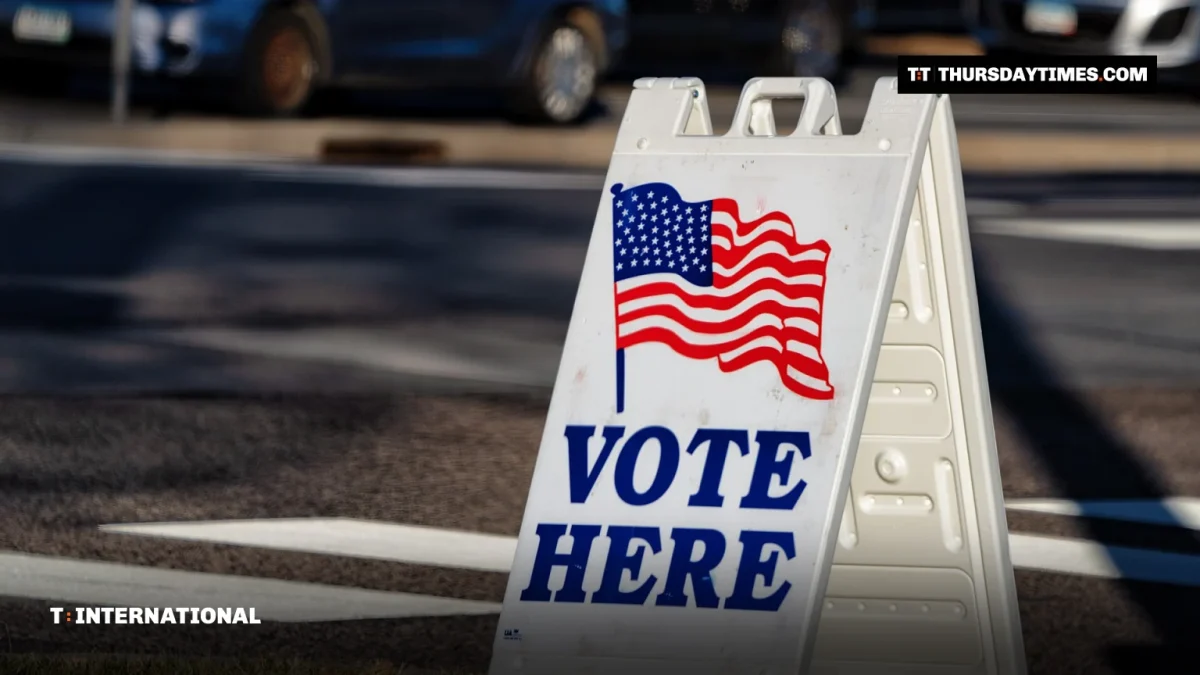
WASHINGTON (The Thursday Times) — Americans vote on Tuesday in midterm elections that will decide who controls Congress for the last two years of President Donald Trump’s term, with all 435 House seats, 35 Senate seats and the governorships of 36 states on the ballot.
Republicans hold the Senate 53-47 and a razor-thin majority in the House. The party in power has traditionally lost seats in midterm years, and this one faces voters with inflation still biting and polls showing the war with Iran to be unpopular.
Polling averages put Democrats about eight points ahead on the national congressional ballot, and most forecasters expect them to retake the House. The Senate is closer: models lean Democratic, while one widely followed ranking still rates it a toss-up. Trump predicts Republicans will hold both chambers and says that if Democrats take control, “this country will go to hell”.
What Democrats need
Democrats need a net gain of four seats to win the Senate, because Vice President JD Vance would break a 50-50 tie for Republicans. In the House, 218 seats make a majority. Control of either chamber would let Democrats limit Trump’s agenda and investigate his administration, and the Senate would also give them the power to reject his judicial nominees.
Independent election analysts rate seven Senate races as toss-ups:
- Michigan: Abdul El-Sayed, who would be the first Muslim elected to the Senate, against Republican Mike Rogers, in the one toss-up on a seat Democrats already hold.
- Texas: Democrat James Talarico against Republican Ken Paxton, the most expensive Senate race ever.
- Maine: Republican Susan Collins, seeking a sixth term, against Democrat Troy Jackson.
- Ohio: Republican Jon Husted against Democrat Sherrod Brown, who is trying to win back his old seat.
- Iowa: Republican Ashley Hinson against Democrat Josh Turek, a Paralympic basketball champion.
- Kansas: Republican Roger Marshall against Democrat Adam Hamilton. The state last elected a Democratic senator in 1932.
- Alaska: Republican Dan Sullivan against Democrat Mary Peltola, in a race with a second Dan Sullivan on the ballot.
When results come in, Pakistan time
Polls close in waves across six time zones, from 4am to 11am on Wednesday in Pakistan:
- 4am: first polls close, in parts of Indiana and Kentucky.
- 5am: Georgia, South Carolina, Virginia, Vermont and most of Florida and New Hampshire.
- 5:30am: Ohio, North Carolina and West Virginia.
- 6am: Pennsylvania, New Jersey, Maine, Massachusetts, Illinois and most of Texas, Michigan and Kansas.
- 7am: New York, Arizona, Colorado, Iowa, Minnesota, Wisconsin and Nebraska, plus the rest of Texas and Michigan.
- 8am: Montana, Utah and most of Idaho and Oregon.
- 9am: California and Washington state.
- 10am: Hawaii and most of Alaska.
- 11am: the last polls, in Alaska.
A clear winner may not emerge by then. California’s mail ballots could delay the final House count, Alaska is usually slow to report and uses ranked-choice voting, and Georgia’s Senate race goes to a runoff if no candidate wins a majority.
The first clues will come from House seats in Kentucky’s 6th and Indiana’s 5th districts, both held by Republicans and more competitive than they looked at the start of the campaign, and from Florida’s 22nd and 27th. Close races there would point to a bigger Democratic night.
Why the world is watching
The vote comes in the middle of the Iran crisis. US officials have said Trump may order a major strike on Iran if Republicans lose, and officials say Israeli Prime Minister Benjamin Netanyahu pushed him to strike right after the midterms, even as Pakistani and Qatari mediators press on with efforts to end the standoff over the Strait of Hormuz.
Voters will also decide 145 statewide ballot measures, including a one-time 5% wealth tax on Californian billionaires, abortion rights in Missouri, Idaho, Virginia and Nevada, and voter ID or noncitizen voting rules in 11 states.