Aga Syed Ruhullah Mehdi signed his resignation from a podium in Budgam on Tuesday, in front of thousands of supporters, and handed the paper to the father of a boy killed in 2010. It was theatre, but it was aimed at a real weakness: the National Conference won Indian-administered Kashmir’s election on a promise it has no power to keep.
The Srinagar MP has ended a 24-year association with the party. He has emailed his resignation to Lok Sabha Speaker Om Birla, and the seat will fall vacant once it is accepted. He chose the anniversary of the death of his father, Aga Syed Mehdi, who was killed in a bomb blast in 2000. The man who received the letter was Muhammad Ashraf Mattoo, whose 17-year-old son Tufail died in 2010 in alleged police firing, when Omar Abdullah was first chief minister.
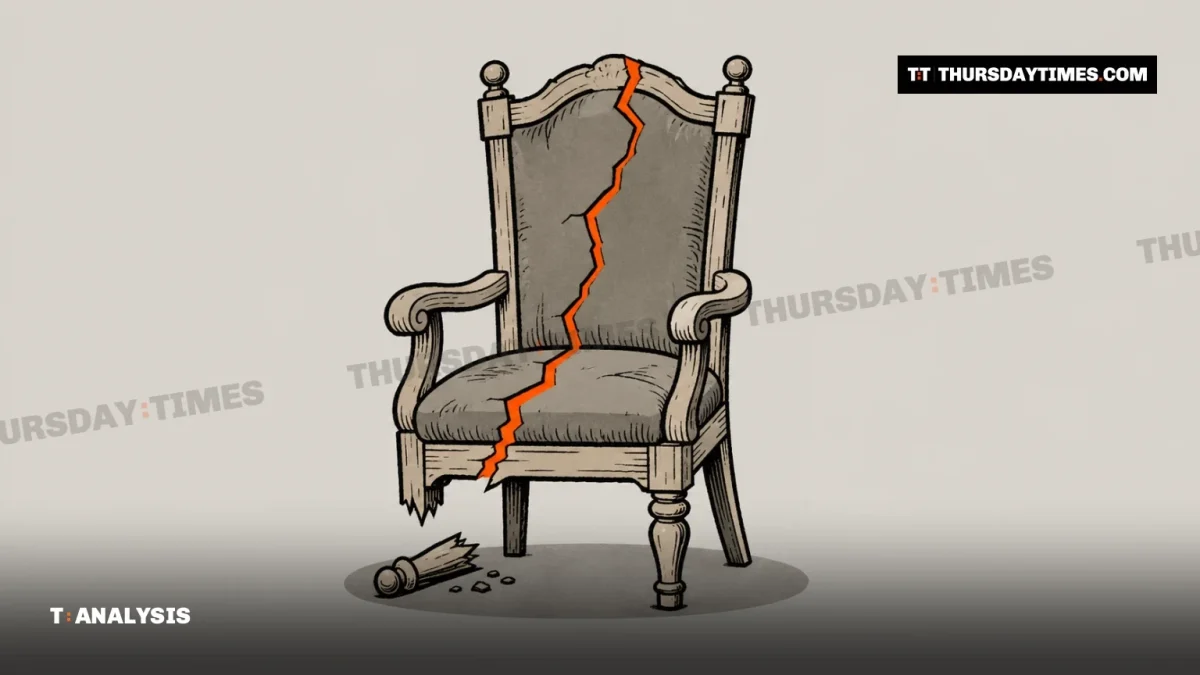
Few gestures in Kashmiri politics could have been more pointed. “You lied and misled the people, you used me,” he told Mr Abdullah from the stage. “People who lose chairs get unhappy, but here we are throwing away a chair, and we are happy.”
For Pakistan, which has never accepted the changes New Delhi imposed in 2019, the temptation is to treat this as vindication. It is more complicated than that, and more useful to understand properly.
“Here we are throwing away a chair, and we are happy.”
The promise and the limits
The argument begins with Article 370The clause of India’s constitution that gave Jammu and Kashmir special status. New Delhi revoked it in August 2019 and split the region in two.. New Delhi revoked it in August 2019, and India’s Supreme Court upheld that decision in December 2023. When the region finally voted for an assembly in 2024, the first such election in a decade, the National Conference campaigned on fighting for the restoration of that status, along with the release of prisoners and fairer reservation in jobs and education.
Voters rewarded it. The party took 42 of the 90 seats, and its government has the backing of about 50 legislators. Mr Ruhullah himself had won Srinagar in the general election that year by about 188,000 votes, on a turnout of about 38%, the highest there in decades. He then sat on the committee that wrote the party’s manifesto, which is why he takes its contents personally.
Seats in the 2024 assembly election
The 90-member assembly as elected in 2024. Later by-elections and defections are not shown.
The trouble is what the government could actually do once it won. Jammu and Kashmir is a union territoryA region run more directly by India’s central government than a full state. Key powers rest with a lieutenant governor appointed by New Delhi., in which a lieutenant governor appointed by New Delhi holds real authority, including over police and security. An assembly in Srinagar can pass a resolution on special status, and it did so soon after the election. It cannot restore anything. Only New Delhi can, and the party in power there is the one that took it away.
So the National Conference faced a choice that it has never quite admitted to. It could spend its time in office in open confrontation, with little to show for it, or it could work with the centre to win back statehood and get services delivered. Mr Abdullah has largely chosen the second. His supporters call that realism. Mr Ruhullah calls it surrender. “We demanded the restoration of Article 370, the release of prisoners and the protection of our rights,” his office said last week. “They sought power on those promises, then treated us as fools for expecting them to deliver.”
Both descriptions contain some truth. That is what makes the split dangerous for the party.
Three separate cracks
It would be a mistake to see this as one man’s quarrel. There are at least three pressures on the party, and they have started to feed each other.
The first is ideological, and Mr Ruhullah has made it his own. He has been openly at odds with the leadership since December 2024, when he joined students outside the chief minister’s home to protest against the reservation policy. He stopped attending party meetings and did not campaign for its candidate in the Budgam by-election last year, a seat the party then lost to the Peoples Democratic Party. He has mocked Mr Abdullah for thanking Prime Minister Narendra Modi at the opening of the tunnel near Sonamarg in January 2025.
The second is organisational, and it has little to do with Article 370. Last week, 17 of the party’s legislators gave the Abdullahs a 15-day ultimatum to end what they called “coterie culture” and “unilateral decisions”, after a cabinet expansion left several senior members out. They ruled out a split “as of now”. Those are complaints about power and access, of the kind every ruling party faces, but they give Mr Ruhullah’s moral case a ready audience inside the party.
The third is his own base. Mr Ruhullah is a prominent Shia leader from Budgam with a following that is not simply on loan from the Abdullahs. He has made a direct appeal to young people, saying he wants to find “honest” newcomers who will fight for their people’s rights and dignity. He has not announced a party. But his words to New Delhi, that Kashmiris “will speak to you on their terms, not on the agenda you set”, sound like someone preparing for more than a protest.
The crisis in numbers
Who gains
The answer is not obviously Mr Ruhullah, and it is certainly not obviously Kashmiris. The government is in no immediate danger. A party with 42 seats and outside support can survive the loss of an MP, who has no vote in the assembly, and spokesman Imran Nabi Dar has been careful, saying only that the party still hopes he will review his decision and that it will miss “an important voice” on Article 370.
The clearest short-term winner may be the Bharatiya Janata Party, which has long argued that the Abdullahs are a dynasty with nothing to offer. Its national vice-president, Ram Madhav, said on Tuesday that the party was “visibly divided”, and that Mr Ruhullah was holding his rally “with the blessings of our people”, while denying any BJP involvement in the party’s internal affairs. Mr Ruhullah would reject any such suggestion, and he attacked the BJP and the RSS from the same stage. But a fractured Kashmiri vote has helped New Delhi before, and Mr Abdullah’s supporters will make that argument loudly.
There is a real risk here for those who want to keep alive the demand for restoring special status. If the people who hold that position spend the next two years fighting one another, New Delhi loses nothing.
“An assembly in Srinagar can pass a resolution on special status. It cannot restore anything.”
How Pakistan should read it
Islamabad’s position is settled: the dispute must be resolved in line with United Nations Security Council resolutions and the wishes of the Kashmiri people, and the 2019 changes do not alter that. Tuesday’s scene supports one part of Pakistan’s case. Seven years on, the claim that the revocation settled the Kashmir question remains hard to sustain, when a sitting MP from the ruling party can draw thousands to a park by saying it has not. Only last month, Farooq Abdullah said that the question being kept alive abroad was what was “saving” Kashmiris.
But Pakistan should be careful about what it claims. Mr Ruhullah is arguing about constitutional guarantees within India, about Article 370 as a promise made and broken. His language is about dignity and rights, and he is not arguing Pakistan’s case. Treating him as if he were would hand his opponents a weapon, and would make life harder for him and for every Kashmiri politician who dares to dissent. The administration’s order for Tuesday’s gathering, which barred any rally or procession and warned against “anti-national” material, shows how thin the ice already is.
The more useful lesson is about the limits of an election in a place where the real decisions are made elsewhere. New Delhi pointed to the 2024 vote as proof that Kashmir had returned to normal. Two years later, the party that won that vote is being torn apart over the fact that winning changed so little.
What to watch
Three things will show whether this is a turning point or a passing storm.
The first is the rebels’ ultimatum, which runs out in mid-November. If those 17 legislators settle for a few cabinet posts, Mr Ruhullah stands alone. If some of them join him, the government’s arithmetic starts to matter.
The second is the Srinagar seat. Once the Speaker accepts the resignation, a by-election should follow, normally within six months. That vote would be the first real test of whether Mr Ruhullah’s anger is shared beyond the crowd in Budgam, and whether the party can hold a seat that it has long treated as its own.
The third is whether Mr Ruhullah builds anything. He says that he does not want simply to leave one party for another. Kashmir has seen many new movements promise that and fade. If this one does not, it will be because enough young Kashmiris decided that the chair really was worth throwing away. If it does, the promise he walked out over will still be there, unkept, for whoever runs Srinagar next.