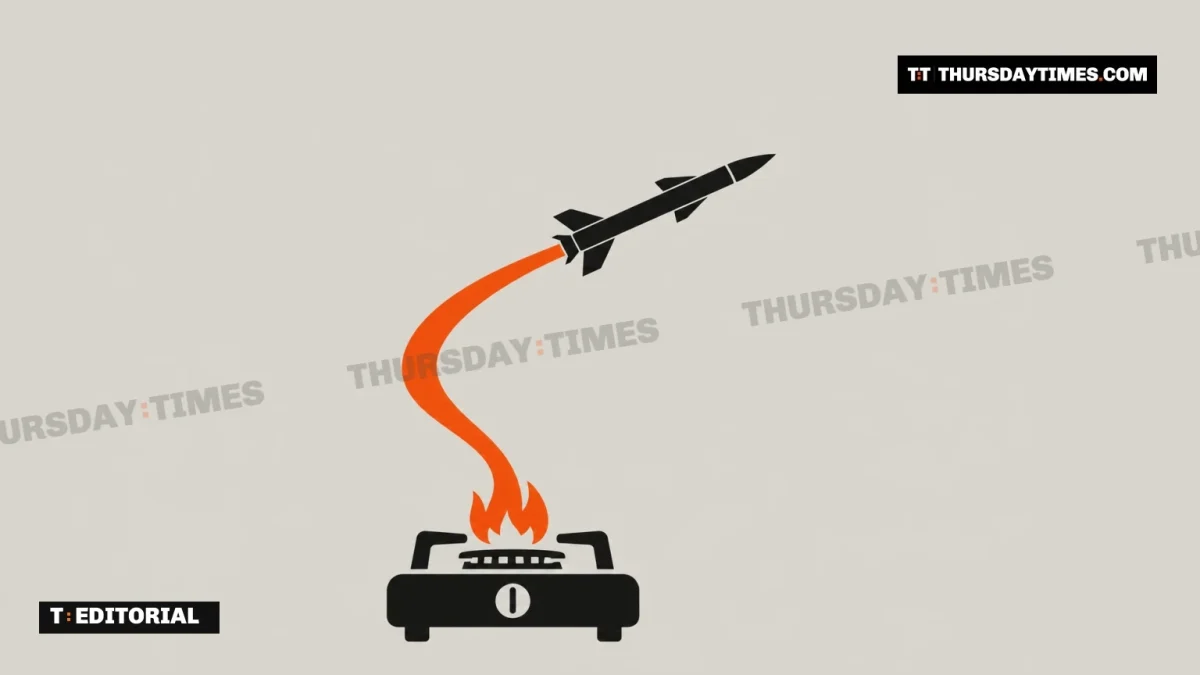
On Tuesday Pakistan test-fired the Fa’az, the first air-to-air missile it has developed itself. The scientists and engineers behind it have earned the country’s congratulations. They have also shown what Pakistan can do when it picks a hard problem and refuses to let go of it.
On the same day, the gas companies told households across the country that piped gas would now come in three slots a day, built around meals. That is the other half of the story of a country trying to stand on its own feet, and this newspaper would like both halves to be read together.
What was tested
The facts released are few, as they usually are with weapons. The Inter-Services Public Relations said the Fa’az has a state-of-the-art terminal guidanceThe system that steers a missile onto its target in the final stage of flight. system and can engage aerial targets at longer ranges. The image released with the news shows it leaving a Pakistan Air Force jet in flight. The range was not given, and neither was the test site. President Asif Ali Zardari, Prime Minister Shehbaz Sharif, Field Marshal Syed Asim Munir and the services chiefs all congratulated the team.
Nobody should expect much more detail, and nobody outside the programme can yet say how it compares with the best in the world. But the word that matters most in the announcement is the plainest one: first. Until now, this was a weapon Pakistan had to obtain from someone else.
“Until now, this was a weapon Pakistan had to obtain from someone else.”
Expect the usual noise around it. Some across the border will play it down, as they play down every Pakistani achievement, and some enthusiasts at home will claim more for it than anyone has yet shown. Neither helps. Only a small group of countries design their own air-to-air missiles: India has its Astra and Turkey its Gökdoğan, and both programmes took years of test firings to mature. Pakistan can be proud of joining that company without pretending that one flight has settled anything. The sober reading is also the more impressive one.
Why this weapon
Modern air combat is increasingly decided well before pilots can see one another. That was the lesson of the air battle with India in May 2025, when beyond-visual-rangeFired at a target too far away for the pilot to see, using radar and data links instead. engagements, sensors and electronic warfare were at the centre of events. Pakistan said its jets brought down Indian aircraft, including the French-made Rafale. India contested that account. What nobody contests is that air forces around the world have been studying those few hours ever since.
Aircraft get the headlines, but in that kind of fight the missile is what reaches the enemy. A nation that buys its missiles buys them on the seller’s terms: the seller’s price, the seller’s delivery dates, the seller’s politics.
Pakistan knows this better than most. It lived through the American arms cut-off after the 1965 war. In 1990 the Pressler Amendment stopped the delivery of F-16 jets it had already paid for, an episode that shaped a generation of officers and planners. Friendships between states are real, and Pakistan has good ones, including with China, which is its partner in the JF-17. But the lesson of those years is that a country should not need anybody’s permission to defend its own sky. Every step towards that position is worth having.
Building an air force at home
Sources: Thursday Times reporting, Inter-Services Public Relations.
A test is the start of the work
Pakistan should enjoy this moment, and it should also be clear about what a first flight test is. It is the point at which a design proves itself in the air. What follows is harder and much less exciting: more firings, full integration with the aircraft and radars that must guide it, production in useful numbers at a cost the budget can bear, and years of steady improvement. Other countries’ missiles have not stood still while this one was being built, and they will not stand still now.
Pakistan’s defence establishment knows this, and its record offers reason for confidence. The country’s strategic programmes, and the JF-17 itself, were carried through by people who kept working for decades through sanctions, financial crises and changes of government. What the Fa’az most needs now is more of the same: stable money, and engineers who can see a career in staying.
That last point deserves attention. Each new programme depends on a small pool of highly skilled people who can earn far more abroad. The tributes paid to them this week should be followed by serious investment in the universities and research institutes that train them, and in the civilian firms that could use the same skills in electronics, materials and software.
There is a practical point here for the wider economy as well. Skills do not stay inside a programme. Guidance electronics, precision machining, propellant chemistry and testing all have uses beyond defence, if the state makes it easy for small firms to supply them, learn from them and sell to others. The countries that have gained most from their defence industries did not treat them as sealed compartments. Pakistan, which needs every export it can find, should not either.
From pride to exports
There is an economic argument too. Pakistan has been working to make defence a real export line. It took the JF-17 Block III and the Super Mushshak trainer to the World Defence Show in Riyadh this year, and a deal with Libya last December put defence exports in the spotlight. Officials say interest has grown since May 2025. Buyers of fighter jets also want to know what they can carry and who controls the supply, so a homegrown missile could, in time, make the Pakistani offer stronger.
Exports bring foreign exchange, and they can spread manufacturing skills well beyond the factory gate. But they should be counted honestly, on delivered contracts and not on talks, and judged against the wider need of an economy that still imports far too much.
“The discipline that built a missile is the discipline the energy sector has never had.”
The other test this week
Which brings us back to the kitchen. From Wednesday, a family in Lahore or Karachi gets gas from 6:30am to 9am, 12pm to 2:30pm and 6pm to 9pm. Those without a piped connection have been offered LPG at Rs700 to Rs800 a kilogram, against a legal maximum of about Rs295, because supply from the western border has dried up. The war with Iran did not create these weaknesses. It exposed them.
Petroleum Minister Ali Pervaiz Malik said as much on Tuesday, with a frankness that deserves credit. “We neither worked on storages, nor on refineries, nor on the LPG chain,” he said. The government now says it is rebuilding the country’s energy security from scratch, and has told four state companies to return to importing LPG. These are sensible first steps.
Self-reliance still to be won
Sources: gas utilities, Thursday Times reporting.
But consider how differently the country has treated the two problems. Pakistan decided long ago that it could not leave its defence to others, and it held to that decision through every government and every crisis. Nobody cancelled the work when the budget was tight, and nobody restarted it from zero when a new minister arrived. Energy has had plans in abundance. It has rarely had that continuity. As we argued this week, each shock brings a burst of urgency, and each fall in the oil price sends the storage tanks and the pricing rules back to next year’s file.
The discipline that built a missile is the discipline the energy sector has never had. It is not a matter of money alone, or of cleverness, as Pakistan has plenty of clever people. It is a matter of deciding that something is a national necessity, giving it a long horizon and protecting it from the politics of the day.
Keep going
The Fa’az is good news for the Pakistan Air Force and for every engineer who has ever been told that such things are beyond this country. They are not, and the people who proved it have earned their moment.
The question for the rest of the state is whether it can learn from them. A country able to design a missile to cross the sky can also build a tank to hold its gas through the winter, and should now decide that it will.