ISLAMABAD (The Thursday Times) — Pakistan has spent the war with Iran as a mediator. It has also been one of the war’s quieter casualties. If the talks now being pushed by Washington, Islamabad and Doha produce a settlement, the gains will show up in four places: at the petrol pump, on the gas grid, at the mines of Balochistan and in the money sent home by Pakistanis working in the Gulf.
None of these gains is guaranteed, and some would take months to arrive. But they are large, and they explain why Field Marshal Asim Munir’s near-daily conversations with US Vice President JD Vance are not an act of charity. Peace next door is worth more to Pakistan than to almost any country outside the war itself.
Pakistan’s stake in a deal
1. The pump
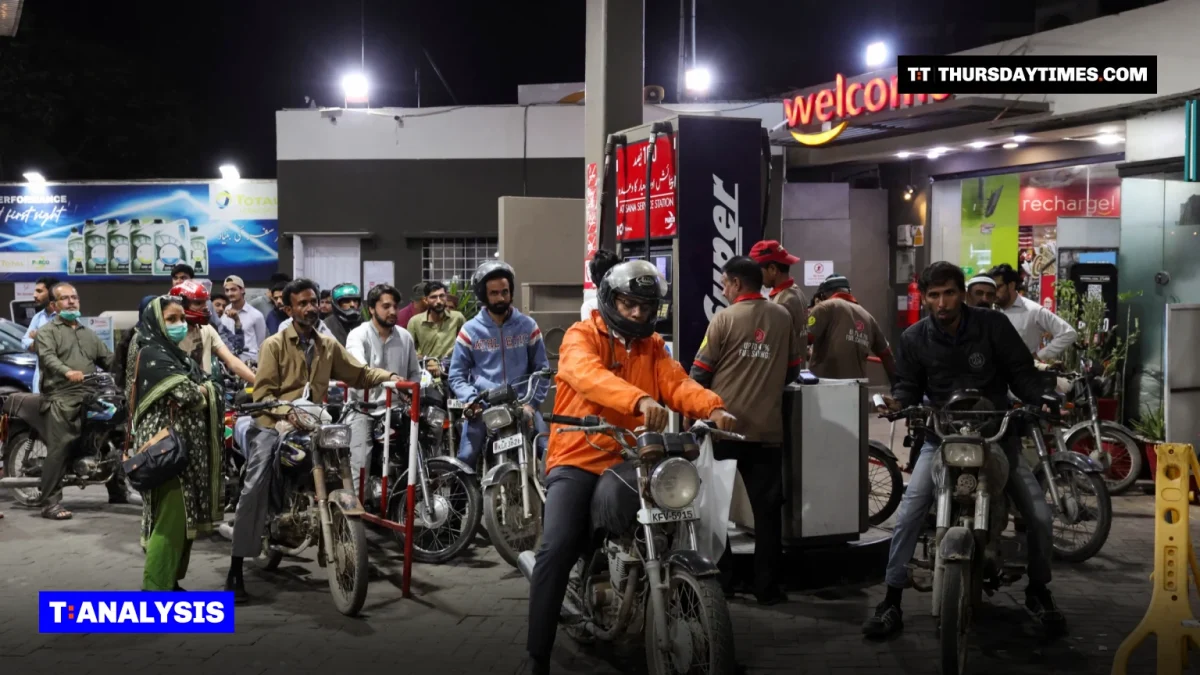
The clearest measure of the war in Pakistani lives is the price of fuel. Petrol peaked at Rs458.41 a litre on April 3 and diesel at Rs520.35. Since then, as world oil prices fell, the government has cut the price four times in a row under its pricing formula. From Friday, petrol costs Rs352.59 a litre and diesel Rs382.25.
Price per litre, rupees
Oil and Gas Regulatory Authority prices. Taxes and duties make up about Rs114 a litre of the petrol price and Rs100 of diesel.
The direction of world prices depends heavily on the talks. When Vance said on November 2 that Washington had “made some progress” with Iran, oil fell more than 7 per cent in a day. A settlement that reopens the Strait of Hormuz would remove the war premium that has sat on every barrel shipped out of the Gulf. A collapse would put it back.
How much of any fall reaches the pump is a decision for Islamabad. The government levies about Rs114 a litre in taxes and duties on petrol and Rs100 on diesel, and under a 30-day arrangement refineries are absorbing Rs15 billion, which the government says takes Rs14.71 a litre off petrol. Cheaper oil gives the finance ministry a choice between lower prices and higher revenue. Either way, it widens the room the country has to work with.
2. The gas grid
The war’s effect on gas has been harsher and will last longer. Pakistan buys most of its imported liquefied natural gas from Qatar under long-term contracts and uses it for power, industry and homes. QatarEnergy has declared force majeure since the war began, and has now told Pakistani buyers that it will not deliver before the end of December. That leaves Pakistan facing the winter peak without its main supplier.
Even the cargoes Pakistan arranged have been at risk. On November 1 the Qatari tanker Al Mayeda, carrying LNG for Pakistan, came under fire near the Strait of Hormuz, hours after Iran had cleared its passage following talks with Islamabad. It turned back into the Gulf. Pakistani diplomacy had kept several earlier shipments moving safely, but the episode showed how thin the margin is.
The country’s exposure is made worse by a gap in its own infrastructure: Pakistan has no LNG storage, so its supply depends entirely on ships arriving on schedule. A US-backed group has applied to build a $4.4 billion terminal at Port Qasim with storage tanks and a 1,100km pipeline upcountry, after a venture of the Lucky Group and QatarEnergy pulled out. That will take years. A ceasefire that lets Qatari cargoes sail normally would help this winter.
“Peace next door is worth more to Pakistan than to almost any country outside the war itself.”
3. The mines
The war has also reached investments that have nothing to do with energy. At Reko Diq in Balochistan, one of the largest undeveloped copper and gold deposits in the world, first production could slip by two years to 2030, government sources and industry insiders say, with security in the province and the war in neighbouring Iran both cited.
Barrick, the Canadian company that holds half the project, began a review in February, the month the war started. Nearly $1 billion has already been invested, all 700 permanent staff and about 2,000 contract workers have been kept on, and people at the site insist work has not stopped. But the company’s chief executive has said it wants “some sort of security improvement” before committing to a full construction schedule. Balochistan shares a long border with Iran. A settlement next door would not solve the province’s security problems, but it would remove one of the reasons for delay.
4. The remittance line
The biggest number in Pakistan’s external accounts is not oil or gas. It is the money sent home by Pakistanis abroad. In April alone, workers sent $3.5 billion, led by Saudi Arabia at about $842 million and the United Arab Emirates at about $735 million. Britain, the European Union and the United States made up most of the rest.
Remittances in April 2026, $ million
State Bank of Pakistan figures. The total for April was $3.5 billion.
So far the flow has held up remarkably well. The State Bank has raised its forecast for this fiscal year to $45 billion, and its own reserves have passed $21.5 billion, the highest on record. Saudi Arabia has rolled over a $3 billion deposit. That resilience owes a great deal to the fact that the Gulf economies have kept working through the war.
The risk is in escalation. Saudi Arabia has come under attack from Yemen’s Iran-aligned Houthis, and Gulf energy sites remain targets. A wider war that hit the cities where Pakistanis work would threaten the single most reliable source of foreign exchange the country has. A settlement protects it.
5. The treasury
All four of these channels end up in one place: the country’s external accounts. Pakistan’s central bank reserves have passed $21.5 billion, the highest in its history, and the finance ministry puts gross external repayments this cycle at about the same figure. Most of that is rolled over rather than repaid in cash. In the same week that the reserves record was announced, Saudi Arabia rolled over $3 billion, and China and Kuwait were reported to have promised to do the same with $4.3 billion more.
That is a far stronger position than the country held two years ago, but it leaves little room for shocks. A higher oil bill, emergency purchases of spot LNG at winter prices or a dip in Gulf remittances would all come straight out of that cushion. A settlement works in the other direction: cheaper fuel imports, cheaper gas once Qatari cargoes return, and steadier inflows from the Gulf would all add to the reserves rather than draw them down.
There is a fiscal side too. Lower world prices let the government either pass relief to consumers or collect more from the levy it already charges. With the economy only recently stabilised, that room to choose is itself worth having.
6. The mediator’s dividend
There is a less tangible gain too. The war has turned Pakistan into a country Washington and Tehran both call. The Makkah Pact countries met Iran together for the first time in October at Pakistan’s initiative, and Riyadh tied its delegation directly to Pakistani and Qatari mediation. That standing has value well beyond this crisis, in trade talks, in financing and in the way Pakistan is treated in the Gulf.
It should not be overstated. The finance minister has lowered expectations of a $10 billion American financing facility that was once talked up, saying Pakistan will “move forward, with or without it”. Diplomatic credit does not pay import bills on its own. But it helps, and it lasts longer if the mediation succeeds.
What could still go wrong
The talks remain fragile. Iran has set five conditions for reopening Hormuz, including the lifting of recent US sanctions, the restoration of oil waivers, a smaller American military presence and recognition of new shipping lanes. Washington wants a verifiable commitment that Iran will not rebuild its nuclear programme. In the same week that Vance spoke of progress, the United States struck Qeshm Island and three tankers hit mines in the strait.
Donald Trump has said the war will end “when I say it ends”. The midterm results, which Vance blamed on the war, have made him readier to let diplomacy run, US officials say. But the military remains ready to resume strikes at short notice.
For Pakistan, the arithmetic is unusually clear. Every month of war costs it at the pump and on the gas grid, delays its biggest mining project and puts its most important source of foreign money at risk. Every month of peace does the opposite. That is why the quiet work in Islamabad matters, and why the country should see it through.