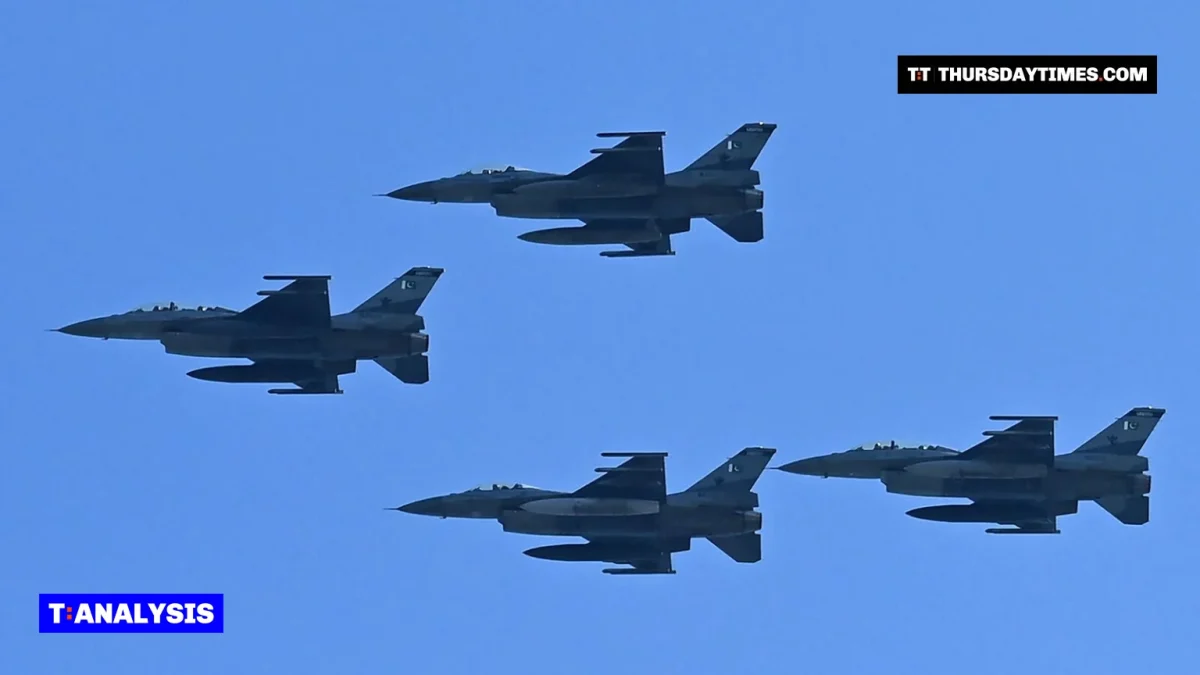
RAWALPINDI (The Thursday Times) — The Pakistan Army’s announcement that troops are leaving for Saudi Arabia is short on detail and careful in its wording. The military’s media wing said a send-off ceremony was held on Saturday 28 November and that the soldiers will carry out their responsibilities “within Saudi territory”, under “agreed commitments and the established framework of defence cooperation”. It gave no numbers, locations, or timeline. Set against the 2025 bilateral agreement and the Makkah pact signed on 7 August, the wording shows what kind of deployment this is, and what it does not settle.
Inter-Services Public Relations (ISPR) issued its statement on Sunday 29 November. Defence Minister Khawaja Muhammad Asif was chief guest at the ceremony, which Saudi Ambassador Rajeh Tami Albugamy, Chief of General Staff Lt Gen Omer Ahmed Bokhari, and Lahore Corps Commander Lt Gen Muhammad Umer Bashir also attended. The day is covered in our news report. This analysis asks what the deployment adds, in law and in the public record, to what Pakistan had already committed.
Three phrases that carry the weight
Three phrases in the statement do most of the work.
“Within Saudi territory”
The troops are described as serving inside the Kingdom, and the statement says nothing about operations beyond its borders. That matches what Foreign Office spokesperson Sajjad Haider Khan told reporters on 9 October: Pakistani forces in the Kingdom would not cross into Yemen to attack the Houthis.
“Agreed commitments and the established framework of defence cooperation”
This names a framework without naming a treaty. It could point to the September 2025 bilateral agreement, to the Makkah pact, to the longer military relationship that Pakistan’s military spokesman has said is not new, or to all three. The statement does not choose between them.
“Defensive capabilities amid emerging security concerns”
The purpose is stated as defensive and the threat is left unnamed. The statement did not say which threats the troops will address. The setting is not hidden, though: on Friday 27 November, the three Makkah allies condemned Houthi attacks on Saudi Arabia in Islamabad and resolved to intensify their support for the Kingdom.
Three layers, and the dates between them
The deployment sits on three layers of commitment, built at different speeds. The oldest is practice rather than paper: the military spokesman has said that the presence of Pakistani forces in the Kingdom is not new and does not come from the Makkah agreement. The second is the Strategic Mutual Defence Agreement, signed in Riyadh on 17 September 2025 by Prime Minister Shehbaz Sharif and Crown Prince Mohammed bin Salman. The Saudi Press Agency quoted its joint statement as saying that “any aggression against either country shall be considered an aggression against both”, and said the agreement aims to develop aspects of defence cooperation and strengthen joint deterrence. The third is the Makkah Joint Defence Agreement, signed by Pakistan, Saudi Arabia, and Türkiye on 7 August 2026.
The public record, step by step
Sources: statements by the Saudi Press Agency, the Saudi defence ministry, the joint statements of the alliance committee, and ISPR.
The April announcement came from Riyadh, not Islamabad. The Saudi defence ministry said the force was there to improve joint military coordination and operational readiness, and tied the move to the joint defence cooperation agreement between the two countries. This time the announcement came from the Pakistani side, amid continuing attacks: Saudi Civil Defence said 11 people were injured on 24 November when an attack hit a tower in Riyadh’s King Abdullah Financial District, and the Saudi-led coalition said its air defences intercepted missiles early on Sunday.
Days from decision to announcement
Calendar days. The first bar runs from 17 September 2025 to the Saudi defence ministry’s announcement on 11 April 2026; the second from 7 August to the 28 November ceremony; the third from the committee’s 5 October resolution to the same ceremony.
The gaps are getting shorter. Speed is not the same as detail, though. The interval between a decision and a departure says nothing about size, and none of the statements gives one.
What the Makkah text asks of its members
The Makkah agreement has 16 articles, and the text submitted to the Turkish parliament in October has since been published in full. Article 2 is the core. It says an externally originating armed attack on any party is an attack on all, that the others shall assist the attacked party immediately, and that the scope and nature of support will be set after an objective assessmentThe phrase in Article 2 for how the allies decide what help an attacked member needs. The text does not say who carries out the assessment or how. of the assistance required. Support is limited by each country’s available resources, including military means, and the article refers to the right of collective self-defenceArticle 51 of the UN Charter recognises the right of states to defend themselves, alone or together, if an armed attack occurs. The Makkah text refers to it.. Article 1 commits the parties to use “all necessary means” against threats to one another’s sovereignty, territorial integrity, or recognised borders.
Read closely, that is a duty to help, not a formula for how much. Nothing in Article 2 fixes a number of troops, a type of unit, or a location. Those questions are left to the alliance’s Strategic Political and Defence CommitteeThe alliance’s top body. It brings together the three countries’ foreign ministers, defence ministers, and chiefs of general staff, and normally meets twice a year. and to any implementing protocols the parties negotiate. ISPR’s reference to “agreed commitments” suggests that terms have been settled between the governments, but those terms have not been made public.
“The Makkah text fixes the duty to help. It leaves the amount of help to be assessed.”
Three other clauses bear on a deployment of this kind. Article 11 makes the agreement the legal basis for carrying out its provisions, “without prejudice” to international law and each party’s domestic laws. Article 12 leaves the parties’ earlier international agreements untouched, which is why the 2025 bilateral agreement stands alongside the new pact, as Pakistani officials have said it would. Article 16 makes the agreement open-ended, with no withdrawal possible until ten years after it enters into force, followed by three months’ written notice.
National procedures are left to each member. Türkiye’s constitution requires separate parliamentary approval to send troops abroad, whatever an international agreement says, and the text provides for ratification under each party’s own procedures. The pact itself does not decide how any one member approves a deployment.
Where Pakistan has drawn the line
Pakistan’s public position has two parts, and the statement is consistent with both. The first is that the alliance is defensive. Deputy Prime Minister and Foreign Minister Ishaq Dar said on 16 November that it is a pact of self-defence and should not be read as an attempt at confrontation with other countries, and a Foreign Office spokesperson said on 20 November that it is not directed against any country. On 9 October, the spokesperson went further on Yemen: Pakistani forces in the Kingdom, he said, would not cross the border to attack the Houthis.
The second part is a commitment to the Kingdom’s own security. ISPR said Pakistan “remains steadfast in its commitment to safeguarding the Kingdom’s security and the sanctity of Haramain Sharifain”, the holy sanctuaries in Makkah and Madinah.
The two-part line is not new. In April 2015, after a joint sitting that ran from 6 to 10 April, parliament unanimously passed a resolution that desired Pakistan to maintain neutrality in the Yemen conflict, while pledging that Pakistan would stand with Saudi Arabia if its territorial integrity were violated or the holy sites were threatened. The 2026 framework is a treaty rather than a resolution, but the line it draws in public speech is recognisably the same: the Kingdom’s territory and the holy sanctuaries on one side, an offensive role in Yemen on the other.
“Defend the Kingdom, stay out of Yemen: a line parliament drew in 2015 and the Foreign Office repeated in October.”
What is not known
The statement leaves a long list of open questions, and some of them are by design. Pakistan’s military spokesman has said in an interview that military alliances do not disclose troop numbers, deployment locations, or operational specifics. That explains the brevity, and it means readers must separate what has been said from what has simply not been said.
On the record, and not
Sources: ISPR statement of 29 November; joint statements of the alliance committee; the text of the Makkah Joint Defence Agreement.
Two further gaps matter for the Makkah pact. The “objective assessment” in Article 2 is a process, and the process has not been described in public. The committee’s 27 November joint statement, which is mostly a review of progress, gave no date or venue for its next session and said only that consultations will continue. Our report on that meeting sets out what was and was not settled, and our news story has the condemnation of the Houthi attacks. The military spokesman’s account of the alliance’s structure is in our earlier report, and our September analysis looked at how far the commitment had been defined by then.
What to watch next
Three developments would add detail. The first is any statement from the Saudi side describing the force, as the defence ministry did in April. The second is the committee’s next session, since the agreement provides for it to meet normally twice a year. The third is whether ISPR or the Foreign Office says more about the troops’ tasks, which would show which of the three layers the deployment rests on.
The fair reading is neither more nor less than the texts allow. Pakistan has said, through its army, that its soldiers are going to strengthen the Kingdom’s defences from within Saudi territory, under commitments it considers already agreed. The Makkah text makes that a duty of help whose size is for the allies to assess, and the 2025 agreement is known only through the statement that announced it. What the public does not yet have is the assessment.