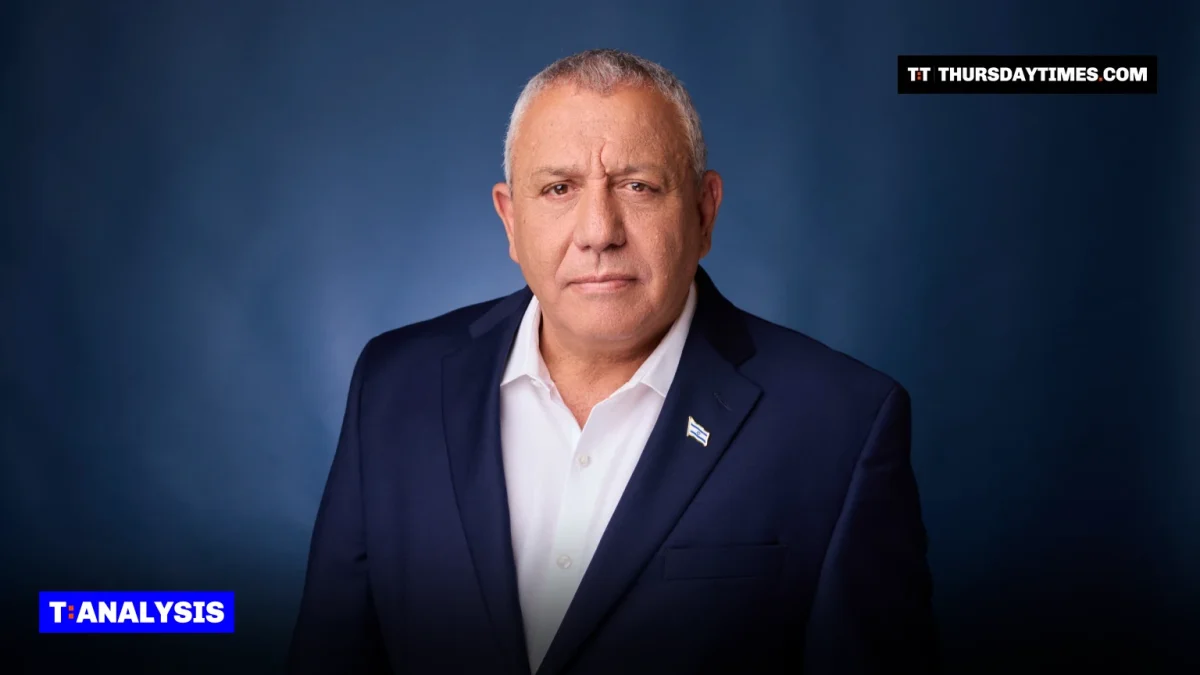
JERUSALEM (The Thursday Times) — Gadi Eisenkot now has the support of 67 of the 120 members of Israel’s next Knesset, and President Isaac Herzog is expected to ask him to form a government within days. On paper that is a comfortable majority. In practice, 19 of those 67 seats belong to Arab-led parties that most of his own allies have sworn never to rely on, which leaves the former army chief with 48 seats he can count on and a hard search for the other 13. How he finds them will decide whether Benjamin Netanyahu’s long run in power is really over.
The consultations at the President’s Residence ended on Thursday with a clear count. Eisenkot’s own Yashar party recommended him, taking him to 67. Netanyahu had 46, from his Likud and its far-right and religious allies. The ultra-Orthodox United Torah Judaism, with seven seats, recommended no one. Herzog must name a candidate by November 11, a day after the new Knesset is sworn in, and the numbers leave little doubt about whom he will choose.
But the recommendation is the easy part. A candidate needs 61 votes to win a confidence vote, and recommendations are not promises to sit in a cabinet, or even to vote for one. The Joint List, which backed Eisenkot, said plainly that it did so “to prevent Netanyahu and his government from returning to power”, not to join him.
Who recommended whom
Seats in the 120-member Knesset. A government needs 61. Eisenkot: Yashar 21, B’Yachad 12, Joint List 11, Ra’am 8, the Democrats 8, Yisrael Beytenu 7. Netanyahu: Likud 27, Otzma Yehudit 7, Shas 6, Religious Zionism 6. No one: United Torah Judaism 7.
How the October vote left the board
The election on October 27, the first since the Hamas-led attack of October 7, 2023 and the wars that followed, did something few expected. It broke Netanyahu’s majority without giving anyone else one. His bloc fell to 53 seats, eight short of a majority and 11 fewer than it won in 2022. The Jewish-led opposition won 48. Arab-led parties, on a record turnout, won 19, their best result ever.
Since then Netanyahu’s Likud has claimed, without evidence, that the vote was “stolen” with foreign money, and asked for the results to be held back. The head of the election committee, Justice Noam Sohlberg, refused, saying the committee had no power to withhold certification and that the result would stand even if the suspicions were proved. Netanyahu has since moved from promising “a strong right-wing national government” to offering a “broad national government”, as long as he leads it. No opposition leader has accepted.
So the starting position is this: one man with a majority of recommendations but no majority of partners, and a caretaker prime ministerThe outgoing prime minister stays in office with full day-to-day powers until a new government wins a confidence vote in the Knesset, however long that takes. who keeps his office, his powers and his cabinet for as long as the deadlock lasts.
“One man has a majority of recommendations but no majority of partners. The other keeps his office for as long as the deadlock lasts.”
The clock
From the vote to a government
October 27
Election. Netanyahu’s bloc 53, Jewish-led opposition 48, Arab-led parties 19.
November 4 and 5
Results certified. Herzog consults every faction. Eisenkot ends with 67 recommendations.
By November 10
The new Knesset is sworn in and must elect a speaker, the first real head count.
By November 11
Herzog names the lawmaker who will try to form a government.
28 days, plus up to 14
The candidate’s time to build a coalition. If it fails, Herzog can give a second lawmaker 28 days, and then a majority of the Knesset can put forward a third. If all fail, Israel votes again.
Netanyahu remains caretaker prime minister throughout.
Four roads to 61
There are only four realistic ways for Eisenkot to reach a working majority. Each one runs into a promise someone in his camp has already made.
The first road runs through the Arab parties. Add Ra’am’s eight seats and the Joint List’s 11 to the 48 and the opposition has 67. That is the arithmetic behind the recommendation count, and thousands of Israelis rallied last week for a Jewish-Arab coalition. But Avigdor Liberman of Yisrael Beytenu has ruled out relying on the Arab parties, and Naftali Bennett will not depend on the Joint List. Yair Golan of the Democrats is the only Jewish opposition leader openly in favour. Eisenkot’s own conditions for joining his government include recognising Israel as a Jewish state and treating Hamas as a terror group whose capabilities in Gaza must be destroyed, terms many Arab lawmakers will not accept. The Joint List’s Ahmad Tibi has said his party would support a government from outside but not join it. Ra’am’s Mansour Abbas has not ruled out going further. A minority governmentA cabinet whose own parties hold fewer than 61 seats, which survives because other parties agree to vote for it or abstain on key votes without joining it. backed from outside is possible. Liberman, whose seven seats it would need, says such a government would “survive less than a year” and bring Netanyahu back stronger.
The second road runs through the ultra-Orthodox. Here the numbers are striking. The 48 Jewish opposition seats, plus United Torah Judaism’s seven and Shas’s six, make exactly 61, a majority without either Likud or the Arab parties. United Torah Judaism withheld its recommendation from Netanyahu, its longtime ally, and Liberman has softened his tone, saying he would “have no problem” with anyone who accepts his principles. The obstacle is the draft. United Torah Judaism says it will back no government that does not pass a law protecting military service exemptions for yeshiva students. Eisenkot campaigned on compulsory national service for all, and Liberman wants a law to conscript the ultra-Orthodox. It is hard to see a formula that satisfies both, though Israeli coalition talks have produced stranger compromises.
The third road runs through Likud. Liberman’s own suggestion is to wait for defectors. “Maybe we’ll get defectors from Likud,” he said. “We’ll wait; we have patience.” Likud is the largest party, with 27 seats, and some of its lawmakers may conclude that their careers do not depend on Netanyahu. But Netanyahu has spent the past week working to stop exactly that, and 13 defectors is a very large number to find.
The fourth road is a unity government. Likud, Yashar and Bennett’s B’Yachad together hold 60 seats, one short. Herzog has urged leaders to find “creative solutions”, and a rotationA coalition deal in which two leaders agree to share the premiership, each serving as prime minister for part of the term. deal is the classic Israeli answer. But Eisenkot and Bennett campaigned on refusing to serve under Netanyahu, and Likud has rejected rotation. “Whoever wants to can join the government on the basis of the existing coalition,” its coalition whip, Ofir Katz, said.
Four roads, four numbers
What an Eisenkot government would change
Outside Israel there is a temptation to treat any change of leader as a change of direction. It is worth being careful. Eisenkot is a soldier who spent nearly four decades in uniform and served as chief of staff from 2015 to 2019. As head of Northern Command in 2008 he set out what became known as the Dahiya doctrineThe use of overwhelming force against areas from which an enemy fires, named after the Beirut suburb heavily bombed in the 2006 Lebanon war.. He says the next government must stop Iran from getting nuclear weapons, whether by force or through a US-backed deal, and his conditions for coalition partners include destroying Hamas’s capabilities in Gaza.
Where he differs from Netanyahu is in how he would govern. The opposition leaders’ joint statement promised to replace what they called the “Oct. 7 government” with a “national emergency government”. Eisenkot left Netanyahu’s war cabinet in June 2024, criticising his handling of the war and of the hostages held in Gaza. His son was killed fighting there. He has accused Netanyahu of “fearmongering, lies and threats”. A government led by him would not include the far-right ministers Itamar Ben-Gvir and Bezalel Smotrich, whose views on Gaza and the occupied West Bank have shaped much of the world’s view of Israel since 2023.
“Where Eisenkot differs from Netanyahu is less in what he would fight for than in who he would govern with.”
That matters to Washington as well. President Donald Trump endorsed Netanyahu before the vote, and Eisenkot has said he is confident Trump would work “in full co-operation with any leader chosen by the people”. With Republicans weakened by this week’s midterm results, an American administration dealing with a new Israeli leader and a Democratic Congress would face a very different set of pressures on Iran and Gaza.
For the wider Middle East, including the Muslim countries that have watched this election closely, the honest assessment is that an Eisenkot government would be a change of tone, partners and process more than a change of strategy. The governments of the region will judge it on what it does in Gaza and towards Iran, not on who sits in the prime minister’s chair.
What to watch
The first real test comes before Herzog even names a candidate. When the new Knesset is sworn in, it must elect a speaker. Liberman has said the opposition’s priority is to “take command of the Knesset” and replace the speaker, and he backs Yair Lapid for the post. The vote for speaker will show, for the first time, how many votes each camp can actually deliver.
The second is United Torah Judaism. Its refusal to recommend Netanyahu was the most important signal of the week. If its leaders open talks with Eisenkot, or if Shas follows, the second road becomes real. If they return to Netanyahu, the opposition is back to choosing between the Arab parties and another election.
The third is the clock. Netanyahu’s best hope is time: every week of deadlock keeps him in office as caretaker, and every failed attempt brings Israel closer to yet another election. Herzog has told the parties that “the election is over” and that he would try to “set up ladders” for leaders who have “climbed very tall trees”. Eisenkot has the recommendations, and probably the mandate within days. Whether he can turn them into a governing majority depends on which of his allies is first to climb down.