ISLAMABAD (The Thursday Times) — Pakistan’s freelancers earned a record $1.76 billion in the 2025-26 financial year, 78 per cent more than the year before, according to central bank figures. This week brought two changes meant to keep that going: Upwork began paying Pakistani freelancers straight into local mobile wallets, and the government opened refunds of up to Rs70,000 for international IT certifications. Together they show where the freelance economy is heading, and where it still gets stuck.
Neither change is dramatic on its own. A new withdrawal button and a refund scheme for exam fees will not make headlines beyond the people who use them. But freelancing has become one of the few parts of Pakistan’s export economy that grows quickly without new factories, new loans or new trade deals. What the state and the platforms do to the plumbing around it matters more than its size suggests.
How big it has become
The jump in a single year is striking. Freelancers brought in $984 million in 2024-25. A year later the figure was $1.76 billion. Earnings from IT freelancing, the core of the trade, rose 49 per cent to about $1.16 billion. Earnings recorded outside the IT category grew much faster, by 188 per cent, from $205 million to $592 million.
Freelance earnings, by financial year
Source: State Bank of Pakistan data. Financial years run from July to June.
The momentum has carried into the new financial year. Freelancers earned $549 million between July and September 2026, 45 per cent more than in the same quarter a year earlier, central bank figures show. Growth is slowing from last year’s pace, as it was always going to, but it is still far faster than almost any other source of foreign exchange the country has.
Some caution is due on the fastest-growing line. A near-tripling of non-IT freelance income in one year may reflect real new work, from writing and design to online tutoring and support. It may also reflect money that was always being earned but now arrives through channels that record it properly. The two explanations are not exclusive, and the official figures cannot separate them. Either way, more of the money is now visible, and visible money can be taxed, banked and borrowed against.
“Freelancing grows without new factories, new loans or new trade deals. That is why the plumbing matters.”
Where it fits
Pakistan’s IT and IT-enabled exports reached a record $4.6 billion in 2025-26, about 20 per cent more than the year before, though some $400 million short of the government’s $5 billion target. IT freelancers alone accounted for roughly a quarter of that total. The rest comes from software houses, call centres and technology companies with offices, payrolls and corporate clients.
Freelancers’ share of IT exports, 2025-26
Source: State Bank of Pakistan data. Share is approximate.
The comparison with remittances is useful. Money sent home by Pakistanis working abroad reached $41.6 billion in 2025-26, more than twenty times what freelancers earned. Freelancing will not replace that any time soon. But remittances grew 8.6 per cent last year and freelance earnings grew 78 per cent. And there is a difference in kind: a remittance is money earned abroad by someone who has left; a freelance payment is an export, earned by someone who still lives here, spends here and can hire here.
Why the wallet change matters
Until this week, most Pakistani freelancers on Upwork moved their money in at least two hops: from Upwork to PayoneerA US-based payments company that many freelancers use to receive money from foreign platforms and clients., then on to a bank account or wallet, paying fees and losing a slice to currency conversion along the way. Upwork’s new direct-to-wallet option sends earnings straight to JazzCash, Easypaisa, NayaPay, SadaPay or Finja, and the money usually arrives within minutes, the platform says.
It is not free, and it is not always the cheapest option. Upwork says the fee varies by wallet. Users report a flat $1.99 a withdrawal, against $0.99 for Upwork’s direct transfer to a local bank. The currency conversion is built into the exchange rate, and the wallet company may add its own charges. For someone who withdraws large sums a few times a month, the bank route still costs less per transfer.
The bigger gain is reach. A student in Multan or a young graduate in Mardan with a smartphone and a wallet, but no bank account and no Payoneer card, can now be paid directly by one of the world’s largest freelance platforms. For people at the start of their freelance careers, earning small amounts from first jobs, the simplest route is often the one that decides whether they keep going. The option is also available in Bangladesh, Indonesia, the Philippines and Kenya, markets that compete with Pakistan for much of the same work, so it removes a disadvantage as much as it creates an advantage.
“For people earning small amounts from first jobs, the simplest route is often the one that decides whether they keep going.”
The Rs70,000 question
The second change is about skills. The Prime Minister’s IT Certification Reimbursement Program, run by the PSEBThe Pakistan Software Export Board, the government body that promotes IT exports, under the Ministry of IT and Telecommunication., will refund up to Rs70,000 for approved certifications from Amazon Web Services, Microsoft, Google, Cisco and Oracle. On crowded freelance platforms, clients often use such certificates as a quick way to sort hundreds of profiles, and in cloud computing and networking, the better-paid end of the market, they can open doors that a portfolio alone does not.
The design has a catch. It is a refund, so candidates pay the exam fee first and are repaid only after they pass and submit their certificate. That favours people who already have the cash, and the young graduate in Mardan is exactly the person who may not. A voucher, or payment straight to the exam provider for candidates who meet set criteria, would reach the talented but cash-poor. No deadline or limit on places has been published, which leaves open how far the money will stretch.
What still holds freelancers back
Getting paid from everywhere, not just one platform
Upwork is one platform. Many freelancers also work for direct clients abroad, and PayPal accounts are still not available to them in the ordinary way. In June 2025 the government launched a mediated arrangement that lets up to 10,000 freelancers receive PayPal-based payments into local bank accounts without their own PayPal accounts. It was a start. A ceiling of 10,000 in a trade that officials have put at more than 1.5 million active freelancers shows how far there is to go.
Keeping the money safe
Sending earnings straight to a phone makes the phone the bank. That raises the stakes on account security. This week the Pakistan Telecommunication Authority and Meta blocked 176,000 WhatsApp accounts registered on recycled SIM numbers, a reminder of how much of digital life still hangs on a phone number that can change hands. Wallet companies and regulators will need to make sure that a new SIM owner can never inherit someone else’s earnings.
Keeping the name clean
Pakistani freelancers sell trust as much as skill. Every scam call centre raided in Karachi or Rawalpindi makes foreign clients a little warier of Pakistani profiles, through no fault of the honest majority. Cracking down on fraud is not only a law-and-order issue. It protects one of the country’s fastest-growing exports.
Keeping some of the dollars
Rules that let IT companies and freelancers keep part of their export earnings in dollar accounts, introduced as a 50 per cent retentionThe share of export earnings that may be kept in foreign currency instead of being converted to rupees. allowance, help freelancers pay for software, hardware and subscriptions abroad without converting twice. How easily wallets and banks let freelancers use that allowance in practice will matter as much as the rule itself.
What to watch
Three things will show whether this week’s changes add up to more than convenience. First, whether other platforms follow Upwork into Pakistani wallets, which would make direct payment the norm rather than one platform’s feature. Second, how many people actually claim the certification refund, and whether the government is willing to turn it into an upfront voucher if take-up is low among those who need it most. Third, the central bank’s figures for October to December, which will show whether a 45 per cent growth rate can hold through the year.
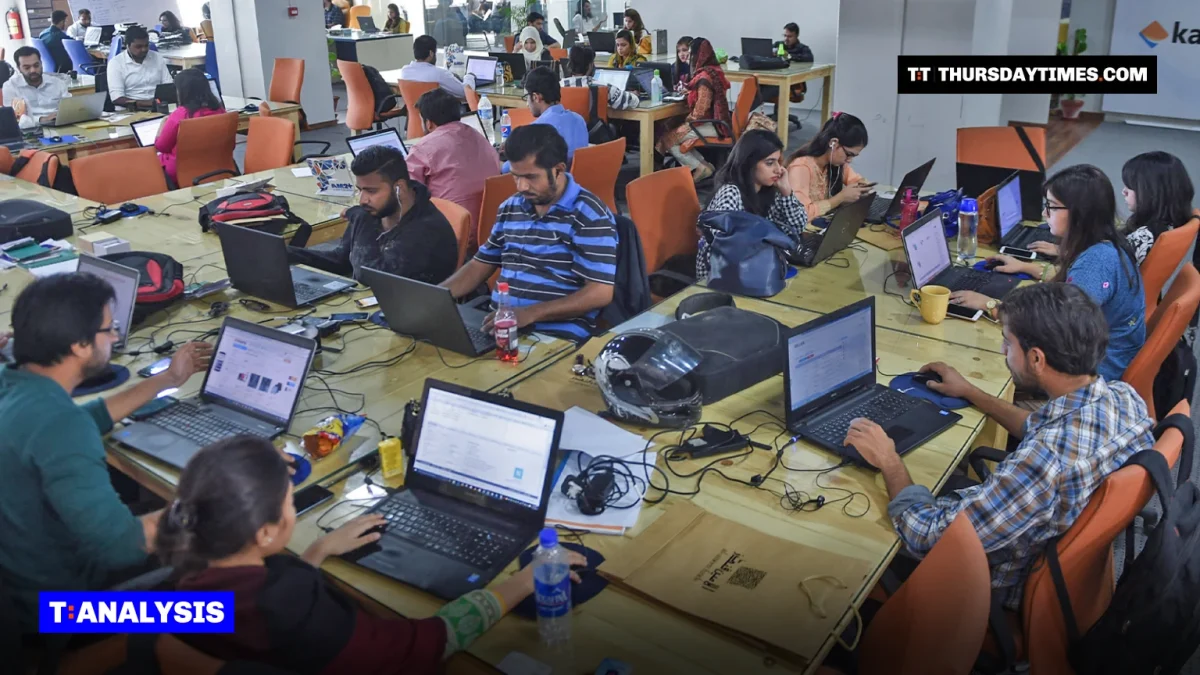
The underlying trend is already clear. Pakistan has hundreds of thousands of young people selling skills to the world from bedrooms, cafes and co-working spaces, and they are earning more every year. They do not need the state to create their market. They need it, and the platforms they use, to make the road home for their money as short, cheap and safe as possible, and to help the next ones in line get the skills to join them.
“They do not need the state to create their market. They need it to make the road home for their money short, cheap and safe.”