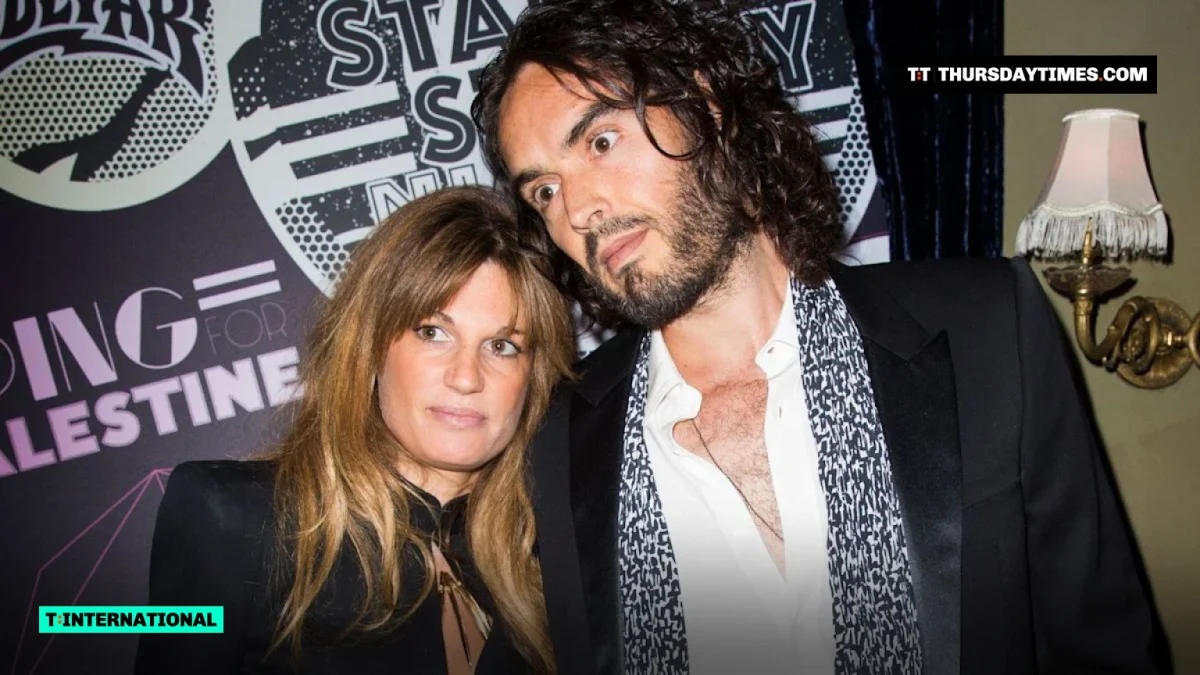
LONDON (The Thursday Times) — Jemima Goldsmith has said Russell Brand subjected her to “violence, coercive control and abuse” and that she had to call the police to remove him from her home during a violent incident in 2014, as she defended a harassment injunction the two obtained that year against a massage therapist who had accused him of assault.
Goldsmith, who is also known as Jemima Khan and was married to former prime minister Imran Khan, set out her account in a long statement on X on Monday, the day Brand was jailed for 10 years and six months for one rape and three sexual assaults. She said she had been “put in a position” where she had no choice but to speak, because of “misleading reports and speculation” about the injunction.
“I am and have always been strongly and unequivocally on the side of all of Brand’s victims,” she wrote. “I am in awe of the courageous women who came forward at Brand’s trial, told their stories, testified and ensured justice was done.”
What Jemima Goldsmith says Russell Brand did
Goldsmith, who was in a relationship with Brand in 2014, said she chose not to press charges after the incident at her house or to go public, because she was worried about the effect of press attention on her children, who were then teenagers. She said she has neither seen nor spoken to him since. Her own pain, she wrote, “pales in comparison” to what the women who gave evidence had suffered, but the period “has had a lasting impact”.
She said she helped, over several years, the journalists who eventually exposed Brand, and had offered to testify to his abusiveness if the newspaper that published his victims’ accounts was ever sued.
The Szilvia Berki injunction
The order at the centre of the row dates from 2014. According to Goldsmith, she booked Szilvia Berki, a massage therapist, to give Brand a massage at her house in June that year. By the time Berki arrived, she said, Brand no longer wanted one and asked her to leave after about 30 minutes. Goldsmith said she was present throughout and “did not see anything untoward”.
Berki later told police that Brand had pushed her in the back as she left. Goldsmith said Thames Valley Police found no case to answer, and that a later review by the police watchdog and the force’s professional standards department upheld that finding. Berki has said she was treated “like a prostitute”. Brand and Goldsmith brought harassment proceedings against her; the High Court granted an interim injunction in September 2014 and made it final in October 2015.
The order came back into the spotlight last week, as Brand’s trial ended. The tax lawyer and campaigner Dan Neidle, who obtained a copy of the final order, wrote on Saturday that Berki “had no lawyer. No trial. Yet she was silenced for life – even barred from speaking to the police.” Supporters of Berki have since called for the order to be lifted.
Goldsmith said she agreed to seek the order only to stop what she described as a campaign of antisemitic and threatening messages from Berki to her, her family, her workplace, journalists, MPs, and Unicef UK, where she had been a goodwill ambassador for decades. She published a selection of the messages, which she said had been put before the judge. One read: “soon we will kill her then.” Others attacked her as a Jew.
“The number, tone and content of these messages was extremely frightening,” she wrote. She said the High Court had found the harassment “oppressive and unacceptable”, and that the order had been upheld by the High Court and the Court of Appeal on several occasions.
Goldsmith said she agreed with those calling for the order to be varied. She said she told Berki’s barrister through her lawyer last December that she would agree to a change so Berki could speak to the police again, and would discuss Berki’s other requests. The barrister has not replied since May, she said, and she was told any change also needed Brand’s agreement, which she has no power to compel.
She said she had agreed to vary the order despite fears that renewed antisemitic abuse could add to the danger her children already face “because of our Jewish heritage and their father’s political career and incarceration in Pakistan”. Imran Khan, the founder of the PTI, has been in prison since August 2023.
Russell Brand’s conviction and sentence
A jury at Southwark Crown Court convicted Brand, 51, on November 5 of one rape and three sexual assaults against four women between 2004 and 2009, and cleared him of two further counts of rape and one of attempted indecent assault. Sentencing him on Monday, Mr Justice Bennathan called him a “predator” who had shown “staggering arrogance”. Brand denied all the charges.
“I am glad and relieved that Russell Brand has finally faced justice,” Goldsmith wrote at the end of her statement.