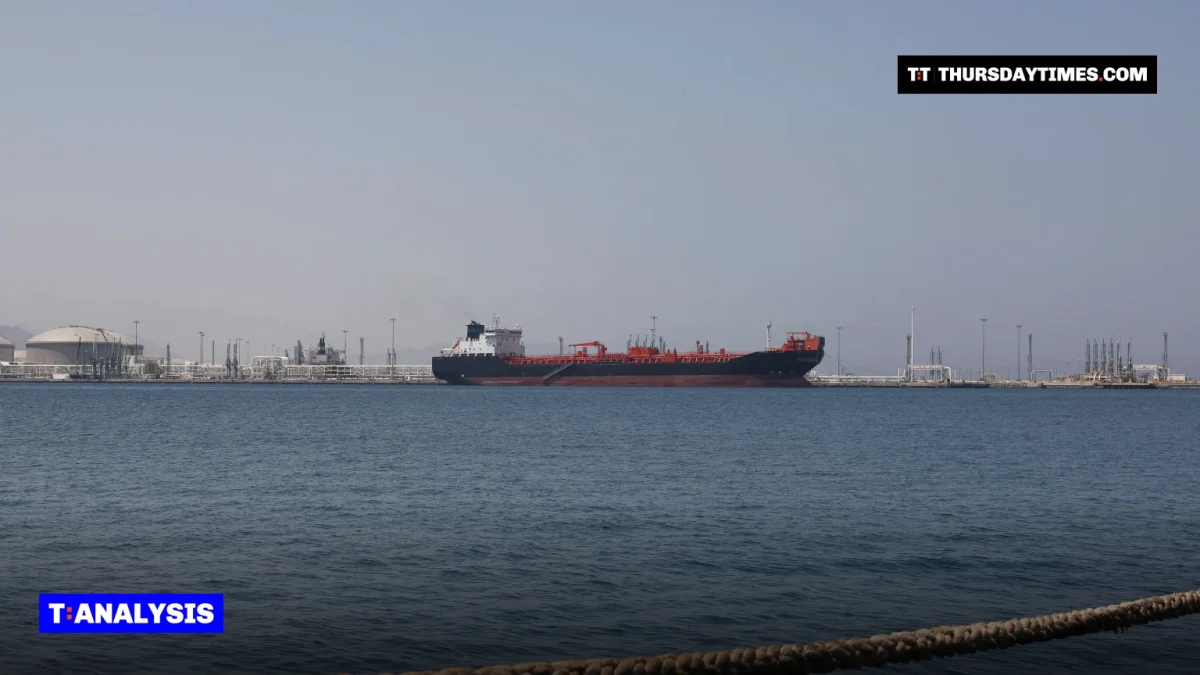
DUBAI (The Thursday Times) — Between Wednesday and Friday, Iran’s armed forces said they had disabled six vessels in and around the Strait of Hormuz, shot down an American drone, and destroyed an American radar in Bahrain. Not one of the six ships has been named. The United States says the radar was never hit, and that the two Iranian drones sent towards Bahrain were shot down without causing any damage. The only tanker struck this week whose name, crew, and position are publicly known, the Liberia-flagged Dominica Prosperity, was not among the ships Iran claimed. That gap, between what is said and what can be shown, is now one of the main things moving oil prices, insurance premiums, and the fuel bill of every country that buys from the Gulf, Pakistan included.
Forty-eight hours of claims
The pattern is easiest to see laid out in order. Each Iranian statement came through state media or agencies close to the Revolutionary Guards. Each described ships that had ignored warnings, switched off their navigation systems, or used a route Tehran has declared off-limits. Almost none could be checked.
What was claimed, and what has been confirmed
Wednesday: a tanker hits a mine in a “restricted area”
Claimed by Iran’s army. No vessel named. Britain’s maritime agency logged a tanker incident in the strait, with the crew’s status unknown.
Wednesday night: two supertankers, four million barrels, disabled
Claimed by the Revolutionary Guards. No names, owners, or flags. Not independently confirmed.
Wednesday: the Dominica Prosperity is struck off Ras Al Khaimah
Confirmed. Named by India’s shipping minister; reported by maritime agencies; all 22 crew evacuated. Nobody has said who fired.
Thursday: two more tankers hit mines east of the strait
Claimed by Iran’s army. No names, flags, or cargo; no independent confirmation.
Friday: a US radar in Bahrain destroyed
Denied. US Central Command says two drones were shot down, with “no injuries or damage”.
Friday: a US drone downed and a gas carrier mined
Claimed by Iran’s navy and the Guards’ navy. The carrier was not named. Neither claim could be verified.
Sources: Iranian state media; UK Maritime Trade Operations; India’s shipping ministry; US Central Command.
None of this means every Iranian claim is false. Ships have been hit this month, and badly. Maritime monitors counted at least 37 attacks on ships in and near the strait in the first eleven days of November, the most in any month since the war began on February 28. The International Maritime Organization had recorded 134 confirmed incidents in the region by November 11, with 25 seafarers killed. On Tuesday, a vessel operated by ADNOC was damaged in an attack inside the UAE’s own waters, which the company confirmed. The danger is real. What is in doubt is the detail, and in a war fought partly over who controls a waterway, the detail is the point.
In the Strait of Hormuz, a claim does not need to be true to move a market. It only needs to be believable.
Why the claims work anyway
Iran’s statements are aimed less at proving what happened than at shaping what shipowners do next. Tehran says ships must use routes it approves, and its security chief, Mohsen Rezaei, has said the strait will stay shut until Washington meets seven conditions. Every report of a burning tanker on an “unauthorised route” tells captains, owners, and insurers that the American escort on the southern route does not buy safety. The army’s statement on Thursday made that explicit, putting responsibility first on President Donald Trump and then on owners who had trusted what it called his “misleading statements”.
The commercial world cannot wait for proof. An underwriter pricing a voyage this week has to weigh an unconfirmed claim of four disabled tankers against a confirmed strike on a fifth, and the cheapest decision is to treat the whole area as dangerous. That is why a statement nobody can verify still raises premiums, delays sailings, and adds a risk margin to every barrel loaded in the Gulf. On Thursday, Brent crude traded at about $93 a barrel, edging higher after earlier falls, as tension in the region offset rising output elsewhere.
Washington plays the same game from the other side. The United States says it has cleared the strait of mines, which is why Iranian reports of mine strikes are so pointed. Secretary of State Marco Rubio said this week that the “economic campaign” against Iran was so devastating that major combat was unnecessary. On Thursday, Trump wrote that Washington no longer needed a deal with Iran because it already had Iran’s money and “their Strait”. Each side is telling shipping companies that it, not the other, sets the terms of passage.
There are, in practice, three kinds of information coming out of the region. The first is a named ship, with a flag, a crew, and a position, reported by a government or a maritime agency that has to answer for it. The second is a statement from a party to the war, which may be true, partly true, or invented. The third is the silence that follows a claim, which is often the most telling. When a supertanker carrying two million barrels is genuinely disabled, its owner, its insurer, and its flag state usually say so within hours. When nobody says anything at all, that silence is information too.
What can actually be checked
A careful reader can apply a few simple tests. Is the ship named? Has UKMTOUK Maritime Trade Operations, a British navy centre that collects and publishes reports of incidents involving merchant ships in the Middle East and nearby waters., a flag state, a port authority, or the owner confirmed it? Has anyone with no stake in the war reported damage, injuries, or pollution? By those tests, this week’s verified record is short: the Dominica Prosperity off Ras Al Khaimah, the supertanker Fujairah Energy hit by a projectile on Tuesday with four crew injured, the Saudi-flagged NCC Fajr in a possible attack, and the ADNOC vessel. All four were confirmed by people who had to put their names to it.
The same caution applies away from the sea. On Friday, the UN’s nuclear watchdog said in a confidential report that its lack of information about Iran’s nuclear material was “a matter of serious proliferation concern”. It said it had never inspected an underground enrichment plant near Isfahan that Iran declared last year, though it did not say enrichment was taking place there. Iran says inspectors cannot return while the United States threatens it. In other words, the agency’s blind spot is now itself a fact that both sides will use.
In Israel, caretaker Prime Minister Benjamin Netanyahu gave Gadi Eisenkot, who is trying to form the next government, a two-hour security briefing on Thursday, as a dispute over whether to strike Iran again spilled into the open. US Central Command called reports that it had told Israel to prepare for renewed war “mere speculation”. Further south, Yemen’s Houthis said they had hit a pumping station on Saudi Arabia’s East-West pipeline, which has been moving about four million barrels of crude a day around the closed strait. Riyadh has not confirmed it, though the Saudi energy ministry said a strike on Monday caused a limited fire that was quickly put out. In Aden, military officials say government forces are digging in as the Houthis advance on the city’s edge.
The strait in five numbers
Sources: maritime monitors; International Maritime Organization; Saudi officials; market data.
What it means for Pakistan
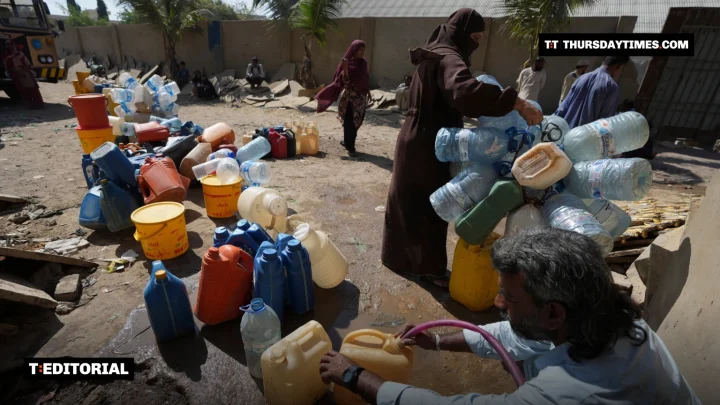
For Pakistan, the war of claims is not an abstraction. Most of its fuel and liquefied natural gas comes from the Gulf by sea, and the government has been reviewing fuel prices daily rather than weekly since July because the market moves so fast. This week, for once, the movement was in Pakistan’s favour. Petrol was cut three times in three days, and diesel with it.
Price per litre this week (Rs)
After three cuts, on November 11, 12, and 13. Source: Oil and Gas Regulatory Authority.
That relief is fragile. The latest cut to Rs332 for petrol and Rs360 for diesel reflects a world market that has priced in a great deal of risk already. One confirmed attack on a large tanker, or one Iranian claim that the market decides to believe, could undo it within days. Diesel feeds straight into freight, bus fares, and food prices, so the strait’s rumours reach Pakistani kitchens faster than its tankers reach Karachi.
Pakistan has been building some insulation. This week Pakistan State Oil said Kuwait would keep diesel and jet fuel flowing, and that Kuwait Petroleum Corporation would use Pakistani storage and ports under the government’s revised Customs Bonded Storage PolicyA policy approved this year that lets foreign suppliers keep petroleum products in customs-bonded storage in Pakistan, then sell them locally or re-export them to the region.. That policy was written after this year’s disruptions in the strait. Fuel stored in Pakistan before a scare is worth more than fuel bought during one, and a role as a regional storage point gives Pakistan a stake in calm that its neighbours share.
Pakistan cannot verify a tanker fire from Islamabad. It can make sure one does not empty its pumps.
The Gulf also pays Pakistan’s bills. Overseas Pakistanis sent home $3.89 billion in October, and Saudi Arabia and the UAE alone accounted for $1.8 billion of it. Millions of Pakistani workers live within range of the drones and missiles now being claimed and denied. A wider war on the Arabian side of the Gulf, of the kind the Houthi claims and the fighting near Aden hint at, would put both their safety and those remittances at risk.
A steady voice in a noisy war
Pakistan’s own position this week has been consistent and clear. At the UN Security Council on Thursday it voted for Resolution 2837, renewing sanctions on the Houthis, and its permanent representative, Ambassador Syed Haider Shah, condemned their attacks on Saudi Arabia as “terrorist attacks” and offered the kingdom Pakistan’s “full and unwavering solidarity”. That stand sits alongside the role Pakistan played earlier this year, when it hosted talks between Washington and Tehran that produced the June memorandum.
Those two roles are not in tension. Standing firmly with Saudi Arabia against attacks on its territory, while keeping open the channels that let Pakistan talk to both Washington and Tehran, is what makes Islamabad useful to all three. In a war where each side’s statements are built to move markets and frighten shipowners, a country that sticks to what it can verify, and says plainly what it opposes, has a credibility that is worth something.
The ships that can be named are the ones that turned out to be real.
What to watch
The first test is names. If any of the six vessels Iran says it disabled this week is identified by an owner, an insurer, or a flag state, the record will change, and so will the price of risk. If none is, the claims will start to count for less.
The second is the American escort. Iran’s statements are built to make the southern route look unsafe. Watch whether shipowners keep using it, and whether insurers keep covering them.
The third is Pakistan’s fuel bill. Three cuts in three days are welcome. Whether they last depends less on what Tehran and Washington say than on what independent sources can confirm.