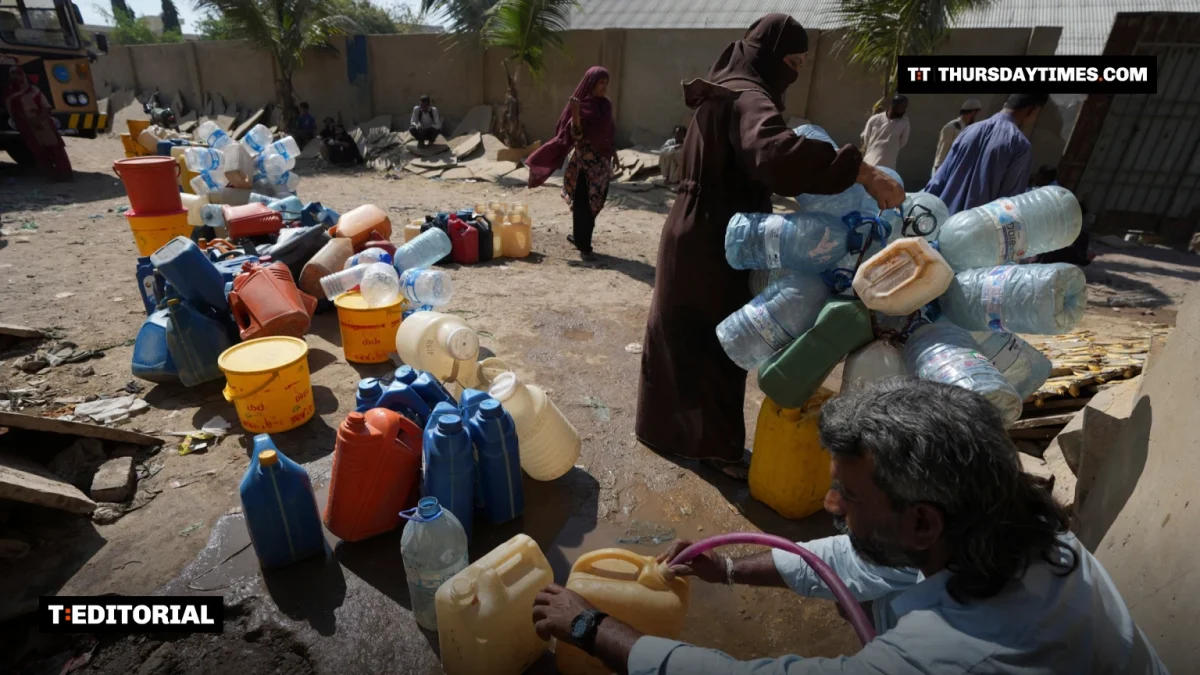
On Friday, about a fifth of Karachi’s water will simply not arrive. From 10am to midnight, K-Electric will switch off the power to the Dhabeji grid station for annual maintenance, nine of the pumping station’s 21 pumps will stop, and the city’s supply will fall from about 650 million gallons a day to about 520 million. Landhi, Korangi, Malir, and Shah Faisal will wait another 22 hours while the water utility does its own repairs. This shutdown, at least, was announced in advance. The question Karachi should be asking is why a city of more than 20 million people still depends so heavily on one set of pumps, on one power supply, in one place, at the far end of a long pipeline.
The Karachi Water and Sewerage Corporation deserves credit for the warning. It named the areas that will be hit, closed the Landhi and Sherpao hydrants for the day, and told residents to store water and use it carefully. K-Electric explained that its engineers will test and service the grid station’s transformer and its switchgear, and fix faults while the substation is cleaned. That is how planned maintenance should be handled, and it is better than what Karachi has often had.
But the warning also exposes the problem. A routine day of maintenance at a single site is enough to take 130 million gallons a day out of the city’s supply. Unplanned failures at the same site have done far worse.
The same station, again and again
Karachi has been here before, and recently. At about 10pm on June 26 last year, a fault in an underground cable cut the power to two feeders at DhabejiThe main pumping complex in Thatta district that lifts water from the Indus-fed Keenjhar system towards Karachi. Most of the city’s supply passes through it.. Rainwater delayed the repairs, and four days later the feeders were still down. The shortfall was put at more than 350 million gallons a day, and Nazimabad, New Karachi, Landhi, and Korangi were among the areas hit.
This year has been no kinder. On the evening of May 30, a fault in one of the Dhabeji grid’s power transformers forced an emergency shutdown that took 10 of the 21 pumps out of action. The corporation said it had first been told to expect a one-hour maintenance outage. The next day, power was still not fully back, and no one could say when it would be. On the morning of July 26, a cable fault knocked out power to one phase of the station, three pumps stopped, and the corporation estimated a temporary shortfall of 75 million gallons a day across parts of North Nazimabad, Nazimabad, Gulberg, New Karachi, Landhi, Korangi, and Scheme 33.
Dhabeji: one station, four disruptions
Sources: the Karachi Water and Sewerage Corporation and K-Electric, as reported at the time.
Four disruptions in 17 months is not bad luck. It is a pattern, and it points to a design flaw rather than a run of careless days. When a cable fails at Dhabeji, half of Karachi feels it within hours, because there is no second route for the power and not enough spare capacity in the pumps to take up the slack.
“Four disruptions in 17 months is not bad luck. It is a design flaw.”
A city that was already short
The shutdowns matter more because Karachi starts every ordinary day behind. The corporation’s own estimate of what the city needs is about 1,200 million gallons a day. What reaches it is about 650 million. That demand figure is an estimate, built on assumptions about population and how much each person uses, and some researchers argue that real use in poorer neighbourhoods is far lower. But even on the most generous reading, there is little margin. A city that receives roughly half of what its utility says it needs cannot absorb the loss of another fifth without real hardship.
Karachi’s water, in million gallons a day
The need is the water corporation’s estimate. Supply figures are the corporation’s, and the K-IV figure is the federal government’s planned capacity for the first phase.
Who pays for that gap is no mystery. Families in Landhi, Korangi, Malir, and Lyari who cannot store water for a day and a half will buy it. The official price of a 1,000-gallon GPS tankerGeneral Public Supply tankers are filled at the water corporation’s official hydrants and sold to households at a notified, subsidised rate. Commercial tankers cost twice as much. was set at Rs1,560 this summer, and a commercial one at Rs3,120. Residents have long complained that they pay far more than the notified rate when the taps run dry, and the Sindh High Court asked earlier this year why tankers seem to find water when the pipelines do not. Every hour Dhabeji is down is an hour in which the tanker becomes the city’s real water utility.
The promise of K-IV, and the pipes it still needs
The answer Karachi has been promised for two decades is K-IVThe Greater Karachi Bulk Water Supply Scheme. Its first phase is meant to bring 260 million gallons a day from Keenjhar Lake. Wapda builds the bulk works, and Sindh and the water corporation build the city network., the bulk water scheme that is meant to bring an extra 260 million gallons a day from Keenjhar Lake. There has been real progress. Wapda put the work at 64 percent complete at the end of last year, with Rs86 billion spent. In February, the federal planning minister, Ahsan Iqbal, visited the site near Thatta, set December 2026 as the new deadline, and said the federal government would bear the whole cost of the revised project, now put at Rs170 billion.
That federal commitment matters, and it should be honoured in full. But water that reaches the edge of Karachi is not water in a kitchen tap. Officials at the water corporation have said that the three augmentation lines needed to carry K-IV’s water into the city, known as R-1, R-2, and R-3, will together run 94 kilometres in pipes 72 to 96 inches wide, and that their contracts have not yet been awarded. They put that part of the work at about Rs80 billion, and the wider network of transmission lines, pumping stations, and filtration plants at another Rs124 billion. At the current pace, they say, the full system will not be ready before January 2029.
“Water that reaches the edge of Karachi is not water in a kitchen tap.”
The first K-IV estimate, more than a decade ago, was about Rs25 billion. Every year of delay has made it dearer, and every year of delay has left the city leaning harder on Dhabeji. Finishing the bulk works by December would be an achievement. Finishing them while the city end of the system waits for contracts would leave Karachi with a new canal and the same dry taps.
What should happen now
None of this needs a new grand plan. It needs the institutions that already exist to do five things, in the open, and on a timetable residents can check.
The first of these is the most urgent, and the cheapest. Planned maintenance at Dhabeji will always be needed. What should not be needed, in 2026, is for a fault in one cable to leave hundreds of thousands of homes without water for days. A second, independent feed and serious standby generation are exactly the kind of resilience the World Bank’s water and sanitation programme for Karachi, approved at $240 million in December 2024 and matched by the Asian Infrastructure Investment Bank, is meant to buy. Its stated aim is safe water for 16 million people by 2030. Keeping the main pumps running when the power fails is where that aim begins.
The third matters because Karachi argues about water in numbers no one fully trusts. The 1,200 figure is an estimate. The 650 figure is bulk supply, before leaks and theft. If the corporation published what actually reaches each town, it would be easier to see where pipes leak, where water is stolen, and where tankers are filling a gap the network should fill. It would also make the case for the federal and provincial money Karachi still needs far harder to ignore.
A shared responsibility
It would be easy to turn Friday’s shortfall into a contest of blame between the federal government, Sindh, the city, K-Electric, and the water corporation. That would help no one in Korangi. Each of them has a piece of this. The federal government is paying for the bulk works and has set a deadline. Wapda is building them. Sindh and the corporation own the city network. K-Electric owns the power. Mayor Murtaza Wahab has said he wants to close the city’s hydrants and move Karachi from tankers to pipes, and the corporation has warned that this is not yet possible with the network it has. Both are right, and the gap between them is exactly the work set out above.
Karachi pays a large share of Pakistan’s taxes, runs its main ports, and is home to people from every province. Its water supply is a national concern, not a municipal one. The city has learned to live with shortage. It should not have to learn to live with fragility. Friday’s shutdown is planned and will pass. The next fault at Dhabeji will not come with a warning, and the time to prepare for it is now.