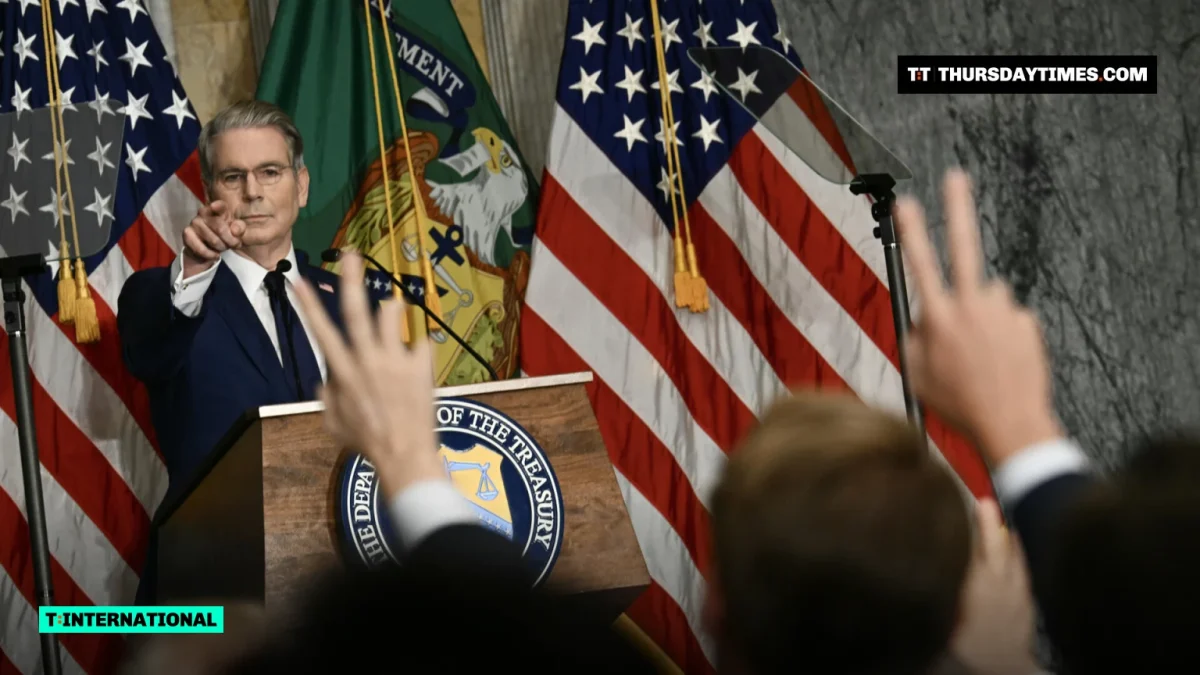
WASHINGTON (The Thursday Times) — US Treasury Secretary Scott Bessent on Friday blamed the Commerce Department for failing to put Megaspeed, the Singapore company at the centre of the scandal that led Jensen Huang to resign as Nvidia’s chief executive, on the US trade blacklist.
Speaking in a television interview, Bessent said the Treasury, the Defense Department, the office of the US Trade Representative, and the State Department had backed adding the company to the blacklist “for months”. “But Commerce has the pen,” he said. “You will have to ask them about their internal processes.”
The Commerce Department is led by Howard Lutnick. Open criticism of one cabinet department by another is rare in Washington.
Bessent said he was “frustrated” because President Donald Trump had “made it very clear that China should not receive any Nvidia chips above H100s”. “Any leakage is very frustrating because it hurts our great companies, and in the AI race gives the Chinese an advantage,” he said.
Megaspeed is suspected of buying Nvidia chips for data centres in Southeast Asia and routing them to China, around US export controls. It reportedly traded more than $4bn worth of Nvidia chips over two years. Its former director, Alice Huang, has been described in US reports as an alleged Chinese intelligence asset who had a relationship with Jensen Huang. The two are not related, and Beijing has denied the spying allegations. China on Friday also warned Washington against tighter chip curbs.
Bessent said coverage of the affair had dwelt too much on Huang’s private life. “The real story here should be: Did Nvidia know their client, and was there a robust effort at Nvidia to make sure that there was no leakage,” he said, adding that anyone at the company responsible should be held accountable. Huang has agreed to answer lawmakers’ questions behind closed doors.
A warning to the Fed
In the same interview, Bessent urged the Federal Reserve not to raise interest rates in response to what he called an energy supply shock caused by the US war with Iran. “I think the Fed should understand that this is an energy supply shock,” he said, adding that the underlying US economy was very strong.
“The Fed’s supposed to look into the future, not look in the rearview mirror,” Bessent said. “I’m not going to tell the Fed what to do. I am going to say they should have an open mind.”
The Fed left its benchmark rate at 3.75% to 4% at its last meeting, and markets expect a quarter-point rise when it next meets on December 8 and 9. A futures-based tracker put the chance of a rise at about 89%. Fed Governor Christopher Waller said this week that he would back a quarter-point increase in December, and that a half-point rise should be considered if core inflation ran hot. The latest consumer price figures showed a monthly rise of 0.4%.
Energy prices have driven much of that pressure. The average price of a gallon of petrol in the US is $3.87, down from $4.34 a month ago but well above the $2.98 recorded on February 28, when the US and Israel first struck Iran.
Higher US interest rates tend to strengthen the dollar and raise the cost of borrowing for developing economies, including Pakistan, where the government has cut fuel prices three times this week as world oil prices eased.