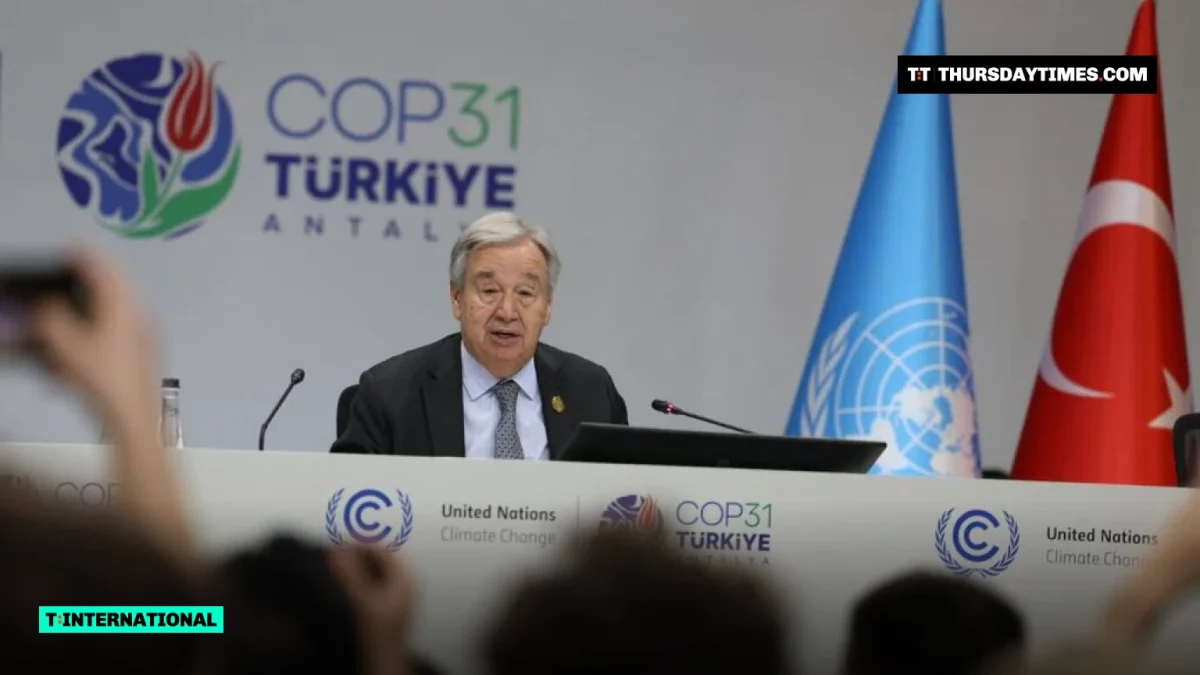
ANTALYA (The Thursday Times) — United Nations Secretary-General António Guterres used his last press conference at a UN climate summit on Friday to argue that almost every other promise the organisation makes depends on climate action, telling reporters at COP31 in Antalya that “you cannot build peace on a burning planet.”
Guterres, who leaves office at the end of December, said he had “never viewed climate action as just one of many other issues.” “Climate action is central to every aspect of the work of the UN,” he said. His successor has not yet been chosen.
“You cannot eradicate poverty when climate disasters keep throwing people back into it,” he said. “You cannot promise young people a better future while destroying the natural systems on which that future depends.”
He said climate change “does not stay in its lane,” listing displacement, development gains wiped out over decades, deeper national deficits, and sharper competition for land and water among its effects. “It fuels instability,” he said.
Guterres said he had met the heads of the multilateral climate funds in Antalya and urged them to cut bureaucracy so money reaches countries faster. Every dollar of capital put into development banks can generate $8 to $10 in financing, he said, calling for wider use of guarantees. “Even tripling adaptation finance would meet less than 30 per cent of what is needed,” he said.
“The future of our planet cannot be negotiated on the terms of those profiting from its destruction,” he added, days after a campaign coalition said more than 100 fossil fuel, finance, and agribusiness groups had been admitted to the talks.
Simon Stiell, the executive secretary of UN Climate Change, said many developing countries were “trapped in a downward loop of debt, disaster, and devastating capital costs,” and that climate finance “must help countries break free.”
Under the finance goal agreed at COP29 in Baku, developed countries are to provide at least $300bn a year by 2035, within a wider target of $1.3tn a year from all sources. An assessment highlighted at COP31 found that finance could fall $840bn short of the larger figure, and several funds have announced new targets during the summit.
The summit now heads into its second week with most of the more than 90 heads of state and government who attended already gone. Countries have until late Saturday to respond to a “reflections” paper on the main issues, and a draft cover decision is expected early next week. The talks are scheduled to close next Friday night.
Australian climate minister Chris Bowen, who is leading the negotiations under Australia’s arrangement with host Türkiye, said the paper was not a draft deal. “The reflection text is not a negotiating text. Nothing in it is prejudged, locked in or necessarily to be included in the final decision,” he said. Campaigners want the outcome to put the transition away from fossil fuels back on the table.
Pakistan has pressed the same finance case. Prime Minister Shehbaz Sharif told the leaders’ segment that Pakistan needs $138bn to move to clean power by 2035 and asked for grants rather than loans for countries hit hardest by climate disasters.
Guterres opened the summit with a call for a “Climate Justice Compact” and later pressed for near-zero methane rules for the oil and gas industry.