RIYADH (The Thursday Times) — Stone points left on the shore of a long-vanished lake in Saudi Arabia’s Empty Quarter about 125,000 years ago carry traces of plant poison, according to a new study, which suggests they may be among the oldest poisoned hunting weapons yet found.
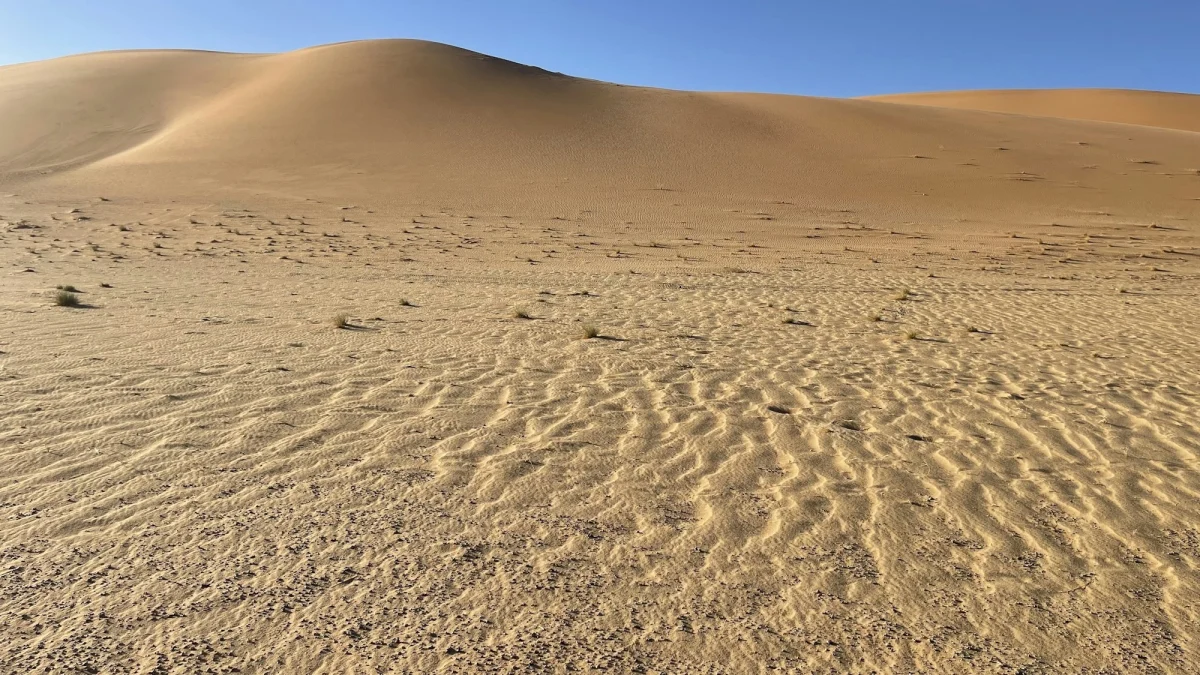
The findings, published this week in the journal Science by Chris Clarkson of Griffith University and the Max Planck Institute of Geoanthropology and 25 colleagues, come from a site called ‘Uruq Aljelibah on the edge of the ancient Mundafan lake in the Rub’ al-Khali, the vast sand sea that covers the south of the Arabian Peninsula.
Several of the points show impact damage and residues of poison from the plant Acokanthera schimperi, the paper’s abstract says, “indicating use as hafted weapon tips within composite hunting systems”.
Clarkson was careful about how far the claim goes. “We haven’t demonstrated exactly how the poison was prepared or whether it was effective,” he said. “So I’d describe these as potentially the oldest evidence for poisoned hunting weapons, rather than an unequivocally established first.”
A green Arabia
The area today is hot and extremely dry, with huge sand dunes. But about 125,000 years ago, during a warm and wet phase researchers call “Green Arabia”, a freshwater lake filled the Mundafan basin. Hippos lived in the water, the authors write, while giant buffalo, gazelles, and oryx roamed the grasslands around it. The paper also lists ostrich and camel among the animals found at the site.
The site’s name means “sand dunes of a watering hole”, according to co-author Frans van Buchem of the King Abdullah University of Science and Technology.
The team collected more than 5,500 stone tools and pieces left over from making them, and mapped where they lay alongside animal fossils. Some flakes fit back together, showing that people made tools and butchered animals on the spot. The researchers dated the old shoreline with luminescence dating, which measures how long buried sand grains have been out of sunlight, and fossil hippo teeth supported the results.
Under the microscope, several points had broken tips consistent with striking an animal. One point kept traces of resin and plant fibres near its base, which the authors say suggests it was glued and bound to a shaft, while animal fat and protein survived nearer the tip. They concede that they “can’t determine whether someone threw it or thrust it”.
Jeffrey Rose, a Palaeolithic archaeologist at the University of Algarve in Portugal who was not involved in the study, said the refitting flakes showed “the tools were made on the spot”. Eleanor Scerri of the Max Planck Institute of Geoanthropology, also not part of the team, called the link between the tools and the animal bones “very convincing”.
Out of Africa
Homo sapiens evolved in Africa, where fossils show the species existed by about 300,000 years ago. The best-known expansion into the rest of the world came about 60,000 to 70,000 years ago, but fossils show earlier groups had already reached parts of Asia, and a human finger bone from northern Arabia places the species on the peninsula at least 85,000 years ago.
The authors say the Mundafan site offers a rare look at how one of those early groups lived, and at the skills that let people survive in a place that is now one of the driest deserts on Earth.