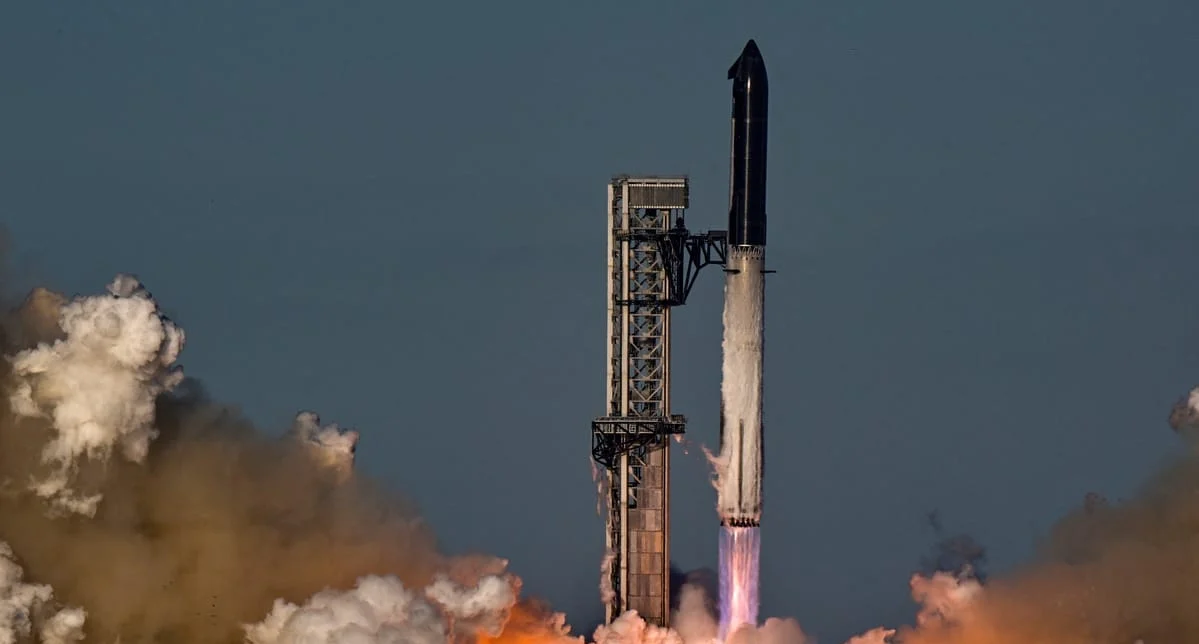
STARBASE, Texas (The Thursday Times) — SpaceX’s first attempt to catch both stages of its Starship rocket was cut short on Friday when the Super Heavy booster was diverted away from its launch tower and exploded over the Gulf of Mexico, though the spacecraft carried on into orbit.
The 124-metre rocket, the tallest and most powerful ever built, lifted off from SpaceX’s Starbase site in south Texas at 4:45pm local time (22:45 GMT) on its 15th test flight. The booster was due to fly back about six and a half minutes later and be grabbed in mid-air by the tower’s mechanical arms, which SpaceX calls “chopsticks.”
Instead, after an automatic abort, it steered to a designated area at sea and blew up just above the water. “Not sure right now why we weren’t able to bring it back,” said SpaceX’s Dan Huot.
“Safety is always the number one priority, and we’re still testing out things that we haven’t done before on these vehicles,” a company spokesperson said during the stream.
The upper stage, called Ship, went on to release 26 Starlink internet satellites. It is due to head back to the launch tower about 22 and a half hours after liftoff, at around 3:15pm local time (21:15 GMT) on Saturday, or 2:15am on Sunday in Pakistan. SpaceX has said it will only try to catch the Ship after checking the vehicle while it is in space, and can bring it down in the ocean if it finds any problems.
A successful grab would be a first. SpaceX has caught the booster on three earlier flights, but this was its first try with the upgraded 72-metre version built for missions to the Moon and Mars. The upper stages of all 14 previous Starships ended up in the ocean, either by design or after failures. The Ship first reached orbit in September.
Recovering both stages is central to Elon Musk’s plan to cut the cost of spaceflight by flying the same rocket again and again. SpaceX’s smaller Falcon 9 now flies more than 100 times a year, largely because its first stage lands and is reused, but its second stage is still thrown away.
“Full reusability has the potential to fundamentally change the economics of accessing space,” said Malcolm Macdonald, president of Britain’s Royal Aeronautical Society. “One successful flight will not prove that model.”
Musk has said he expects Starship to fly once a week by early 2027, and the company plans to begin launches from Florida within months. SpaceX has put at least $15 billion into the programme, which has also received billions of dollars from NASA.
The flights matter to NASA’s timetable. SpaceX is turning the Ship into a lander meant to put astronauts on the Moon by 2028, and NASA has also picked Jeff Bezos’s Blue Origin to build a rival lander. Earlier this month, NASA picked eight firms for up to $10 billion in lunar lander deals, and Blue Origin’s next New Glenn launch has slipped to 2027.