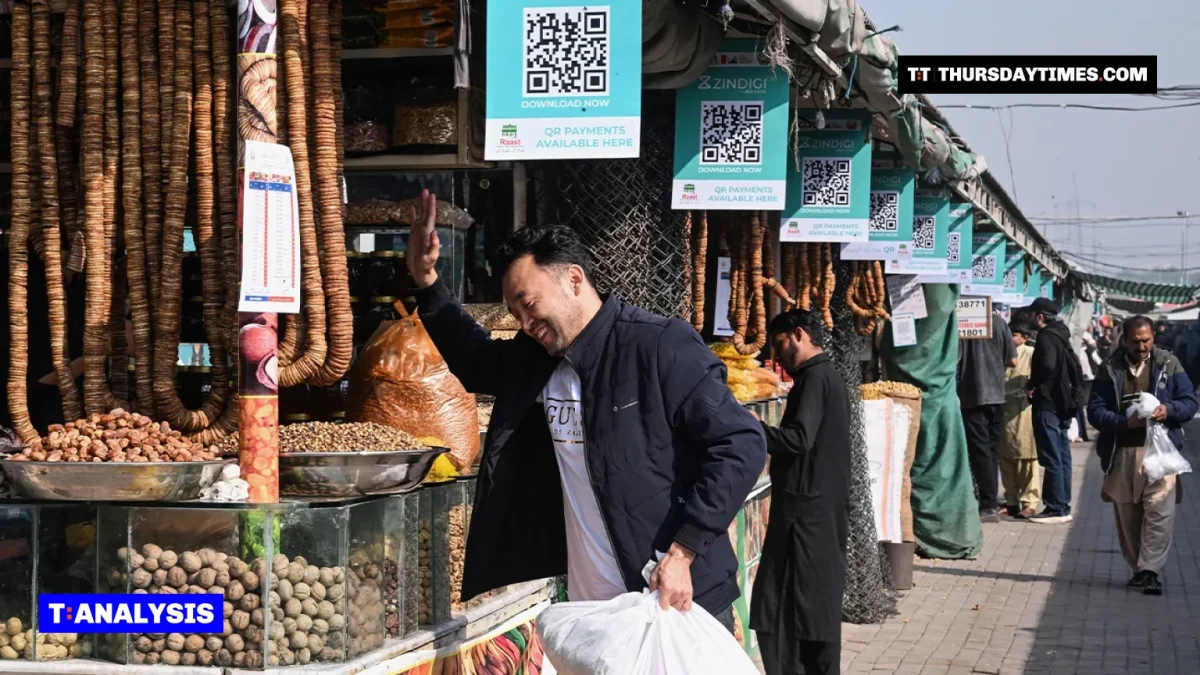
ISLAMABAD (The Thursday Times) — Islamabad has given itself 47 days. After November 30, offices of the Islamabad Capital Territory administration and the Capital Development Authority will stop accepting cash, and by December 31 every merchant in the capital, from the roadside vendor to the shopping mall, is meant to be taking digital payments. Minister of State for Interior Talal Chaudhry set both deadlines on Friday, saying about 26,000 of the city’s merchants are already connected. The government wants Islamabad to be Pakistan’s first cashless city and, in Interior Minister Mohsin Naqvi’s words to the prime minister, the world’s first cashless capital. The State Bank of Pakistan’s own figures suggest the first deadline is well within reach. The second is a different kind of problem, and the reasons have less to do with technology than with how shopkeepers and their customers think about money.
Two deadlines, two very different jobs
The November 30 deadline is about the state’s own counters. Fines, fees, and charges paid at government offices in the capital are to go through bank apps, wallets, and QR codes. Much of the groundwork is already laid. The district administration began taking fines by QR code this week, and from November 16 payments made through Asaan Assignment AccountsAccounts that government drawing and disbursing officers use to pay for official spending. Until now many of these payments were made by cheque. will move from cheques to RaastThe State Bank of Pakistan’s instant payment system, launched in 2021. It moves money between bank accounts and wallets in seconds, using a phone number, account number, or QR code. across the country. Prime Minister Shehbaz Sharif ordered a roadmap with deadlines for fully digital payments on November 6, and officials told that meeting that most federal and provincial institutions should be paying digitally by December 2026.
A government office can switch because the government decides how it gets paid. It controls the counter, the software, and the staff, and the people paying it usually have no choice about whether to pay. The December 31 deadline asks something else entirely: that tens of thousands of private businesses change how they take money, and that their customers change how they hand it over. No order from a ministry does that on its own.
Digital by number, cash by value
On paper, Pakistan is already far down the road. In January to March 2026, the latest quarter the State Bank has reported, 3.7 billion retail payments worth Rs168.8 trillion went through banks and payment channels, and 92 per cent of them by number were made digitally, through mobile apps, internet banking, ATMs, card machines, and online checkouts. Mobile apps alone handled 2.9 billion transactions. The number of people using mobile banking apps rose from 95 million to 137 million in the year to June, the Prime Minister’s Office said in July, and 92 per cent of workers’ remittances in that year arrived digitally.
The value tells a different story. Those 3.4 billion digital payments were worth Rs68 trillion, about 40 per cent of the quarter’s total. Bank branches processed only 128 million transactions, but they were worth Rs99.5 trillion. Big payments still go over the counter. Small ones have moved to phones.
How much of Pakistan’s paying is digital
Retail payments through banks and payment channels, January to March 2026. Digital payments numbered 3.4 billion of 3.7 billion, but were worth Rs68 trillion of Rs168.8 trillion. Source: State Bank of Pakistan quarterly payment systems review.
Even these numbers flatter the shop counter, because the State Bank counts only money that passes through the formal system. Cash that moves from a wage packet to a grocer and on to a wholesaler never appears in them. That cash is still there. Currency in circulation stood at about Rs11.55 trillion at the end of October, down from Rs11.94 trillion at the end of June, according to State Bank data, and it remains about a quarter of the country’s broad moneyAlso called M2: all the cash held by the public plus deposits in banks. It is the standard measure of how much money is in an economy.. Pakistan is moving money between people digitally at a fast pace. It is still spending a great deal of it in notes.
The shop is where the switch stalls
Raast shows the gap most clearly. It processed 742.1 million transactions worth Rs23.3 trillion in January to March, up from 645.7 million worth Rs18.5 trillion in the previous quarter. But 664 million of those were transfers from one person to another. Person-to-merchantP2M: a payment from a customer to a business, usually by scanning the shop’s QR code. P2P, person-to-person, is a transfer between individuals. payments, the kind a cashless shop depends on, numbered 55.9 million. That was a strong rise from 36.3 million the quarter before, and it is still only about one Raast payment in 13.
Raast payments, in millions
Bars are drawn on the same scale. Merchant payments grew by more than half in a quarter but remain a small share of Raast traffic. Source: State Bank of Pakistan.
The government’s headline figure on merchants is real progress. The number actively taking digital payments has risen fourfold, from 500,000 to 2.03 million, officials told a meeting chaired by Minister of State for Finance Bilal Azhar Kayani this week. But being able to take a digital payment is not the same as taking many of them. A QR code taped to a counter costs nothing and commits no one to using it.
The best evidence on why comes from the capital region itself. In 2023 and 2024, Innovations for Poverty Action and researchers at the Lahore University of Management Sciences ran a randomised study with 816 merchants in Lahore, Islamabad, and Rawalpindi who already had QR codes but rarely used them. Asked about the week before the survey, the merchants said 75 per cent of their customers had paid in cash and 5 per cent by QR code. More than 80 per cent agreed that digital payments could add real value to their business. Yet 42 per cent of those who did not accept them said it was because customers preferred cash, while customers who did not pay digitally often said it was because merchants preferred cash. Each side was waiting for the other.
Shopkeepers said customers wanted cash. Customers said shopkeepers wanted cash. Each side was waiting for the other.
The study also tested whether money could break the stand-off. Merchants offered Rs200 cashback for each QR payment from a new customer, up to Rs1,000 a month, made about 11 percentage points more transactions than those offered nothing. Information campaigns alone did not help. And once the incentives ended, use fell back to where it started in every group. A three-month push changed behaviour for three months.
What holds the shopkeeper back
The study’s other findings read like a list of what Islamabad’s planners now have to solve. Thirty-seven per cent of merchants feared fraud. About 45 per cent had been asked to ring up fake purchases so that someone could turn wallet balances into cash. Almost a quarter of customers said payments did not always go through for technical reasons, and one in 10 feared being cheated when paying digitally. None of these is a reason to keep cash for ever. All of them are reasons a small trader with thin margins hesitates.
Cost is the next question, and it is still open. Kayani’s meeting asked the State Bank to prepare a working paper on a merchant discount rateThe fee a shop pays its bank or payment provider for accepting a card or digital payment, usually a small percentage of each sale. scheme for Raast QR payments, which would set what shops pay to accept them. For a grocer working on a margin of a few per cent, how that fee is set will matter more than any deadline. A rate that is zero or close to it for small merchants would remove one of the oldest arguments for cash. A rate that eats into each sale would hand that argument back.
Then there is the paper trail. The government has been open that one aim of the Cashless Pakistan drive is to make transactions easier to trace and to bring more businesses into the tax net. That is a fair goal, and a documented economy is a stronger one. It also means some traders will see a QR code as the first step towards a tax notice. Islamabad will move faster if the government is clear about what digital records will and will not be used for, and if small shops see the benefits of documentation, such as easier credit, before they feel its costs.
Finally, there is the line itself. A cashless shop needs a working phone signal or internet connection at the moment of sale. When the network drops, a cash-only fallback is the only way to keep trading. Officials said this month that work is under way on a digital payment system for areas without internet access. Until it is ready, a city cannot sensibly require every vendor to refuse notes.
What the government is getting right
It would be wrong to read the gaps as failure. The drive has done the hard groundwork that many cashless plans skip. Raast QR codes are now printed on more than 45 million gas and electricity bills. Every National Database and Registration Authority centre can take Raast payments. Benazir Income Support Programme payments go through digital wallets. The overall volume of digital payments has doubled in a year, officials said this week. And starting with the state’s own counters is the right order: when paying a fine, a fee, or a bill is easiest by phone, people get used to the habit without a shopkeeper in the middle.
Islamabad’s starting line
Cash is about a quarter of broad money. Sources: State Bank of Pakistan, Ministry of Interior, Finance Division.
Islamabad is also a sensible city to try. A large part of its workforce draws salaries paid straight into bank accounts, and it has a dense network of bank branches and agents. If a cashless shopping street can work anywhere in Pakistan, it can work in Blue Area and the sector markets.
What would make December 31 stick
The lesson of the Lahore, Islamabad, and Rawalpindi study is that a deadline can get a QR code onto every counter, but only a reason to use it keeps the code in use once the campaign ends. Four things would give shopkeepers and shoppers that reason.
The first is a merchant fee that small shops can live with. The State Bank’s working paper is the place to settle it, and settling it before December 31 would answer the question every trader will ask.
The second is fast, visible help when something goes wrong. A payment that fails, a sale reversed by fraud, or money stuck in transit needs a phone number that answers and a refund that arrives within the day. Trust in digital payments is built one dispute at a time.
The third is an offline answer. Until payments can be made without a live connection, vendors need to be told plainly that they may still take cash when the network is down. Rupee notes remain legal tender, and the deadline should be read as a requirement to accept digital payments, not a ban on cash.
The fourth is honesty in the numbers. The government plans a central dashboard tracking payment values, transaction volumes, and individual users. Publishing it, with figures for merchant payments in Islamabad by month, would show whether shops are actually being paid digitally rather than merely displaying a code. The goal on December 31 is not 100 per cent of shops with a QR code. It is a city where paying by phone is the easier choice at the till.
Islamabad has a real chance to show the rest of the country how that is done. The counters will be ready by November 30. Whether the corner shops follow by December 31 depends less on the date than on what the government does in the weeks before it.