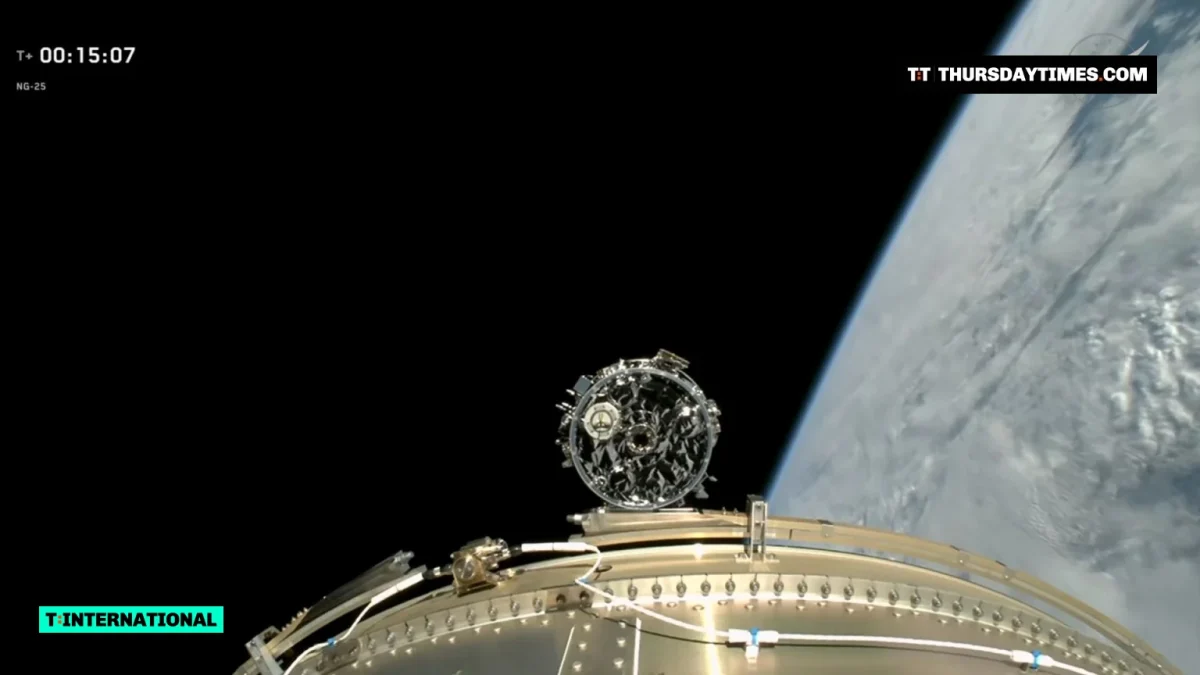
CAPE CANAVERAL, Florida (The Thursday Times) — Northrop Grumman’s Cygnus XL cargo spacecraft lifted off on a SpaceX Falcon 9 rocket at 10:47 a.m. US Eastern time (15:47 GMT, 8:47 p.m. in Pakistan) on Sunday, carrying about 11,000 pounds of science and supplies to the International Space Station, NASA said.
The rocket left Space Launch Complex 40 at Cape Canaveral Space Force Station on the mission NASA calls Northrop Grumman CRS-25. NASA’s launch broadcast showed the Falcon 9’s first-stage booster landing back at Cape Canaveral about eight minutes after liftoff, and the Cygnus XL in orbit minutes later. NASA said the spacecraft was expected to reach its preliminary orbit about 10 minutes after launch and to deploy its solar arrays about 1 hour and 45 minutes after that.
NASA astronauts Jessica Watkins and Luke Delaney, who are living aboard the station, will capture the spacecraft with the Canadarm2 robotic arm at about 2:35 a.m. Eastern time (07:35 GMT, 12:35 p.m. in Pakistan) on Tuesday, 1 December. Ground controllers will then install it on the Earth-facing port of the Unity module, where the crew will begin unloading the cargo.
The shipment includes experiments to improve drug delivery for cancer and osteoarthritis, predict how cancer spreads, advance treatments for muscle loss, and improve radiation sensing, along with research on food production for future long-duration missions, NASA said. Among the science is Ohalo III, a prototype plant-growth chamber that is part of what NASA called a first-of-its-kind space crop production system, and a miniature fluid-handling system meant to keep small lab-grown models of human brain tissue alive for longer studies in space. Our earlier report has more on the experiments and the launch plan.
Northrop Grumman has named the spacecraft the S.S. James “Jim” A. Lovell, after the former NASA astronaut who flew Gemini VII, Gemini XII, Apollo 8, and Apollo 13. It is due to stay at the station until May 2027, when it will leave with several thousand pounds of disposal items and burn up harmlessly on re-entry.
NASA’s arrival coverage begins at 1:10 a.m. Eastern time on Tuesday (06:10 GMT, 11:10 a.m. in Pakistan). It will stream on NASA’s website at nasa.gov/live and other platforms listed there. NASA said it will not provide live coverage of the installation.