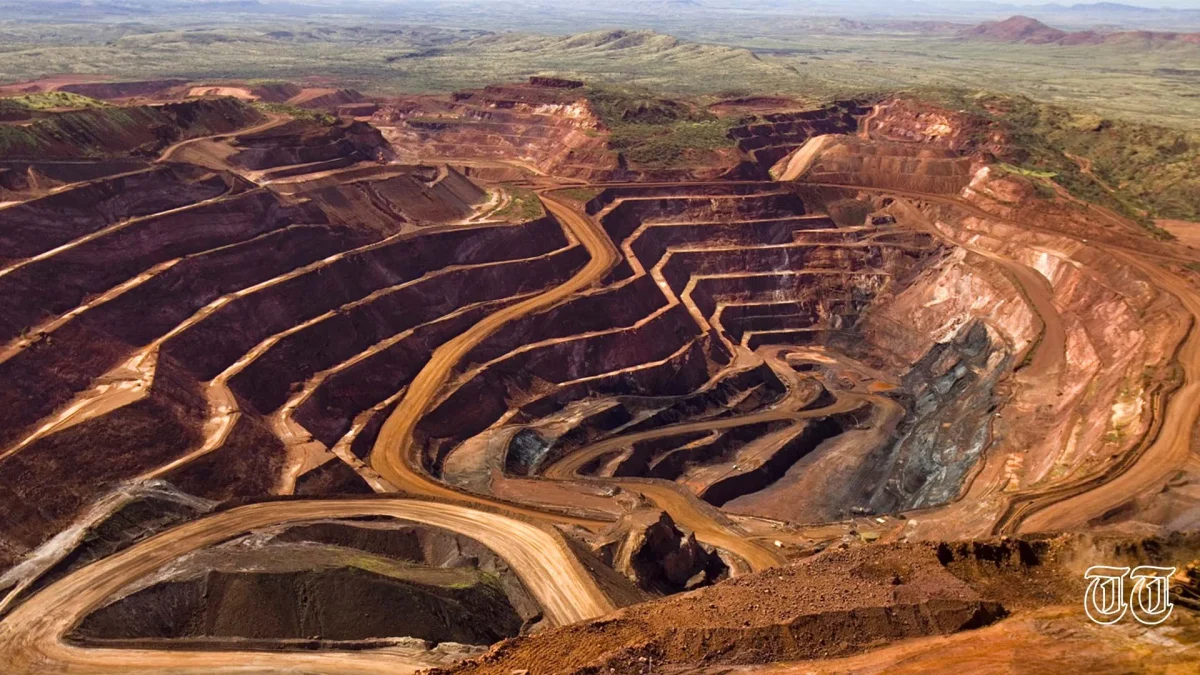
Saindak, in Balochistan's Chagai district and part of the Tethyan geological belt, is known worldwide for its immense reserves of precious minerals such as gold, silver and copper.
There, an agreement exists between a federal government company called Saindak Metals Limited (SML) and a Chinese company, Metallurgical Corporation of China (MCC), which has been extracting gold, silver and copper from Saindak for the past twenty years.
The five-year term of the agreement ends on 31 October this year, and the Government of Pakistan has approved a new agreement with the same company until 2037.
Saindak has three mines in all, known as the northern, eastern and southern mines and bodies. For the past twenty years, reserves had been extracted from the northern and southern mines; very little is now left in them. Under this agreement, the turn of the eastern mine is now coming.
The surprising thing is that in the Eighteenth Amendment, passed by Pakistan's Parliament in 2010, all of Balochistan's resources, including Saindak, Reko Diq, the islands and the coast, and all the reserves of the other provinces, were declared the property of the provinces, and authority over them was transferred from the federation to the provinces. The rulers of each province were to make the decisions for their own province. Yet even twelve years after the Eighteenth Amendment, the federal government is deciding the fate of Balochistan's Saindak.
The Chinese company says that the eastern mine, or East Body, of Saindak currently holds 273 million tonnes of gold reserves. In return, Balochistan's share of sales revenue, which was five per cent, has been raised to 6.5 per cent, and corporate social responsibility (CSR) has also been raised to 6.5 per cent. In addition, one crore a year has been set aside for the students of Chagai, male and female.
The Chinese company, which has been working for the past twenty years, was giving Balochistan only five per cent in sales revenue and CSR, and with that five per cent there is not a single boys' or girls' degree college in Chagai. In Balochistan's Chagai district, there is no university or medical college at all.
Then consider: what has Chagai got from Saindak?
Only this: for the past twenty years the people of Saindak have watched trillions of rupees of Saindak's wealth, trillions of days' worth, fall prey to corruption, have then watched those same corrupt people become rulers, and have then seen deprivation, despair and poverty.
This has been going on for two decades. In two decades, neither the 18th Amendment nor the federation has solved the citizens' problems.
Gangzar, the true heir of Saindak, has seen all of this with his own eyes. In Gangzar's view, all of this is the plunder of resources, and he says that nobody here takes the interests of the local people seriously. If a word called "interests" really exists, he says, the word "personal" is written in front of it, and when the two are joined they make "personal interest".
Time has not only left Gangzar aggrieved but has also taught him a great deal. Gangzar now knows the difference between a politician and a leader, and between personal and collective interests.
In his view, increasing Balochistan's share in this agreement will make no particular difference to the ordinary lives, or the social and economic lives, of the ordinary people of Chagai and Balochistan. He believes percentages are for those who hold the key to Saindak's treasure, and that key is not with us at all. All we own is Saindak.
The contributor, Yousuf Baloch, specialises in the discussion of human rights violations worldwide.
Reach out to him @YousufBaluch1.