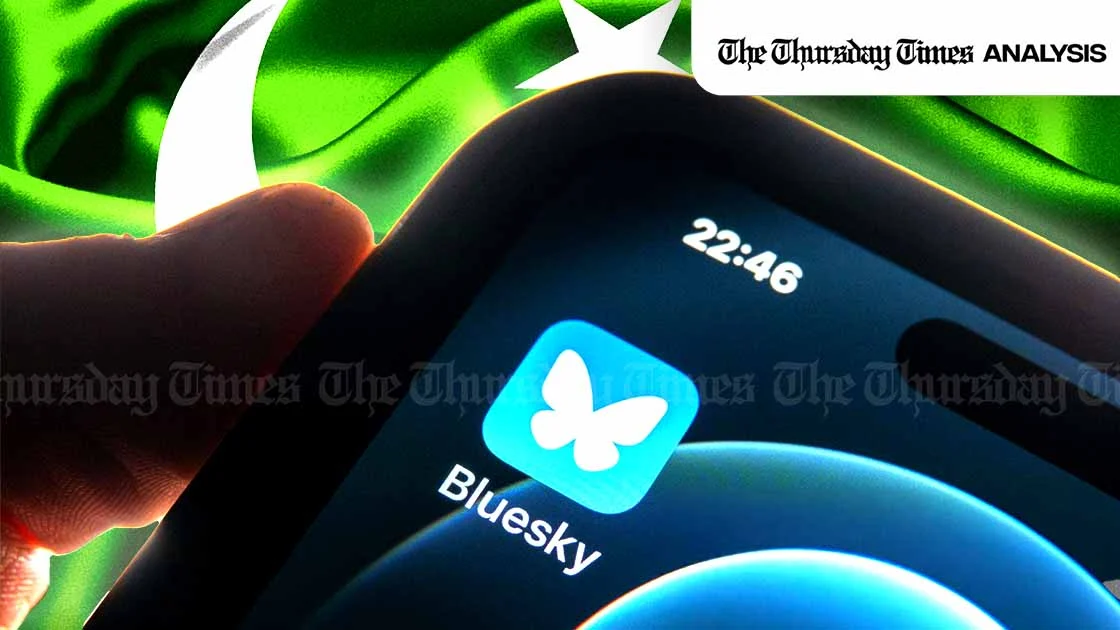
Islamabad (The Thursday Times) — In Pakistan, ‘Bluesky’ has unexpectedly become a social media platform enjoying meteoric popularity. Its success is down not to technology or features but to people: Pakistanis who refuse censorship, declare their resistance and look for a platform for free expression.
Pakistan... the land of cricket and tea, is a victim of endless restrictions on social media. According to the latest situation, the social media platform rapidly gaining popularity in the country is none other than the tech world's favourite, ‘Bluesky’. It is no surprise that Pakistani social media users have flocked to Bluesky as if lunging for the last mango of a passing season. But why such an attachment to a platform that few people knew about until last year? What are the real reasons?
Let us set out the factors behind Bluesky's popularity. X, originally named ‘Twitter’, has recently been banned inside Pakistan. If anything truly unites people, it is a shared love for the things to which they have no access, or to which access is very difficult. In fact, as soon as X (Twitter) vanished from the digital landscape, Bluesky drew users in astonishing numbers, because, given the government restrictions, people found in it an alternative platform.
The government has not been content with merely banning X (Twitter). It has gone a step further and begun scrutinising the “VPNs” used to access X (Twitter), because if people can reach X (Twitter) through a VPN, the ban becomes ineffective. With access to X (Twitter) made difficult, and with possible restrictions on “VPNs” to follow, people’s options have been left limited. “Facebook” has become far too crowded, while “Instagram” has limited features. In this situation “Bluesky” appeared as the best alternative and a safe haven, where one can converse freely, beyond fear of government restrictions.
What is interesting in all this is that Bluesky, which previously did not occupy a central position, has now become central for those looking for a suitable platform on which to use social media freely. But if you want to know why Pakistanis in particular need “Bluesky”, the answer is that when the government here says “no”, people take it as a challenge, and in just such a situation “Bluesky” offers them an excellent platform, with open-source policies on ethics and a system free of unnecessary interference.
Without doubt, “Bluesky” deserves credit for its timing. It seems as though its creators were sitting in a closed room planning their entry into the Pakistani market, saying: let us wait for the Pakistani government to ban all the other platforms, and then we will hit a four on the spot. Without doubt, “Bluesky” is focused on ensuring freedom of expression. In a country where speech attracts the police, and where it is considered better to stay silent than to state certain opinions, Bluesky has emerged as the ultimate, unfiltered microphone.
It is also a fact that "Bluesky" does not have many features, or any unusual ones. It does not offer better features than X (Twitter). It is more like a basic social media platform with a fancy story behind it. When all you need is a platform for expressing your views, you do not ask questions about advanced technology. Bluesky has become a digital therapy room, where Pakistanis are getting an unfiltered opportunity to air grievances, hold political debates and express their opinions.
The question now is how long this digital utopia will last. Will Bluesky remain a platform for freedom of expression in Pakistan, or will it meet the same fate as X (Twitter)? Only time will tell, but for now users of "Bluesky" are enjoying it like winter sunshine. As for the government, there is an irony in its conduct: by banning X (Twitter) to bring the situation under control, it has only created a vacuum, which "Bluesky" is now filling. It is just like the game of "Whac-A-Mole", in which every ban gives birth to a new platform.
The failure of VPNs in this matter should not be forgotten either. The government's crackdown on VPNs is tantamount to trying to put out a fire with petrol, because every attempt at online control is increasing people's demand for access. It is the government's possible restrictions on VPNs that have forced people to look for an alternative platform, because in Pakistan the more restrictions you impose, the more people resist.
The growing popularity of "Bluesky" in Pakistan suggests that people are tired of censorship. They are looking for platforms where they can talk freely without fear of surveillance, and for now that platform is "Bluesky", where freedom of expression has been made possible without any filter or fear.
But what if Bluesky is banned? Will another platform take its place? Perhaps it will, because the desire for free expression is like a game of Whac-A-Mole: you can ban one platform, but another is always ready to take its place. It makes no difference how many platforms the government bans; people will always keep finding a way to say what they want to say, whether it is Bluesky after X (Twitter) and then whatever comes after that. In effect, by choosing Bluesky, Pakistanis are sending the message that they will not stay silent.
Bluesky continues to grow in popularity, but what lies ahead for the platform? Will it achieve a large and exceptional standing, or will this digital platform remain a special, safe refuge for disillusioned people? Only time will tell, but there is no doubt that the growth of Bluesky in Pakistan is remarkable. Bluesky's success is based not on technology or features but on people. It is about those Pakistanis who refuse censorship, who look for a platform for free expression and who will not be deterred by government restrictions, and it is for these very reasons that Bluesky is attracting so much attention.
So that is Bluesky: the platform that has emerged as an unexpected hero on Pakistan's social media landscape. It is to be hoped that it will continue to grow, and that the voices of Pakistanis will keep rising and resounding in the proper manner, whatever digital obstacles are placed in their path. In truth, free expression does not need a platform; it needs determined people to find one.