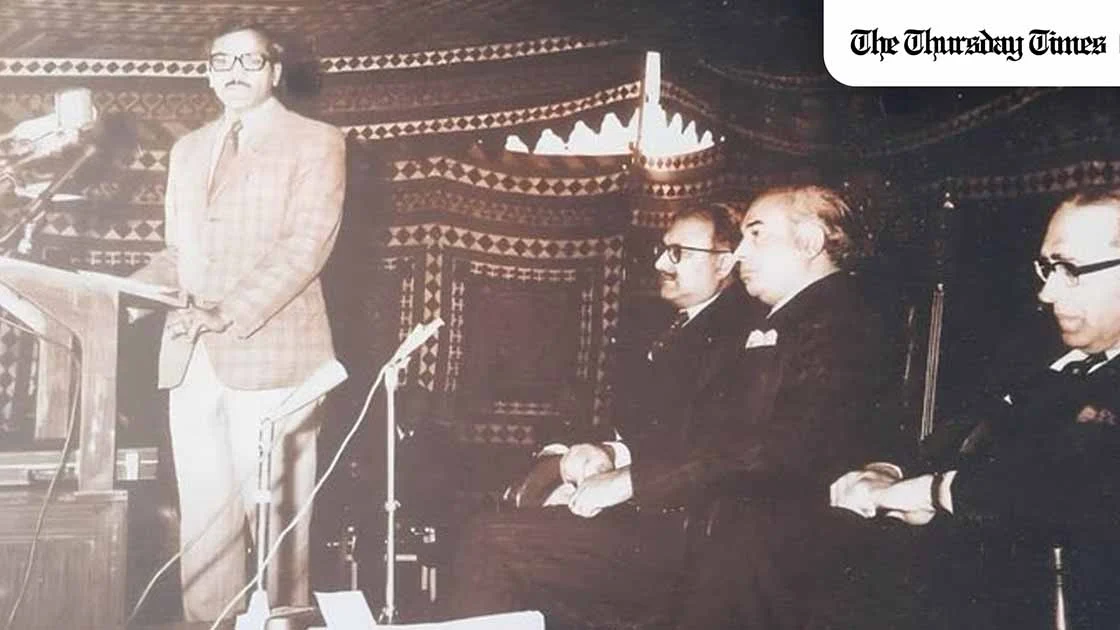
The name of Sultan Bashiruddin Mahmood is among those of the figures who played a prominent part in the history of Pakistan's struggle to acquire nuclear power and in its scientific progress. When Pakistan needed scientific minds of the highest calibre, Sultan Bashiruddin Mahmood was one of the benefactors of the country and the nation who developed Pakistan's nuclear capability.
Sultan Bashiruddin Mahmood was born under British rule in a Muslim Punjabi family in Amritsar, in Punjab. His father, Chaudhry Muhammad Sharif, was a local landowner who moved with the family from Amritsar to Lahore in 1947. Sultan Bashiruddin Mahmood won a scholarship by finishing top at a local high school in Lahore, and then entered Government College University to study electrical engineering.
After studying for just one semester at Government College University Lahore, he moved to the University of Engineering and Technology, Lahore (UET), where he took his bachelor's degree in 1960 and became a gold medallist, ranking first in the university. On the strength of the same ability he joined the Pakistan Atomic Energy Commission (PAEC), from where he won another scholarship and went to Britain.
In terms of his academic record and his scientific services to the country and the nation, Sultan Bashiruddin Mahmood is one of Pakistan's most successful engineers. After completing a master's in control systems engineering at the University of Manchester in 1965, he obtained a master's degree in nuclear engineering as well in 1969. He also gained extensive experience of nuclear reactors in Britain.
Sultan Bashiruddin Mahmood joined the Pakistan Atomic Energy Commission (PAEC) in 1968, taking his place among the architects of the country's nuclear infrastructure. He joined the Pakistan Institute of Nuclear Science and Technology, where, under the guidance of the nuclear physicist Dr Naeem Ahmad Khan, he had the distinction of working alongside such eminent figures as Samar Mubarakmand and Hafeez Qureshi. Sultan Bashiruddin Mahmood was a senior engineer at Pakistan's first commercial nuclear power plant (the Karachi Nuclear Power Plant) and one of the country's leading experts in reactor technology.
In January 1972, when President Zulfikar Bhutto approved the crash atomic weapons programme under the nuclear engineer Munir Ahmad Khan, Sultan Bashiruddin Mahmood was working in the engineering division of the Karachi Nuclear Power Plant and was an important part of it. After India's nuclear tests of 1974, Sultan Bashiruddin Mahmood was appointed director of the Uranium Enrichment Division in Pakistan. In the 1980s he was appointed project manager of the Khushab reactor, where he played a key role in the development of coolant systems, which are vital for plutonium production.
Sultan Bashiruddin Mahmood played an important part in the Chashma and Khushab nuclear projects, and his years of work formed the foundation of the 1998 nuclear tests, through which Pakistan emerged as the world's first Muslim-majority nation with nuclear power. Mohsin-e-Pakistan Dr Abdul Qadeer Khan was an expert in uranium enrichment, while Bashiruddin Mahmood was one of Pakistan's leading experts in plutonium production, reactor design and thermal hydraulic systems.
In 1998, Prime Minister Nawaz Sharif awarded Sultan Bashiruddin Mahmood the Sitara-i-Imtiaz, Pakistan's highest civil award, in recognition of his important services to science and national security. In the same year, he was appointed Director of the Nuclear Power Division. He contributed to the design and development of nuclear power systems, which helped Pakistan in its pursuit of long-term energy supply.
Sultan Bashiruddin Mahmood wrote more than 15 books, including "The Mechanics of the Doomsday and Life After Death", which draws on Quranic teachings and scientific theories concerning the Day of Judgement. He founded SEWA (Society for the Protection of Environment and Welfare of All), which focuses on humanitarian aid and sustainable agricultural reform. He advocated Pakistan's peaceful nuclear technology, for nuclear energy and for agricultural and medical use, and as a senior scientist he mentored dozens of Pakistani engineers and physicists.
Sultan Bashiruddin Mahmood's son, Ahmed Sharif Chaudhry, is a three-star general in the Pakistan Army and is currently serving as the 22nd Director General (DG) of the army's public relations wing, Inter-Services Public Relations. He belongs to the Pakistan Army Corps of Electrical and Mechanical Engineering.