Pakistan’s central bank reserves have passed $21.5 billion, the highest in the country’s history, the finance minister says. In the same week Saudi Arabia rolled over $3 billion and China and Kuwait reportedly promised to do the same with $4.3 billion more, while hopes of a $10 billion American backstop faded. Those facts can all be true at once. Taken together, they show how Pakistan’s external accounts actually work, and how far they have come.
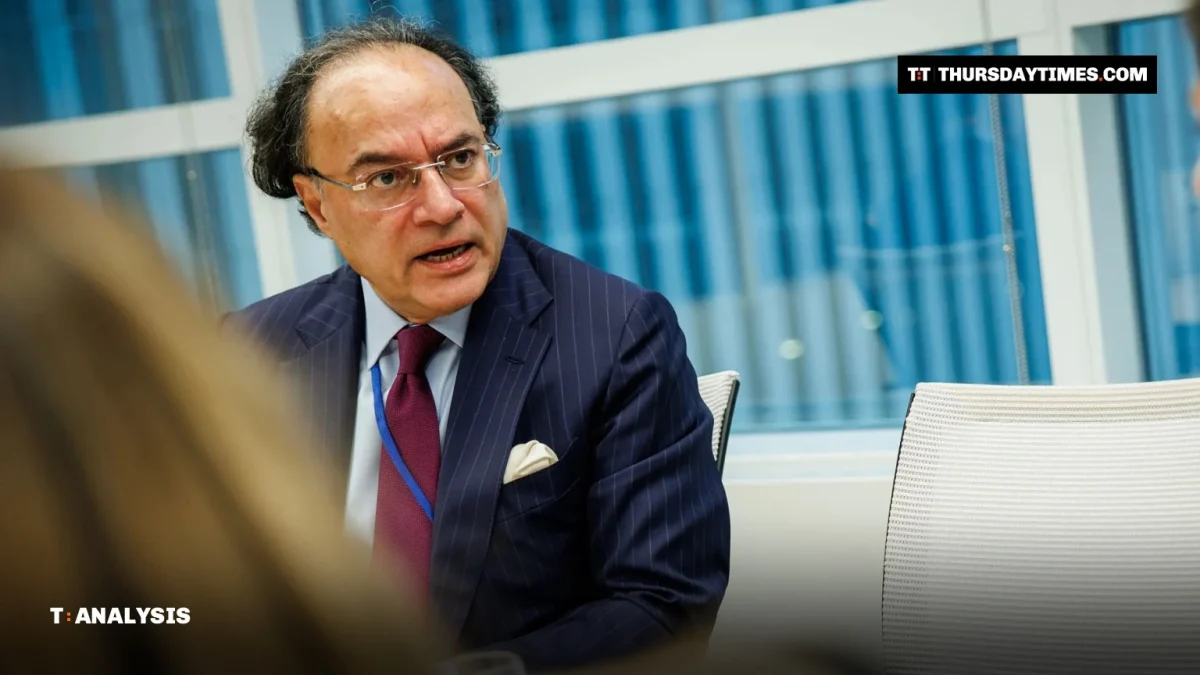
Finance Minister Muhammad Aurangzeb was in a confident mood at Parliament House on Wednesday. Asked how long the Saudi extension would last, he replied: “It has been extended and for a reasonable period. You don’t need to worry as to for how long given the kind of strategic relationship we have.” Asked about the American facility he had talked up for months, he lowered expectations. “If that materialises, fantastic,” he said. “If possible, fine; if not, we are going to move forward, with or without it.”
A few hours earlier his officials had given the Senate Standing Committee on Finance the numbers behind that confidence. They are worth going through carefully, because they answer a question Pakistanis often ask and rarely get a straight answer to: how much do we really have to find this year, and from where?
The bill
The finance ministry puts gross external repayments this cycle at about $21.5 billion. That headline can sound alarming, and it needs unpacking. Reports of the briefing put it at roughly $17 billion in principal and $4 billion in interest. Of that total, $7.3 billion consists of deposits from three friendly countries that are expected to be rolled over rather than repaid.
Once rollovers and other refinancing are taken out, Finance Secretary Imdadullah Bosal told the committee, the net requirement is $11 billion. Of that, $5 billion had already been paid in the first four months of the fiscal year, leaving $6 billion over the next seven. That last figure is the one that matters for anyone wondering about the months ahead. It is a manageable sum next to reserves of $21.5 billion.
From the headline bill to what is left
Source: Finance Ministry briefing to the Senate Standing Committee on Finance, November 4, 2026, as reported. The bars do not add up, because each is a different cut of the same bill.
Who is holding what
The $7.3 billion breaks down, according to finance ministry sources, into $3 billion from Saudi Arabia, $4 billion from China and $300 million from Kuwait. China’s money is mostly held through what are called SAFE depositsMoney placed with the State Bank of Pakistan by China’s State Administration of Foreign Exchange, usually for a year at a time and then renewed., and the $4 billion is reportedly next due for renewal in March 2027.
The Saudi $3 billion has a particular history. Riyadh provided it in April, Mr Aurangzeb said, to bridge a gap when Pakistan repaid $3.5 billion to the United Arab Emirates. It was a three-month facility that matured on October 31. It sits alongside a separate $5 billion Saudi facility already extended to 2028.
Add those together and, on this newspaper’s own arithmetic from the reported figures, about $12.3 billion of friendly deposits sit against central bank reserves of $21.52 billion. It is a rough sum, and these are not the only friendly funds in the system. But it gives a sense of scale. It also explains why people who read only the reserves number and people who read only the rollover number often seem to be describing different countries.
The accounts at a glance
None of this is unusual or shameful. Central banks across the developing world hold deposits from allies, and rollovers of this kind have become routine. Mr Aurangzeb’s remark about strategic relationships is also fair: since the mutual defence pact of September 2025 and the Makkah agreement this August, ties with Riyadh in particular run far deeper than a loan book. Nobody has said in public that the deposits and the alliances are linked, and they have their own economic logic. But a lender that is also an ally behaves differently from a bond investor, which is a large part of why these deposits keep being renewed.
“People reading only the reserves number and people reading only the rollover number often seem to be describing different countries.”
What has really changed
The more interesting story is the one the minister was keen to tell. Three years ago Pakistan’s external position was a daily emergency. Today several indicators have moved the right way, and they are not trivial.
The clearest is market access. In September, Pakistan sold $3 billion of Eurobonds, the largest such issue in its history, $1.75 billion for five and a half years at 7.5 per cent and $1.25 billion for ten years at 7.9 per cent, against orders of nearly $6 billion. It has also issued a Panda bond in China’s market worth about $258 million. Mr Aurangzeb says investors he met in Bangkok last month offered five- and ten-year money, “because clearly we are looking beyond the [IMF] programme”. That is how the minister now frames the American request too: “What we asked for back in July and were looking at was the market access. We have got the market access.”
Debt indicators have improved too. Public debt fell to 68.6 per cent of GDP by June from 75.1 per cent in 2022-23, the finance secretary said, and its growth last year was the slowest in two decades. Interest payments fell from Rs8.9 trillion in 2024-25 to Rs6.9 trillion in 2025-26. External debt, which rose by $5 billion to $6 billion a year as it climbed from $45 billion in 2014-15 to around $100 billion, has risen by about $1 billion a year over the past two years, according to the minister. He wants to bring it down by $4 billion this fiscal year and by $3.5 billion the next.
The aim, he told senators, is not to add debt at all, but to swap expensive, short facilities for cheaper, longer ones. Investors will judge that claim over time. Its direction is right. Short-term money that has to be renegotiated every few months is what makes a country vulnerable to any single creditor’s mood or any sudden crisis.
The American facility
Pakistan asked Washington in July for a $10 billion Exchange Stabilisation Support Facility, and the request drew attention because of the country’s role as a mediator in the Iran war. Its prospects now appear to have waned, and the minister no longer counts on it. A facility of that size would have been a remarkable cushion, about half of current central bank reserves, and its loss would be a real disappointment.
But the minister’s fallback is reasonable. He has further Eurobond, Panda and rupee-linked dollar-settled issues in mind, and says he wants four months of import cover by the end of the year, up from more than three now. He also pointed to the American institutions that lend to projects, the Export-Import Bank and the Development Finance Corporation. “That is real financing and real credit,” he said. It is a sensible distinction. Project finance builds things, while a liquidity line only sits in reserve.
The point should not be overstated in either direction. Market access costs money, at about 7.5 to 7.9 per cent in dollars, and it can disappear quickly if the war flares up again or sentiment turns. A backstop is valuable because it is there when markets shut. Pakistan is now relying on those markets staying open.
What to watch
Three dates and one number will show how solid this is. The IMF’s Executive Board meets in December on a disbursement of about $1.2 billion, which staff agreed in October. The Fund has already urged an end to the fuel support scheme and has reportedly tied the tranche to tax targets, and the Federal Board of Revenue was Rs124 billion behind its target after four months. That makes December the most immediate test.
March 2027 brings the reported renewal of China’s $4 billion. Few expect trouble, but the terms and length will be worth noting, as will Mr Aurangzeb’s plan to seek a larger swap lineAn agreement between two central banks to exchange currencies for a set period, giving one of them access to the other’s money when needed. when the current 30 billion yuan arrangement expires next year. June then brings the end of the fiscal year, when officials will show whether external debt really fell by the promised $4 billion.
The number is the current account. The minister expects a deficit of no more than 1 per cent of GDP this year, after 0.1 per cent last year. That depends heavily on oil, which is why the course of the Iran war matters so much to a country that buys its fuel abroad. Lower prices help, and Brent fell to about $94 a barrel this week, a two-month low. A renewed conflict would test every assumption above, and the reserves would be doing real work for the first time since they were rebuilt.
“Rollovers are no longer the whole story. They are still a large part of it.”
Reading the two headlines together
A fair reading of this week is neither of the two popular ones. Pakistan is not living on handouts: it paid $5 billion in four months, sold record bonds to investors who were not doing it any favours, and cut its debt ratio. It also has not yet outgrown its need for friends: about a third of this year’s gross bill will be met by asking three governments to wait another year.
What has changed is the direction, and that is worth a good deal. The stated goal now is to look beyond the IMF programme, with longer money, a broader set of investors and less dependence on any one capital. Rollovers are no longer the whole story, though they are still a large part of it. The test of Mr Aurangzeb’s “basic hygiene” is whether, a year from now, the share of the bill covered by friendly deposits has started to shrink. That is the number to keep an eye on, more than any single record in the reserves.