A mineral-processing plant cannot afford an unreliable electricity supply. When power fails, grinding mills stop, pumps shut down and production is interrupted. Restarting a complex operation takes time and money. Even a rich mineral deposit can become an expensive proposition if such disruptions are frequent.
These are not the questions that usually attract attention at investment conferences. Geological discoveries, reserve estimates and billion-dollar commitments make better headlines. Yet the less glamorous details of power supply, water management and transport often determine whether a promising mineral project becomes a successful business.
They deserve particular attention as Pakistan prepares to host the Pakistan Minerals Investment Forum (PMIF26The government’s second Pakistan Minerals Investment Forum, at the Jinnah Convention Centre in Islamabad, moved from April to November 12–13, 2026.) in Islamabad on November 12–13.
01Having minerals is not enough
Pakistan has good reasons to be optimistic about its mineral sector. Its geological potential, location near major Asian markets and available workforce offer genuine opportunities. The international market is also changing in its favour. According to the International Energy Agency’s Global Critical Minerals Outlook 2026, the pipeline of announced projects is still insufficient to fully meet projected demand for copper and lithium through 2035.
Copper is essential for electricity networks, renewable-energy systems and electric vehicles. Other minerals are needed for manufacturing, energy storage and modern infrastructure. Countries able to supply these materials reliably will have opportunities to attract investment.
But there is an important distinction between having minerals and running a competitive minerals industry.
A buyer does not pay a premium simply because a mineral comes from Pakistan. What matters is the quality of the product, its price and whether it can be delivered consistently. The real challenge, therefore, is not only to attract mining companies but to create the conditions in which their investments can succeed.
02The Reko Diq reminder
Reko Diq provides a timely reminder of the stakes involved.
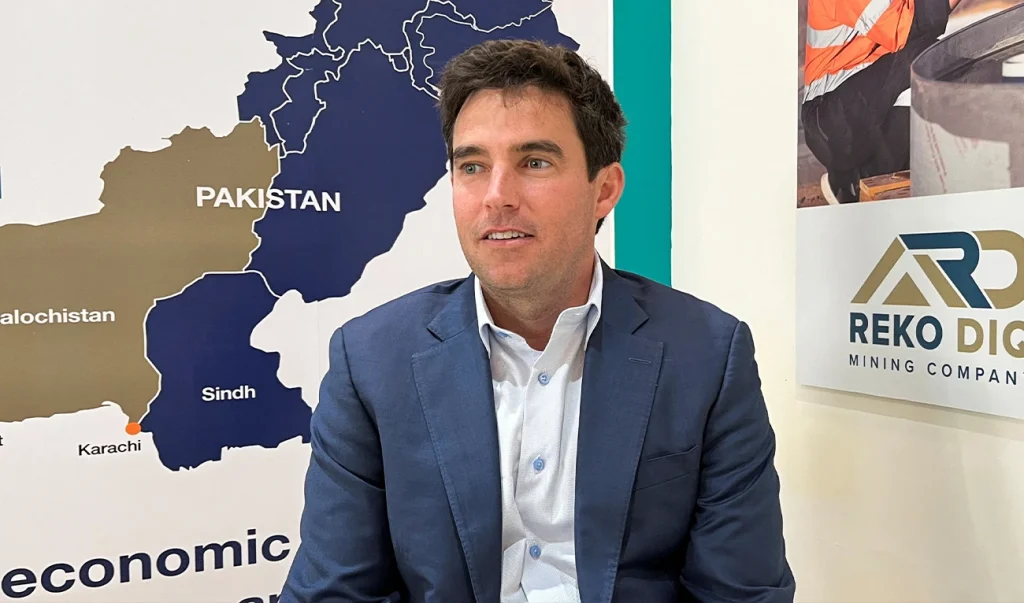
In April 2026, Barrick Mining Corporation announced that worsening security risks had led it to slow development and extend its review of the project until mid-2027. The company also warned that its earlier capital estimates and development timetable could change significantly.
Those estimates put the cost of Phase 1 at $5.6–6 billion and Phase 2 at another $3.3–3.6 billion, excluding capitalised financing costs. Together, the two phases represent planned expenditure of approximately $8.9–9.6 billion.
Barrick subsequently lowered its expected capital spending for 2026 on its 50 per cent share of Reko Diq from $600–700 million to $450–500 million.
Reko Diq in numbers
- $5.6–6bnEstimated cost of Phase 1, before financing
- $3.3–3.6bnEstimated cost of Phase 2
- $450–500mBarrick’s 2026 spending on its 50% share, down from $600–700m
- Mid-2027When Barrick’s extended review of the project ends
It is important to interpret these figures correctly. The reduction reflects a slower pace of investment, not a reported financial loss. Barrick has not yet disclosed a revised total budget from which the cost of the delay can be calculated.
03Power after sundown
The immediate slowdown has been attributed to security concerns, not electricity shortages. Nevertheless, the project illustrates another challenge facing mining developments in remote parts of Pakistan.
Barrick has stated that the Reko Diq project area is not currently connected to the national electricity grid. The planned power system combines solar generation with a heavy-fuel-oil plantA power station that burns the thick, cheap residue left over from oil refining. It runs day and night, but costs more to fuel and pollutes more than solar or grid power. to support continuous operations, while the possibility of a future grid connection is being examined.
For a mining operation, this is a serious engineering and commercial consideration. A processing plant must operate at night, during poor weather and when renewable generation is unavailable. Solar power can reduce fuel consumption, but electricity must still be supplied when the sun goes down.
My experience in mineral processing and energy-storage engineering has reinforced a simple lesson: the cheapest source of electricity is not necessarily the cheapest way to operate an industrial plant. Reliability matters just as much as price.
The cheapest source of electricity is not necessarily the cheapest way to operate an industrial plant.
A mine may need to invest in its own generation, fuel storage, electrical infrastructure and backup systems before producing a single tonne of saleable material. These costs ultimately influence whether the project can compete internationally.
04Mineral-energy corridors
Pakistan should use this reality to reconsider how it develops mining infrastructure.
Rather than treating every major mine as a separate industrial island, the government should explore what I would call mineral-energy corridors.
The idea is straightforward. Where a commercially viable mineral project requires major investment in electricity, water, roads and communications, planners should examine whether that infrastructure can also serve other industries and nearby communities.
A mine could become the first major customer for an electricity network that later supports small manufacturing units, workshops and settlements. An improved transport route could carry agricultural products as well as minerals. A maintenance facility established to service mining equipment could eventually serve a wider industrial market.
None of this should be taken for granted. Shared infrastructure costs money, and its benefits must be established through proper engineering and financial studies. But there is little sense in building expensive facilities for a single user without examining whether a wider economic return is possible.
Electricity deserves particular attention.
Pakistan should assess each major mining development against realistic power-supply alternatives: extending the national grid, developing dedicated renewable generation, using battery storage and retaining dependable backup capacity.
Battery storage can help maintain power quality, manage short interruptions and make better use of solar electricity. It cannot generate electricity on its own. An effective system must be designed around the mine’s actual operating requirements, including peak demand, night-time consumption and local environmental conditions.
Such projects could also create work for Pakistani companies. Domestic businesses need not wait for a battery-cell factory to participate in the energy-storage industry. There are opportunities in electrical engineering, system integration, industrial controls, testing, maintenance and safety services.
05Water is not an afterthought
Water is another issue that cannot be treated as an afterthought.
Mineral processing may require large volumes of water for grinding, separation and other operations. In water-stressed regions, these demands must be considered alongside the needs of households, livestock and agriculture.
Developers should be required to establish credible water balances, maximise recovery and recycling where feasible, and monitor any effects on groundwater. The findings should be independently reviewed and explained to affected communities.
A project that is financially attractive but creates lasting uncertainty over local water supplies will struggle to earn public confidence.
06Roads, ports and people
There is also an economic opportunity in Pakistan’s location.
The country sits close to China, Central Asia and the Gulf, with access to important regional markets and maritime routes. But geography alone cannot make Pakistani exports competitive.
A mineral shipment does not become cheaper merely because a port appears nearby on a map. Road conditions, freight capacity, handling charges, customs procedures and delays all affect the final cost. Pakistan will need dependable transport links and efficient logistics if it wants to become a serious participant in international mineral supply chains.
A mineral shipment does not become cheaper merely because a port appears nearby on a map.
Our workforce can provide another advantage, but it would be a mistake to build the industry around low wages alone.
Modern mines need trained electricians, process operators, welders, mechanics, laboratory technicians and safety specialists. They also need local suppliers capable of meeting demanding technical and quality standards.
Technical institutes, universities and mining companies should work together to develop practical training programmes, paid apprenticeships and recognised qualifications. These opportunities should extend to women, who remain underrepresented in many technical and industrial occupations.
A country that supplies minerals but must continually import the expertise to operate and maintain its own industrial equipment is missing a substantial part of the economic opportunity.
The same principle applies to local mineral processing.
Pakistan should certainly examine opportunities to upgrade minerals and manufacture higher-value products domestically. However, building a refinery is not automatically better than exporting a concentrateCrushed ore that has been processed to remove most of the waste rock, so it carries far more metal per tonne. It still has to be smelted and refined before the metal can be sold.. Refining requires reliable feedstock, substantial energy, water, technical expertise and access to buyers.
Each investment must stand up to commercial scrutiny. Local value addition makes sense when it creates a competitive industry, not simply when it adds another processing stage.
07Who pays?
These considerations lead to a difficult but necessary question: who should pay for the infrastructure?
A private mining company cannot reasonably be expected to finance every public facility in a remote district. Equally, taxpayers should not be asked to underwrite commercial ventures without clear evidence of wider benefits.
Well-designed public-private partnerships may offer a solution, provided the agreements identify who pays, who carries the risks and who will maintain the infrastructure. Electricity tariffs, water rights and public guarantees must be transparent.
08A plan for PMIF26
PMIF26 provides an opportunity to turn these arguments into practical planning.
I would propose that federal and provincial authorities, working with investors and independent technical experts, commission a pilot Mineral-Energy Corridor Investment Plan within six months of the forum.
It should begin with one commercially verified mineral project rather than an ambitious map covering the entire country.
The assessment should establish the project’s long-term electricity requirements, compare supply options, examine water availability, calculate transport costs and identify possible industrial users beyond the mine. It should also set out how infrastructure would be financed and what safeguards would protect neighbouring communities.
Most importantly, its findings should be made public. Investors need credible numbers; communities need meaningful consultation; and policymakers need milestones against which progress can be measured.
Pakistan has spent many years discussing the promise of its mineral wealth. The present investment interest offers a chance to move from promise to production, but only if the foundations are built carefully.
The minerals themselves will eventually leave the country as concentrates, refined products or manufactured goods. The electricity networks, transport connections, technical skills and local enterprises developed around them could remain for generations.
That is the outcome Pakistan should pursue.
The success of our mineral policy should be judged not only by what we take out of the ground, but by what we leave behind.