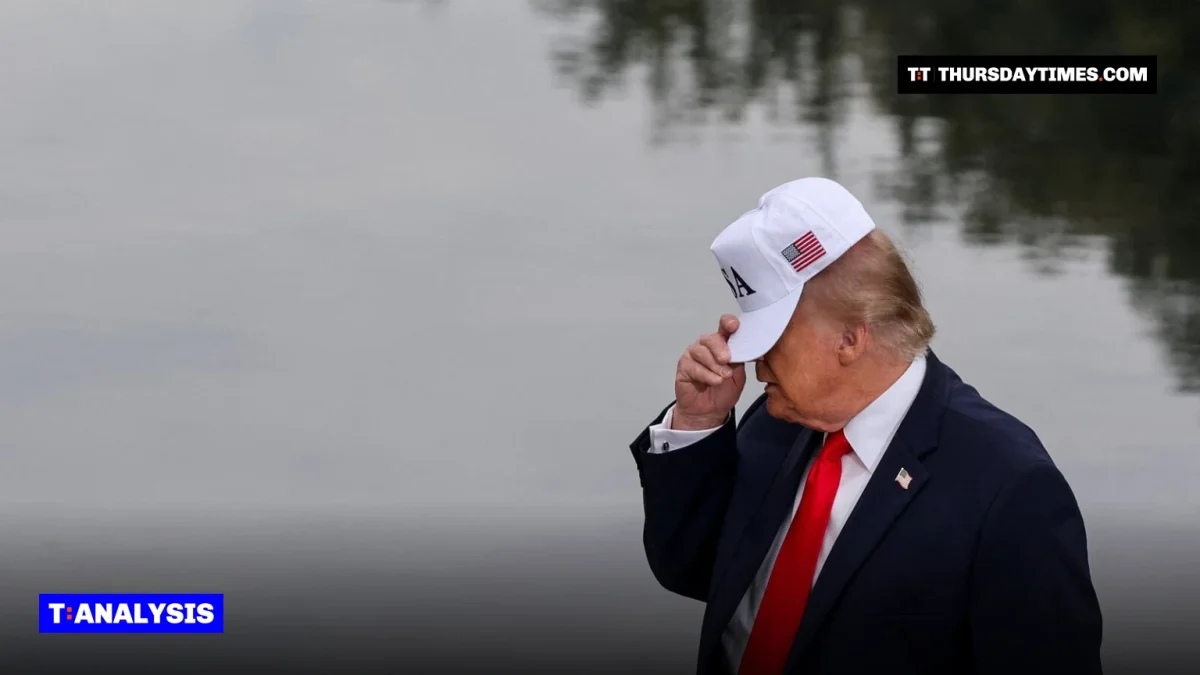
WASHINGTON (The Thursday Times) — For most of this week, the man Washington put forward on Iran was JD Vance. He had been speaking almost daily to Pakistan’s Field Marshal Asim Munir and Qatar’s prime minister, and he was reported to be weighing a face-to-face meeting with Iran’s security chief. On Thursday, in a post on his social media platform, President Donald Trump said he had asked his vice president to give his “complete and total attention” to something else: what Trump called corruption and crime in Democrat-run cities and states. In the same post he wrote, “We don’t need a deal with Iran. Those days have long since passed.” The post is short, but it changes three things at once: who speaks for Washington on Iran, what Washington says it wants, and where the president wants the country’s attention after a heavy election defeat.
What the post says, and what it does not
The post has two halves. The first is about the United States. Trump named Minnesota, California, and Illinois as “poorly run, corrupt disasters”, said “Billions of Dollars” were being stolen every month, and claimed the federal budget “could be quickly BALANCED” if that were corrected. He did not say which programmes he meant, who was responsible, or what evidence he had. The scale of the claim is hard to square with the arithmetic. The federal deficit was about $1.8 trillion in the 2025 fiscal year, according to the Congressional Budget Office. Even a few billion dollars a month would cover only a small part of that.
The second half is about Iran. “We’ve got their money, Hundreds of Billions of Dollars, and we’ve got their Strait!” Trump wrote. He gave no breakdown of that figure either. Iranian state media has put the country’s frozen funds abroad at about $12 billion, including $6 billion held in Qatar, and US officials have said that none of it has been released.
The post does not end the diplomacy. It changes who is doing it, and on what terms.
A week of mixed signals
Read on its own, the post looks like a sudden turn. Read against the past four days, it is the end point of a week in which the administration spoke with several voices. On Monday, Trump said he saw “positive momentum” toward ending the conflict. By Wednesday he was telling veterans at Arlington National Cemetery that he wanted “total victory, not a 93 percent victory.”
The order matters. A US report on Wednesday said Trump had privately questioned the June framework agreementThe memorandum of understanding the United States and Iran signed in Islamabad in June, meant to lead to a full peace deal. It collapsed after attacks on shipping resumed., which Vance helped negotiate, on the grounds that it gave Iran time to recover and earn oil revenue before the blockade. The White House denied that. Within a day, Tehran had publicly refused Vance’s request for talks until Washington answered its conditions, and Trump had moved his vice president to a domestic brief. Whatever the president intended, the sequence leaves the impression that the Vance channel was closed from both ends.
What has not changed is the method. Rubio and Treasury Secretary Scott Bessent, who runs the sanctions drive the administration calls Operation Economic Outcast, have argued all week that pressure, not strikes, is the right tool. Trump’s post fits that view. “No deal” in this sense does not mean war. It means keeping the blockade and sanctions in place and waiting for Iran to move.
Whose strait?
The most striking line is the claim that “we’ve got their Strait”. It is true in one sense. The US Navy has kept a naval blockadeThe US operation that stops ships entering or leaving Iranian ports. In November it was extended to Iran’s land borders and the Caspian Sea under Task Force Iron Gate. on Iranian ports for months, and US Central Command extended it this month to Iran’s land borders and the Caspian Sea. Iran cannot freely sell its oil by sea.
But control of a waterway is also about who can make it unsafe, and on that Tehran has made its own case all week. Mohammad Bagher Ghalibaf, Iran’s parliament speaker and chief negotiator, said on Wednesday that the strait would be governed by the laws of the two littoral statesThe countries whose coastlines border a body of water. For the Strait of Hormuz, these are Iran and Oman., Iran and Oman, and that the UN Convention on the Law of the Sea did not apply. Hours later, the Revolutionary Guards said two tankers carrying more than four million barrels of oil had been disabled for using a southern route Iran had banned. The cause and the ships’ names have not been independently confirmed, and the US military has said it cleared the strait of mines. But the message to shipowners was plain.
The strait in four numbers
The donut shows the share of world oil and LNG shipments that passed through Hormuz before the war began on February 28. Sources: international energy data; Iran’s Revolutionary Guards; Iranian state media; Allianz Trade.
So both governments can claim the strait, and both can stop the other from using it normally. That is a stalemate, not ownership. Foreign Minister Abbas Araghchi has said the strait could reopen within two days if Iran’s demands are met. Those demands, Ghalibaf says, come from the Islamabad memorandum itself: lifting the blockade and sanctions, releasing frozen funds, ending the fighting on all fronts, and a clear declaration that the war is over.
A blockade can keep Iran’s oil in. It cannot, on its own, make the strait safe for everyone else’s.
The election behind the post
The domestic half of the post cannot be separated from the November 3 midterms. Democrats won both chambers of Congress, and with the Mississippi result this week they will hold at least 55 Senate seats from January. Vance was blunt about why. “The reason we lost is the war,” he wrote the day after. A national poll completed on Monday found that 71% of Americans favoured legislation in Congress to halt the war.
That leaves the White House with a choice about the story it tells. Vance’s account blames the war. The post offers a different subject: blue-state corruption, a balanced budget, and an Iran that has already lost. Giving the vice president that brief does two things. It puts the most visible advocate of a deal on a domestic campaign, and it moves the national conversation toward ground where Trump would rather fight the next two years. A claim of billions stolen each month will invite requests for evidence from a Congress that Democrats will soon control.
There is a risk for Vance too. He has said the war cost his party the election, and he spent weeks on a deal. If talks later resume under someone else, he will not get the credit. If the conflict drags on, he is now attached to a domestic campaign his own words do not obviously support.
What it means for Pakistan
For Pakistan, the post lands awkwardly but not fatally. Islamabad hosted the April talks that Vance led, and the June memorandum carries its name. Field Marshal Munir has been one of Vance’s regular contacts, and Prime Minister Shehbaz Sharif urged restraint when he met Iran’s President Masoud Pezeshkian at the COP31 summit this week. On Thursday he discussed implementing the Islamabad memorandum with Turkey’s President Erdogan.
Losing an interlocutor who knew the file is a setback. But the value of a mediator does not depend on one person in Washington. It depends on whether both sides still want a channel they trust, and both still do. Iran says its conditions are drawn from a document signed in Islamabad. Washington has been talking to Tehran through Qatar and Pakistan. And the president who says no deal is needed said on Monday that he saw momentum toward ending the conflict. Positions this public tend to soften in private. When they do, the channels that held through the summer will still be there.
Where Pakistan’s remittances came from in October
Workers’ remittances, October 2026. The two Gulf states together sent $1.8 billion of the month’s $3.89 billion. Source: State Bank of Pakistan.
The economic stakes are more immediate. Pakistan imports most of its oil, and much of it comes from the Gulf. The country has just had two fuel price cuts in two days, bringing petrol to Rs335 a litre and diesel to Rs364, after crude slid on hopes of a settlement and on Saudi Arabia raising its output to 10.563 million barrels a day in October. Brent crude rose to about $93 a barrel after Trump’s post. One day’s move does not undo the cuts, but the next price review will reflect where prices settle.
Remittances are the other exposure. Overseas Pakistanis sent $3.89 billion in October, up 14% on a year earlier, and Saudi Arabia and the UAE were the two largest sources. The Gulf economies are absorbing heavy costs: a credit insurer estimates the war will cost them about $790 billion in lost output by 2030, and expects the bloc’s economy to shrink by 4% this year. So far, Pakistani workers there have kept sending more money home, not less. A long stalemate at sea would test that.
What to watch
The first test is Tehran’s reply. Iran had not responded to the post by Thursday afternoon. Ghalibaf said this week that the ball is in Washington’s court, and an adviser to Ghalibaf said the Americans had set a window of about two weeks before Trump decides on military action. Israel’s security cabinet has ordered its military to prepare for a possible strike, according to Israeli media, while its caretaker government waits for a new coalition.
The second is who, if anyone, takes Vance’s place. The administration’s other senior envoys, Steve Witkoff and Jared Kushner, were in Moscow on Thursday on Ukraine. If no one is named, the Qatari and Pakistani channels will carry more of the load, not less.
The third is the strait itself. Iran says it has agreed with Oman on how to oversee it, and Washington says it controls it. Shipowners will decide which claim they believe by where they send their tankers, and insurers by what they charge. For Pakistan, which needs that oil and the Gulf jobs it pays for, a deal is still the better outcome, whatever the president’s post says this week. Islamabad’s task is to keep the door it built open until both sides are ready to use it again.